NEMO Flyer Review
NEMO's Flyer is a 2-inch hybrid foam-and-air self-inflating pad with a 3.3 R-value. It's comfortable and warm for three seasons, but heavier than pure air pads.

Overview
The NEMO Flyer is a self-inflating pad with air channels carved through open-cell foam. It’s built for backpackers who want the cushion of an air mattress without giving up the foam’s durability and its self-inflating convenience. The trade-off is weight. It’s far lighter than a car-camping self-inflater, but it’s not in the same class as a dedicated ultralight air pad.
Key Specs
| Spec | Detail |
|---|---|
| Weight | 652–850 g depending on size |
| R-value | 3.3 (ASTM F3340-18) |
| Thickness | 2 in (5 cm) |
| Construction | Horizontally cored open-cell foam with air channels |
| Fabric | 20D PU polyester, 100% recycled, bluesign approved |
| Valve | Laylow zero-profile, micro-adjustable |
| Dimensions | Regular: 72 x 20 in (183 x 51 cm); Regular Wide: 72 x 25 in (183 x 64 cm); Long Wide: 76 x 25 in |
| Packed size | Regular: 10.0 x 6.5 in; Regular Wide: 12.0 x 6.5 in; Long Wide: 12.0 x 8.0 in |
| Season rating | 3-season |
| Included | Stuff sack, repair kit, Velcro strap |
| Warranty | NEMO Lifetime Warranty |
| Price | $139.95–$149.95 at REI for the Regular and Regular Wide |
Versions compared
| Image | Version | Weight | vs. lightest |
|---|---|---|---|
| Standard | 652 g (23.0 oz) | lightest |
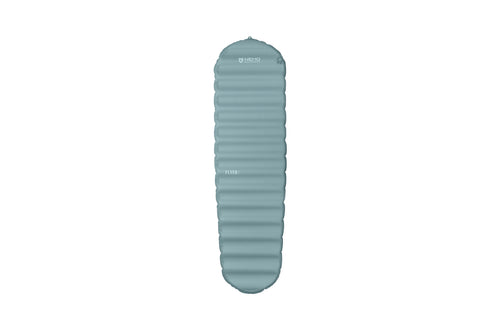 | Regular | 739 g (26.1 oz) | +87 g |

Would the Flyer Self-Inflating Sleeping Pad earn its spot in your pack?
652 g · 23.0 ozAdd the NEMO Flyer Self-Inflating Sleeping Pad to your Gear Closet and see exactly what it does to your base weight, then start packing for your next trip.
Free · No credit card · iOS, Android & web · Trusted by 3,000+ backpackers
Performance
Comfort. The Flyer’s main selling point is how it feels. NEMO says its manufacturing process removes 60 percent of the foam compared with a conventional self-inflater, then lets the pad loft to nearly four times its compressed thickness. The result is a 2-inch sculpted surface with air cells alternating with solid foam bridges. Side sleepers are the most vocal fans. Reddit owners describe better support and no waterbed wobble, and one REI reviewer chose the Regular Wide specifically because he sleeps on his side.
The ridged surface does have a quirk. One owner found the horizontal ribs noticeable at full inflation and said the pad worked better slightly soft. Letting out a little air fixed it.
Inflation. “Self-inflating” is generous. Owners and reviewers report the pad doesn’t expand fully on its own and needs a few breaths, or NEMO’s Vortex pump sack, to reach full loft. The micro-adjustable valve makes it easy to dial in firmness. A critical REI reviewer who received a free pad said the pad’s comfort was real but its self-inflation fell short of what the name implies. One reviewer who slept on it several nights running reported no air loss overnight.
Warmth. The 3.3 R-value is tested to the ASTM standard, so it can be compared directly with other brands. It suits spring through fall in three-season conditions. It isn’t a winter pad, and cold sleepers on frozen ground should look at something with a higher rating.
Durability and noise. The foam core is the pad’s insurance policy. If the air chambers are punctured, the foam still provides some cushion. Reddit discussions are mixed, though, and some owners mention punctures and leaks. The 20D fabric is soft and quiet rather than crinkly, but owners note it’s quieter when fully inflated. Several also say the surface is slick, so a quilt or sleeping bag can slide off during the night. Silicone printing on the underside helps the pad stay put on a tent floor.
Packing. The Regular packs to 10 x 6.5 inches, about the size of a large Nalgene lying on its side. That is compact for a foam-filled pad, but it is bulkier than a comparable air pad. One owner deflates the pad, folds it in thirds, and uses it as a frame sheet against the back of the pack.
Choosing a Version
The Flyer comes in three sizes, and the differences are width, length, and a modest weight penalty.
- Regular (72 x 20 in): The lightest and most compact, at 652 g. It suits back sleepers and anyone who tosses little. The 20-inch width puts elbows and shoulders at the edge for restless sleepers.
- Regular Wide (72 x 25 in): The pick for side sleepers and anyone who rolls around. It adds about 170 g over the Regular, and the pack size grows to 12 x 6.5 inches. Owners who sleep on their sides tend to choose this size.
- Long Wide (76 x 25 in): For anyone above roughly six feet, or who wants room for feet and a pillow. It adds about 200 g over the Regular and packs to 12 x 8 inches.
Pros & Cons
Pros
- Plush 2-inch surface that side sleepers rate highly
- 3.3 R-value tested to the ASTM standard
- Foam core provides some cushion even if the air chambers fail
- Micro-adjustable valve for fine-tuning firmness
- Recycled, bluesign-approved fabrics and a lifetime warranty
- Repair kit and stuff sack included
Cons
- Heavier and bulkier than insulated air pads of similar warmth
- Doesn’t fully self-inflate; needs top-off breaths or a pump sack
- Slick top fabric lets bags and quilts creep
- Some owners report punctures and slow leaks
- Not warm enough for winter or cold ground
Who Should Buy This
The Flyer suits three-season backpackers and weekend hikers who put sleep quality ahead of the last 200 grams, particularly side sleepers and anyone with a sore back. It also suits hikers who like the safety of a foam core on rough ground. Thru-hikers counting every ounce, and anyone sleeping on snow or frozen ground, should look at a lighter air pad or a higher R-value.
Verdict
The NEMO Flyer is a comfortable, reasonably priced hybrid that does what its design promises: cushion for side sleepers, a foam backup, and three-season warmth. It isn’t light or fully self-inflating, and it isn’t for winter. For backpackers who want a pad that feels like a mattress, it’s a solid choice.