Packstack: The Modern LighterPack Alternative
Thinking about switching from LighterPack? Here's an honest look at Packstack — a gear list builder with a real gear closet, calorie planning, and native mobile apps — plus where LighterPack still holds its ground.
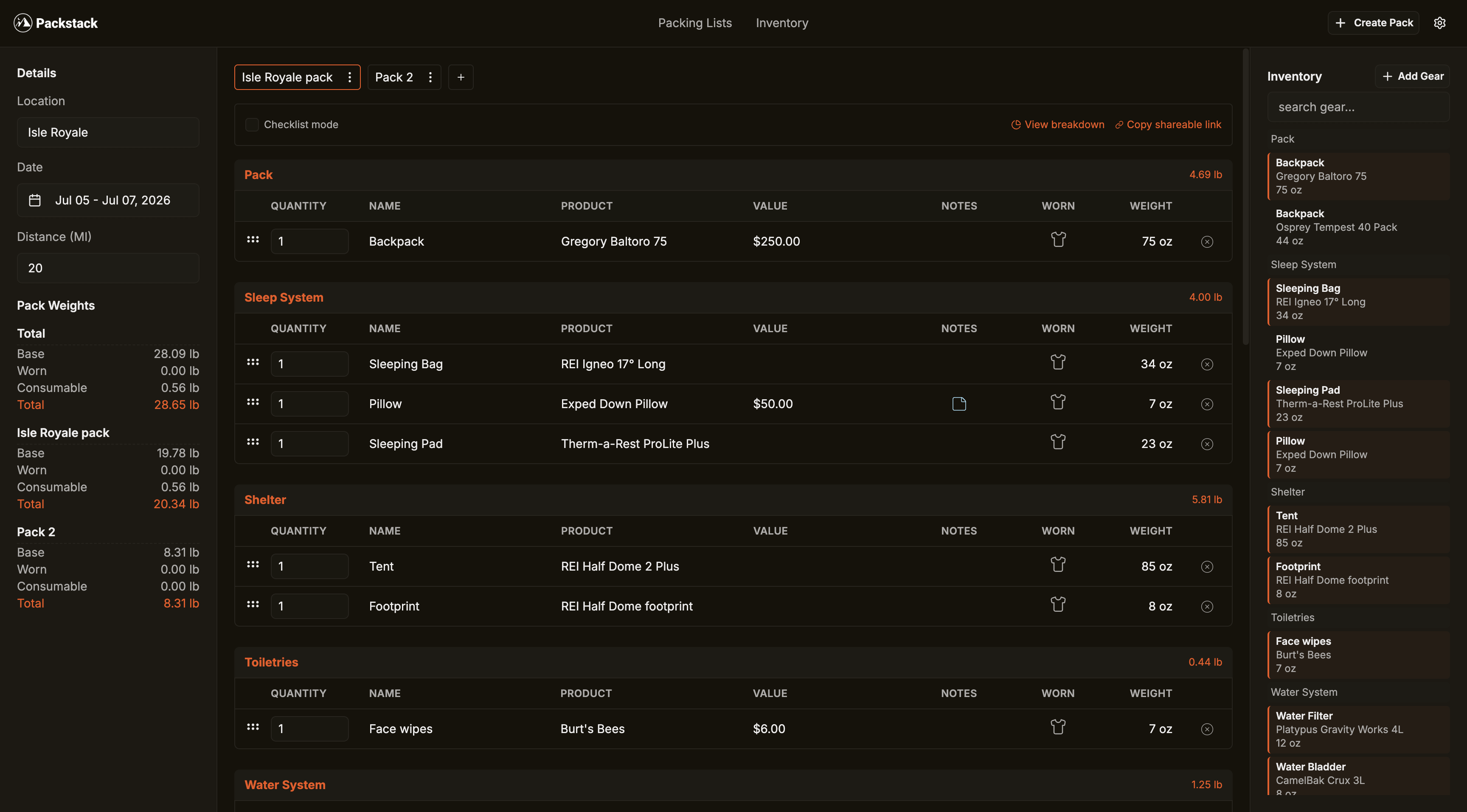
If you’ve spent any time in the ultralight backpacking community, you’ve almost certainly seen a LighterPack link. Drop into any Reddit shakedown thread, browse the Backpacking Light forums, or read a thru-hiker’s trail journal, and there it is — that tidy spreadsheet-style list with the pie chart at the top, quietly doing its job. When every gram counts, ultralight backpackers often rely on crowdsourced gear databases, expert blogs, and online communities to optimize their base weight, and LighterPack has established itself as the preferred tool for tracking and visualizing pack weight.
But LighterPack hasn’t meaningfully evolved in years, and that stagnation has opened the door for alternatives. Packstack is one of the most capable of that newer generation — a purpose-built gear management and trip planning app that takes some of what LighterPack does well and adds a layer of structure that serious planners will appreciate. This isn’t a “LighterPack is dead” article, though. I’ll walk you through what Packstack actually does, where it improves on LighterPack, and where LighterPack still has the upper hand — so you can make an informed call.
Why People Are Looking Beyond LighterPack
LighterPack deserves its reputation. LighterPack isn’t the only organization tool used by ultralighters, but it was one of the first, and remains the most popular. It allows users to create and manage packing lists tailored to different trips as well as organize their gear by category, and it displays useful metrics like total, consumable, worn, and base pack weight, along with the ability to share a link to your list with other hikers.
That shareable link is the killer feature. The ability to share is what’s made LighterPack such a fixture in the UL community — many ultralight enthusiasts enjoy perusing other hikers’ gear lists to glean insights and ideas about how to lighten their own load.
So what’s the problem? For all of LighterPack’s usefulness, its clunky mobile interface and absence of a dedicated app have long been a sore spot for users. On mobile, entering gear is a frustrating experience — the kind that makes you want to wait until you’re back at a laptop. The interface hasn’t kept up with how people actually plan trips today. And for a tool many hikers rely on for every outing, that friction adds up.
For many users of LighterPack, the simplicity of the interface is a big part of the appeal — it helps you make packing lists, and it doesn’t try to do anything else. That’s both its strength and its ceiling. If all you need is a fast, shareable weight list, LighterPack still delivers. But if you want a more structured gear management system — something that treats your gear as an actual inventory, not just a list of rows — that’s where tools like Packstack start to make sense.
What Packstack Actually Is
Packstack is a free gear list builder and gear management app for backpackers and ultralight hikers — designed to track every ounce, build detailed gear lists, and share your setup. It’s available on the web and as native iOS and Android apps, and it’s free to use with no credit card required.
Packstack is open source software for planning backpacking expeditions. That matters for two reasons: the code is publicly auditable (no mystery about what data it handles), and community contributions can drive ongoing development.
The creator’s vision, laid out in a public manifesto, is worth understanding: Packstack’s objective is to provide a comprehensive tool that helps explorers plan their expeditions as well as serving as a public directory of packing lists. Every expedition requires a set of equipment — and in some cases, such as backpacking, the gear you bring is essential to keeping you safe. The problem is that there isn’t a one-size-fits-all packing list, since each expedition raises its own unique challenges, such as weather conditions, temperature, access to water, and duration. Packstack is designed with that variability in mind.
In the broader community, Packstack is described as a “supercharged tool for planning and documenting outdoor expeditions,” used by backpackers, hikers, climbers, bikepackers, hunters, and world explorers. In practice, that means the tool isn’t narrowly built around a single activity — a bikepacker organizing a loaded rig will find it just as useful as a thru-hiker dialing in a sub-10-pound base weight.
Core Features: Where Packstack Goes Further
A Real Gear Closet — Not Just a List
The biggest conceptual difference between Packstack and LighterPack is the gear closet model. Packstack lets you build a comprehensive gear closet with detailed specs for every item you own — weight, brand, product, price, and category — and that closet is always at your fingertips when building gear lists.
In LighterPack, your “gear” section is essentially a byproduct of your lists. Items accumulate as you create lists, but there’s no real inventory management layer. In Packstack, the gear closet is the foundation. You build it once, and then every gear list draws from it. That makes a meaningful difference if you own 30+ pieces of gear and swap items between trips based on season or terrain.
Packstack also lets you group gear into reusable Kits — bundles like a cook kit, first aid kit, or camera setup that you always pack together. Instead of dragging eight items into every new list, you drop in the kit. It’s a small feature that compounds: the more trips you plan, the more time it saves.
Weight Tracking That’s Actually Granular
Packstack separates base weight, worn weight, and consumables so you always know exactly what your pack weighs on the trail. LighterPack does this too, but Packstack’s approach is woven into the inventory level — items are tagged at the source, not as an afterthought.
Instantly see how your weight is distributed across categories. The visual breakdown is real-time, which means as you drag items into a pack, you’re watching the numbers shift live. For anyone who’s spent time wrestling with a spreadsheet trying to shave two ounces, that immediacy is genuinely useful.
Multi-Pack Trip Planning
You can create multiple packs per trip for base camp and day hike setups. This is a feature LighterPack doesn’t offer in any meaningful way. If you’re doing a hut-to-hut traverse and want to model what stays at camp versus what goes on a summit push, Packstack handles that natively. For most weekend trips it won’t matter, but for longer or more complex adventures, it’s the difference between managing one list and managing two separate spreadsheets.
Drag-and-Drop Interface
Packstack supports importing from LighterPack or CSV in seconds, offers auto-fill of weights from a product database, and lets you create custom categories for organization. You can then drag items from your inventory, organize by category, and fine-tune quantities — all in a clean, purpose-built interface.
The drag-and-drop workflow is something LighterPack mimics but doesn’t execute as cleanly. In practice, building a new list in Packstack feels closer to organizing a spreadsheet with a good UX layer on top — which is exactly what most gear nerds want.
Cost Tracking
Packstack lets you track the total value of your kit. This sounds like a minor feature, but it’s practically useful when you’re doing a gear refresh and want to know what you’re sitting on. It’s also helpful for insurance documentation — something most of us don’t think about until a bag goes missing at baggage claim.
No Lock-In
Packstack supports LighterPack & CSV import, metric and imperial units, and lets you export your gear as needed — no lock-in. This is a deliberate design choice and a meaningful one. You’re not trapped. If you want to move back to LighterPack, a spreadsheet, or a future tool that doesn’t exist yet, your data travels with you.
Trip Planning Intelligence: Calories and AI
This is the area where the gap between Packstack and LighterPack is widest — because LighterPack simply doesn’t try to do any of it.
Packstack stores a hiker profile with your body stats — weight, height, age, sex, and body type — so calorie numbers are yours, not a generic average.
That profile feeds into a calorie calculator that uses the Pandolf load carriage equation and Mifflin-St Jeor BMR model to estimate daily calorie burn based on your body, pack weight, terrain, elevation, pace, and temperature. The output gives you total daily calories, a macro breakdown, and a practical food-weight estimate (~130 kcal per ounce of typical backpacking food). That’s the kind of number that turns vague food planning into a real weight calculation. The calculator is also available as a free public tool even if you don’t have an account.
The other piece is AI-enhanced trip information. When you create a trip and set a location — say “John Muir Trail” or “Roan Highlands” — Packstack automatically researches and fills in trail distance, daily elevation gain, terrain type, and expected temperature ranges for your trip dates. It only fills fields you haven’t already set, so it won’t overwrite your local knowledge. The practical effect is that your calorie and water estimates start with real data instead of guesses.
LighterPack has no calorie estimation and no trip intelligence. It’s a packing list. That’s fine if all you need is a packing list — but if you want your gear tool to actually help you plan the trip, Packstack operates on a different level.
Ultralight Gear Research
Packstack recently launched an Ultralight Gear Research tool that lets you browse thousands of products across every backpacking gear category, sorted by weight from lightest to heaviest. You can filter by brand or weight range, toggle between metric and imperial, and expand any product to see variant weights and detailed specs — materials, R-values, packed dimensions, temperature ratings, and more. Each row shows how the product compares to the category median weight, so you can immediately see whether something is meaningfully light or just average.
LighterPack doesn’t do gear research at all — it’s a list tool, not a catalog tool. If you’ve ever spent an hour cross-referencing REI, manufacturer pages, and Reddit threads to find the lightest option in a category, Packstack’s research tool replaces that workflow with a single sortable table.
The research tool also lives inside the mobile app as a dedicated Research tab: search the entire catalog by brand or product name, browse by subcategory with lightest/median/heaviest stats, open any product for its full specs and image, and add it to your gear closet with one tap. Researching a new sleeping pad and adding it to your kit happens in the same place.
Native Mobile Apps
One of LighterPack’s most persistent complaints from users is its clunky mobile experience. Packstack has native iOS and Android apps — full mobile apps with your gear closet, gear lists, kits, calorie estimates, gear research, and the same weight breakdown tools available on the web. They sync with your web account, they’re fast, and the interface is built for a phone screen. Checklist mode turns any gear list into a tap-to-check packing checklist at the trailhead, and a shareable trip summary card — trip stats, weight breakdown, and category chart sized for Instagram Stories — exports straight from the app. For the many hikers who do last-minute gear checks and list tweaks on their phone, this is a major practical advantage.
Who Else Is in This Space?
Packstack isn’t the only LighterPack alternative worth knowing about. The landscape has gotten genuinely crowded over the past couple of years:
- OutPack — A web app that combines itemized packing lists with features to catalogue trips, add notes, mark waypoints, and upload photos. Think LighterPack meets a trail journal. It was featured in Backpacker Magazine as the best new trip planner.
- ShakedownKit — A newer entrant that specifically aims to address LighterPack’s pain points. If you already have existing LighterPack lists, you can preview them first before importing by just swapping the domains.
- Carryless — A mobile-first app that supports import from existing sources including LighterPack and Packstack, and adds features like group pack balancing for multi-person trips.
- Gearli.io — Helps hikers and backpackers organise their gear, create reusable gear bags, plan trips, track pack weight, and import gear lists from LighterPack, PackLight, Google Sheets, and Excel.
Each of these tools has a slightly different personality and feature set. The broader point is that LighterPack’s monopoly on this category is over. You have real choices now, and Packstack is one of the most mature and well-rounded of them.
Practical Tips for Getting Started with Packstack
- Import your LighterPack first. Don’t rebuild your inventory from scratch. Packstack supports LighterPack import in seconds. Export your LighterPack as a CSV, import it into Packstack, and you’re working from a real starting point.
- Build the gear closet before the lists. Resist the urge to jump straight into building a trip list. Spend 20 minutes populating your gear closet with proper categories, brands, and weights — you’ll save time on every gear list you build afterward.
- Bundle repeat gear into Kits. If the same stove, pot, and fuel go on every trip, make them a cook kit once and drop the whole bundle into future lists.
- Set up a hiker profile immediately. It takes thirty seconds to enter your body stats, and it feeds directly into calorie estimates for every trip you create. Do it once and forget about it.
- Let the AI fill in trip details. When creating a trip, enter the location and dates and let Packstack auto-populate distance, elevation, and temperature. You can always override the values, but it’s a better starting point than guessing.
- Use the gear research tool before buying. Before you drop $400 on a tent, check the Ultralight Gear Research tool to see how it stacks up against everything else in the category by weight. You might find a lighter option you hadn’t considered.
- Use custom categories. The default categories are fine, but tailoring them to your gear — “Sleep System,” “Big 3,” “Electronics,” whatever makes sense for how you think — pays off when you’re scanning a list at speed the night before a trip.
- Track cost from day one. Even if you don’t care about the total right now, adding price data to inventory items costs nothing and will be useful later when you’re comparing upgrade options or doing a gear audit.
- Check the weight visualizations after every major change. The category breakdown chart is most useful as a diagnostic tool, not a trophy. If shelter is eating 40% of your base weight, that’s the conversation to have — not how many grams you can trim from your toothbrush.
Wrapping Up
Packstack won’t replace LighterPack for everyone, and it doesn’t need to. If your workflow is simple — build a list, share it, get feedback — LighterPack still does that job efficiently.
But the gap between the two tools has grown significantly. Packstack now offers calorie estimation tied to your actual body and trip details, AI-powered trip research that fills in distance and elevation and temperature ranges automatically, a gear research tool for comparing thousands of products by weight across every category — on the web and inside the app — and native iOS and Android apps that LighterPack still doesn’t have. It’s not just a better gear list builder — it’s a trip planning system.
If you’re managing a serious gear closet across multiple trip types, want to plan food around real calorie numbers instead of guesswork, or simply want a modern app that works as well on your phone as it does on a laptop, Packstack is worth the hour it takes to set up. Start by importing your existing LighterPack, set up a hiker profile, and see whether having a tool that actually understands your trip — not just your gear list — changes how you prepare.