Exped Dura 3R Review
The Exped Dura 3R is a burly, comfortable 3-season inflatable sleeping pad built for hikers who prioritize durability and sleep quality over shaving every last ounce.
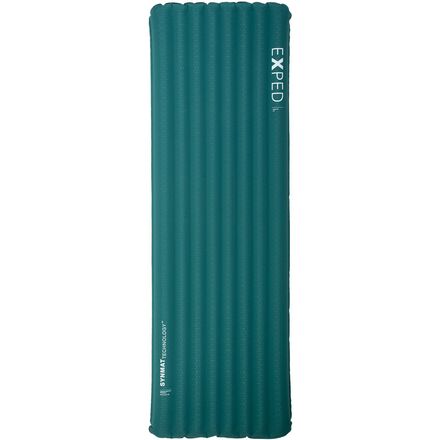
Overview
The Exped Dura 3R sits at the top of Exped’s rebuilt sleeping pad lineup — specifically the “Dura” tier, which prioritizes durability and insulation over minimum weight. Exped’s Dura line is their thickest, warmest, and most durable sleeping pad option. With a 2.9 R-value, 3 inches of loft, and a seriously reinforced shell, it’s aimed squarely at three-season backpackers and expedition campers who’ve been burned by a puncture at 2 a.m. and aren’t eager to repeat the experience.
Key Specs
| Spec | Value |
|---|---|
| R-Value | 2.9 |
| Temperature Rating | -5°C / 20°F |
| Thickness | 7 cm / 3 in |
| Weight (M) | 714 g / 25.2 oz |
| Weight (MW) | 839 g / 29.6 oz |
| Weight (LW) | 910 g / 32.1 oz |
| Dimensions (M) | 72 × 20.5 in |
| Dimensions (MW) | 72 × 25.6 in |
| Dimensions (LW) | 77.6 × 25.6 in |
| Packed Size (M) | 9.1 × 5.1 in |
| Packed Size (MW) | 10.6 × 5.3 in |
| Packed Size (LW) | 10.6 × 5.7 in |
| Shell Fabric | Recycled 75D/170D ripstop polyester |
| Insulation | SynMat Technology (recycled Texpedloft) |
| Pump | Schnozzel Pumpbag (included) |

Would the Dura 3R earn its spot in your pack?
714 g · 25.2 ozAdd the Exped Dura 3R to your Gear Closet and see exactly what it does to your base weight, then start packing for your next trip.
Free · No credit card · iOS, Android & web · Trusted by 3,000+ backpackers
Performance
Durability — The Whole Point
This is where the Dura earns its name and justifies carrying the extra weight. The Ultra 3R is covered with 20-denier recycled polyester, while the Dura uses recycled polyester — 75-denier on top and 170-denier on the bottom, considerably thicker. For context, that bottom layer is over eight times the denier of Exped’s own Ultra series. On rough ground, over multiple seasons of use, that difference matters. One Reddit user reported using their Exped pad for about 80 days over several trips, noting “it’s a very robust build.” The Dura addresses what has been a recurring criticism of ultralight pads across the category.
Comfort
Three inches of loft does a lot of work. The 3-inch thickness is sufficient to mask uneven ground, including small rocks, roots, and bumps — one of the best reasons to switch to a thick inflatable since you can make crappy tent sites comfortable without bottoming out. All Exped backpacking mats feature Cradle Comfort, where the vertical outer air chambers are slightly raised for even better support and to keep you centered on the pad. In practice, this means you roll off the edge less — especially useful on the Medium’s 20.5-inch-wide sleeping surface.
One notable quirk: the air chambers run the full length of the mattress, which can feel like sleeping on a pool float to some users. Side sleepers comfortable with lengthwise baffles will be fine; if you’ve found that format bothersome on other pads, it bears trying before you commit.
Noise
This is an underappreciated win for the Dura. The Dura is made of a softer polyester with soft synthetic insulation inside — it doesn’t make nearly as much noise as some other mats. Exped’s use of synthetic fill rather than reflective film makes it more comfortable in summer and significantly quieter. If you’ve ever shared a tent with someone on a crinkly metallic pad, you know this matters more than the spec sheet suggests.
Warmth
The 2.9 R-value is honest, ASTM-tested insulation — not a marketing number you have to discount. This is a solid 3-season sleeping pad. The R-value of 2.9 places it a notch above closed-cell foam pads, but a firm notch or two below more insulated pads like the Insulated NEMO Tensor or NeoAir Xtherm (R-4.2 and 6.9, respectively). Real-world reports suggest it performs close to its rating: one user who took it on a Capitol Reef overnight noted it was “not the lightest pad,” but easy to inflate and warm at temps down into the low 30s. For deep shoulder season or sub-freezing nights, you’d want to supplement with a closed-cell foam layer or step up to a higher R-value pad.
Inflation & Deflation
Exped’s flat, stemless dual-valve system is genuinely one of the better implementations in the category. The pair of flat stemless valves allows rapid inflation and deflation, and is more durable and less accident-prone than old-school valves that stick out of a mattress. The separate inflate/deflate valves are a highlight, and the Dura is surprisingly quick and easy to fill both with the Schnozzel pumpbag and by lung. The Schnozzel itself is featherlight and earns genuine praise — it’s one of the highlights of the Exped line, made of extremely lightweight material that even the hint of a breeze poofs to full capacity. It also doubles as a dry bag, which is a small but real win for pack organization.
The additional material thickness means no noticeable air loss over multiple nights, and one tester reported not re-inflating the pad once over a 6-day trip that saw sun, rain, and snow.
Sustainability
Exped prides itself on being a carbon-neutral brand, and many parts of this mat are made from recycled materials and PET bottles, with the rest being bluesign certified.
Not the deciding factor for most buyers, but worth knowing.
Pros & Cons
Pros
- Extremely durable shell (75D top / 170D bottom) — a genuine step up from ultralight pads
- 3-inch loft irons out rough terrain without bottoming out
- Quiet: soft polyester and synthetic insulation, no metallic crinkle
- Excellent dual-valve system — separate inflate/deflate, flat and stemless
- Schnozzel pumpbag is fast, moisture-free, and doubles as a dry bag
- ASTM-tested R-value you can trust
- Recycled, bluesign-certified materials; CO2-balanced
- Multiple size options (M, MW, LW) cover a wide range of sleepers
Cons
- Heavy: 25.2 oz for the Medium, 29.6 oz for the Medium Wide — this is real weight for a backpacking pad
- R-2.9 leaves you underinsulated for shoulder season without a CCF supplement
- Lengthwise baffles can feel pool-float-like to some sleepers
- No pillow attachment system (a gap that Sea to Summit fills with velcro integration)
- Pumpbag is one more piece to keep track of; some users leave it home
Who Should Buy This
The Dura 3R is built for hikers who camp on rough terrain regularly, travel heavy, or have simply had one too many pad failures in the backcountry. It’s particularly recommended for shorter backcountry hikes, especially where the sleeping surface may be rocky, it might be cold, or you just want extra comfort. It’s also a smart pick for anyone who wants to worry less about punctures compared to lighter-weight options. If you’re chasing a sub-20-oz base weight, this pad isn’t your tool. But if you sleep poorly and pay for it the next day on trail, spending the weight budget here is a reasonable trade.
Verdict
The Exped Dura 3R is a well-executed pad that delivers on its core promise: durability and comfort, without the nerve-wracking fragility of ultralight competitors. The weight — 25.2 oz for the Medium — is the honest cost of that durability, and it’s a trade-off you need to make knowingly. At an R-value of 2.9, it’s a true three-season pad, not a shoulder-season one, so pair it with a foam underlayer if your trips regularly push into the 20s. For hikers who value reliable sleep and bulletproof construction over gram-counting, this is a pad worth considering.