Exped DownMat 9 Review
Exped's down-filled DownMat 9 delivers an R-value of 8 and a 9 cm-thick platform for deep-winter camping, at a weight that sits well outside ultralight territory.
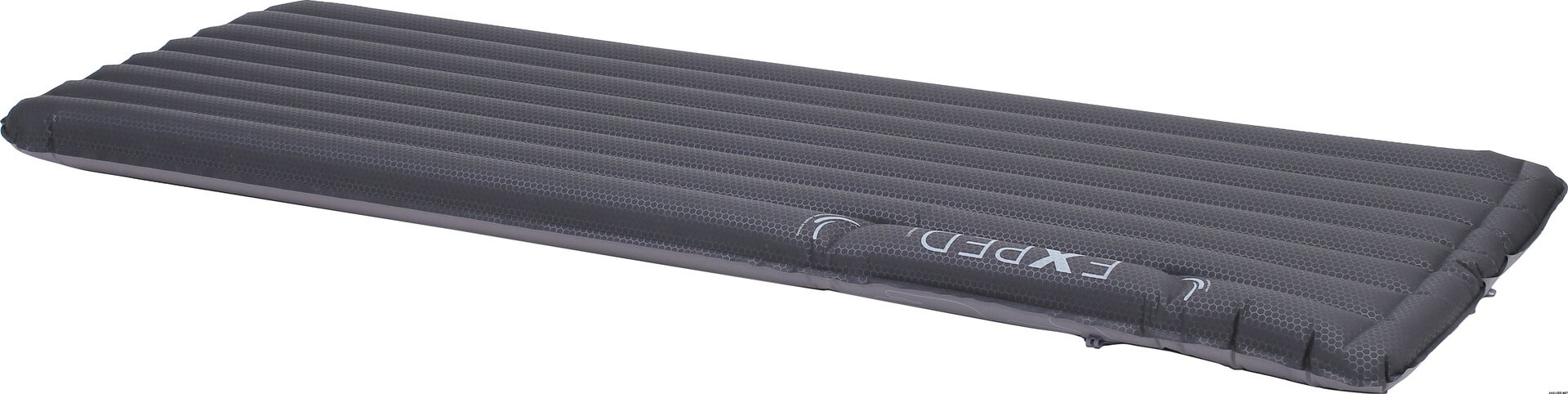
Overview
The Exped DownMat 9 is an inflatable pad filled with 700-fill goose down, built for sleeping on snow at temperatures where most air mattresses become expensive ice trays. Its R-value of 8 and 9 cm of loft make it one of the warmest and most comfortable pads a backpacker can carry. The trade-off is weight: at 930–990 g it belongs on winter trips and base-camp approaches, not on a sub-10-pound summer loadout.
Key Specs
| Spec | Detail |
|---|---|
| Weight | 930–990 g depending on version |
| R-value | 8 |
| Temperature rating | -38 °C |
| Thickness | 9 cm (3.5 in) |
| Dimensions | 183 x 52 cm |
| Packed size | 24 x 16 cm |
| Insulation | 700-fill goose down |
| Fabric | 75D polyester |
| Inflation | Integrated pump system with Schnozzle-style pump bag |
Versions compared
| Version | Weight | vs. lightest |
|---|---|---|
| Medium | 930 g (32.8 oz) | lightest |
| Standard | 990 g (34.9 oz) | +60 g |

Would the DownMat 9 earn its spot in your pack?
990 g · 34.9 ozAdd the Exped DownMat 9 to your Gear Closet and see exactly what it does to your base weight, then start packing for your next trip.
Free · No credit card · iOS, Android & web · Trusted by 3,000+ backpackers
Performance
Warmth. The headline number is an R-value of 8. For perspective, one owner who reviewed the long-wide version set it against a Therm-a-Rest ProLite Plus, which tops out at 3.8. Exped lists a comfort rating of -38 °C, and users who have taken it onto sand, ice, forest floor and snow describe the same result: the cold-bottom problem goes away. One owner who had been stacking a thin inflatable on a closed-cell foam pad called the DownMat 9 the end of questioning whether the sleeper or the insulation was at fault. Another noted that the pad kept them warm without roasting them when daytime heat crept in, which they credited to down’s natural thermoregulation.
Comfort. Nine centimeters of air is the real selling point for side sleepers. Reviewers say it swallows roots and rocks, and the honeycomb-textured, slip-resistant top fabric keeps sleepers from migrating overnight. Raised outer baffles help hold a body in place. One Trailspace reviewer reported sleeping better on it than in a bed at home. Another bought one to ease a back injury, and ran it slightly underinflated for the best feel.
Weight and pack size. Alpinist’s reviewer put the Medium at just over two pounds and said that was too much for a multi-day alpine route, though fine for an approach to base camp. That is the fair framing. Against other pads rated for winter, the weight is competitive. Against a three-season pad, it is a brick. The 24 x 16 cm packed size (roughly 4.8 liters) is small for what it delivers, which is the point of using down instead of foam or synthetic fill.
Inflation. Exped built in a pump system that keeps breath moisture out of the down. It also takes a while. One hammock user clocked two to three minutes. Another reviewer found it tedious without the Schnozzle bag. A tester on the long-wide version counted 100 to 120 compressions. Owners tend to treat this as a small price. A few point out that the effort warms you up before you climb into the bag. The two-valve flat system sits flush when closed and has a better reputation than older valve designs.
Durability. Exped’s 75D polyester is among the sturdier pad fabrics, and a long-term owner logged 80 to 90 nights on an older DownMat 9 with no leaks. The weak spot in the DownMat line is the lighter UL 7: a Backpacking Light poster had one blow a baffle and another leak feathers from the valves, though Exped replaced both free of charge. Forum veterans say the heavier 9 is the safer bet. They still carry a closed-cell foam pad as a backup, and use a ground cloth. Exped backs the pad with a five-year warranty, and the original DownMat 9 is listed by Trailspace as discontinued, so remaining stock is largely retail leftovers and the used market.
Choosing a Version
The two versions differ by 60 g: the Medium weighs 930 g and the Standard 990 g. Both share the same 9 cm thickness, R-value of 8 and 700-fill goose down. For most sleepers, the choice comes down to those 60 g, about two ounces. The Medium suits anyone counting every gram on a long winter approach. The Standard suits those who would rather have the extra margin.
Sleepers who find a 52 cm width tight should know that owners rave about the separate Long Wide model, at 197 x 65 cm and about 1,270 g. A 1.98 m owner and a 5’7” hammock-camper both said it eliminated the feeling of sliding off, but it is a heavier, separate pad and a tight fit in small two-person tents.
Pros & Cons
Pros
- R-value of 8 and a -38 °C rating handle genuine winter camping
- 9 cm of loft smooths over rough ground and suits side sleepers
- Packs to 24 x 16 cm, far smaller than foam or synthetic equivalents of similar warmth
- Built-in pump keeps moisture out of the down
- Tough 75D fabric and a five-year warranty
Cons
- 930–990 g is heavy for anyone not camping on snow
- Inflation is slow compared with a sack-style pump or mouth-blown pad
- A puncture is a serious problem, since down gives no fallback cushion
- Discontinued, so availability and pricing vary
Who Should Buy This
Winter campers, ski tourers, mountaineers hauling gear to base camp and cold-sleeping thru-hikers tackling shoulder season at altitude are the target. It also suits the sleeper who wants a remarkably comfortable pad and doesn’t mind carrying two extra ounces for it. Summer and three-season hikers should look elsewhere. A pad rated R 3–4 will save roughly half a pound, and those weight-focused users will never use most of the DownMat’s warmth.
Verdict
The DownMat 9 is a cold-weather specialist that earns its weight with real insulation and unusually good comfort. Buy it for snow camping and expedition use, and bring a foam pad as a backup. Skip it for anything above freezing.