Sony FE 70-200mm F2.8 GM OSS II Review
The Sony 70-200mm f/2.8 GM OSS II is a 1,045g professional telephoto zoom for Sony E-mount — 29% lighter than its predecessor, with class-leading autofocus and optics.
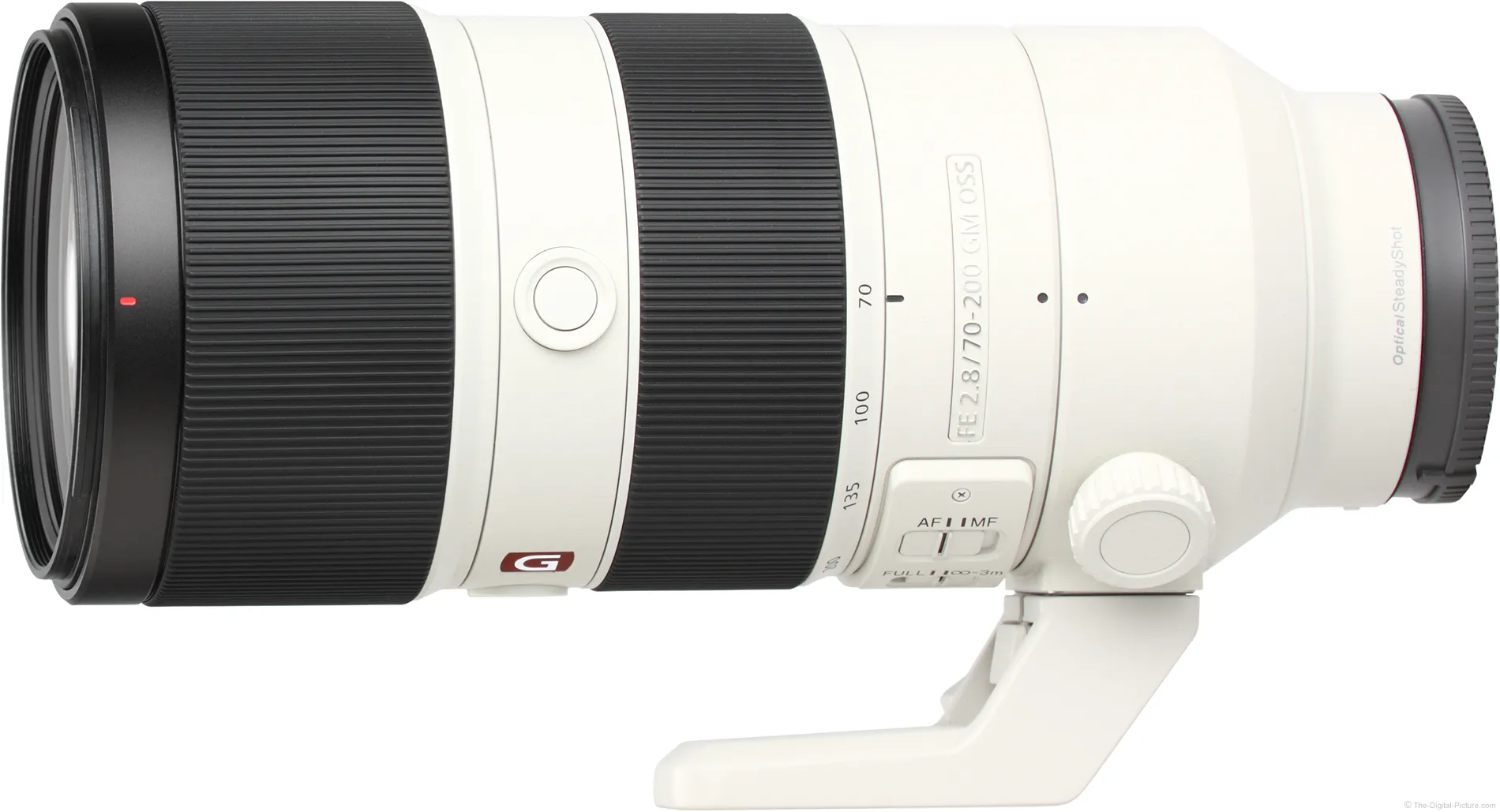
Overview
The Sony FE 70-200mm F2.8 GM OSS II is a professional-grade telephoto zoom — one of the sharpest zoom lenses tested by major reviewers — that serves as a versatile workhorse for portraiture, events, indoor sports, and weddings, with the constant f/2.8 aperture extending its utility into low-light and motion-freezing scenarios.
It’s the lens Sony’s first-generation 70-200mm GM always aspired to be:
the original FE version fell noticeably behind Nikon’s and Canon’s offerings, and Sony responded with this thoroughly re-engineered Mark II.
If you’re a serious Sony shooter who works in the telephoto range professionally or semi-professionally, the GM II belongs on your shortlist.
Key Specs
| Spec | Value |
|---|---|
| Model Number | SEL70200GM2 |
| Focal Length | 70–200mm |
| Aperture | f/2.8 constant (f/2.8–f/22) |
| Mount | Sony E-Mount (Full-Frame) |
| Weight | 1,045g (2.3 lbs) |
| Dimensions | 88 × 200mm (3.5 × 7.8 in) |
| Optical Design | 17 elements in 14 groups |
| Aperture Blades | 11 (circular) |
| Filter Thread | 77mm |
| Min. Focus Distance | 0.4m (70mm) / 0.82m (200mm) |
| Max Magnification | 0.3× |
| Image Stabilization | Optical SteadyShot, Mode 1/2/3 |
| AF System | 4× XD (Extreme Dynamic) Linear Motors |
| Teleconverter Support | SEL14TC (1.4×), SEL20TC (2×) |
| Zoom Design | Internal (non-extending) |
| Price (MSRP) | ~$2,798–$3,148 USD |

Would the FE 70-200mm F2.8 GM OSS II earn its spot in your pack?
1045 g · 36.9 ozAdd the Sony FE 70-200mm F2.8 GM OSS II to your Gear Closet and see exactly what it does to your base weight, then start packing for your next trip.
Free · No credit card · iOS, Android & web · Trusted by 3,000+ backpackers
Performance
Weight and Build
The headline story of the GM II is still the weight. Sony trimmed the lens from 1,480g down to 1,045g — a remarkable reduction for a lens that didn’t change in size — achieved largely through cutting the optical element count from 23 down to 17, using magnesium alloy for the barrel, and adopting the new XD AF motors. That’s a legitimate 435g off your shoulder over a long shooting day. While less than a pound may not sound like much on paper, testers who had used the original model for just a few hours reported significant arm fatigue, whereas the updated model could be comfortably shot for an entire day.
The build itself is what you’d expect from a G Master: magnesium alloy body, smoothly operating control rings, and a dust- and moisture-resistant construction. Nano AR Coating II suppresses flare and ghosting, and a fluorine coating on the front element repels dust, oil, and moisture. One practical annoyance: the included tripod foot is not Arca-Swiss compatible, so you’ll need to add a quick-release plate before mounting it on most tripods or ball heads.
Autofocus
Sony packed four XD (“Extreme Dynamic”) linear AF motors into the lens, promising AF speed up to 4× faster than the Mk I.
In practice, that promise holds up.
Mounted on the A7R V, the lens tracked moving subjects impressively — including mid-air leaps — and continued performing well as subjects ran toward the camera, with a good number of sharp shots in challenging bursts.
For video,
pulls are quick, quiet, and confident; focus breathing is fairly minimal, and enabling Sony’s Focus Breathing Compensation in-camera provides a mild additional improvement.
The on-lens controls give you meaningful options here too. A Full-Time DMF (Direct Manual Focus) on/off switch lets you instantly override autofocus when the camera locks onto the wrong subject — a practical fix for the occasional stubbornness of Sony’s AF when a close foreground competes with a background subject.
Image Quality
In MTF lab testing, the lens delivers a sharp center from f/2.8 through f/5.6, with the near-center zone close behind, borders and corners on a very good level, and performance that’s notably even across the entire zoom range.
Real-world shooters echo that:
shooting wide open produced stunning results, with negligible sharpness difference between f/2.8 and f/5.6 even in the corners.
The one caveat reviewers consistently flag is slight corner softness wide-open at 200mm — acceptable for most shooting, but worth knowing if you’re pixel-peeping full-resolution landscapes.
Bokeh is very pleasant, smooth and sometimes creamy, sometimes swirly, depending on the makeup of the out-of-focus areas.
The 11-blade circular aperture and XA element hold up their end of that bargain.
Vignetting at f/2.8 measures around 1.4 EV — noticeable but not extreme — and largely disappears by f/5.6; in-camera auto-correction eliminates it at f/2.8 at the cost of slightly elevated corner noise.
Distortion is pincushion throughout the range, measuring +0.59% at 70mm and reaching +1.74% at 135mm — well-controlled for a zoom, and easily handled in software or automatic correction.
Teleconverters
Both the 1.4× and 2× Sony teleconverters are supported, sacrificing one and two stops of light respectively; the GM II performs well with both.
At 400mm with the 2× attached, comparisons show very little difference in sharpness between the GM II and a dedicated Sony 100-400mm zoom.
This is one area where the Mark II meaningfully outperforms the Mk I, which struggled more noticeably with converter-induced quality loss.
Controls and Video Features
The GM II is the first Sony FE zoom lens to feature an aperture ring
— a significant addition for hybrid shooters.
A two-position switch toggles between 1/3-stop clicks and smooth, non-clicked rotation for silent iris control during video recording.
Three OSS modes cover standard stills, panning, and an active mode that prioritizes stabilization of the captured frame rather than the viewfinder — useful when shooting from a moving vehicle or boat.
Pros & Cons
Pros
- 29% lighter than the Mk I at 1,045g — a genuine, all-day difference
- Exceptional sharpness from f/2.8, consistent across the zoom range
- Quad XD Linear Motors deliver fast, confident tracking AF
- Teleconverter performance significantly better than Mk I
- First Sony FE zoom with an aperture ring; de-clickable for video
- Improved close-focus distance (0.4m at 70mm vs. 0.96m on Mk I)
- Internal zoom keeps balance predictable throughout the range
- Comprehensive on-lens controls (DMF, focus limiter, OSS mode switch)
- Dust and moisture sealing; fluorine front element coating
Cons
- Price is steep — roughly $850–$1,000 more than the Mk I, and $1,600+ over the Tamron 70-180mm alternative
- At 1,045g, still the heaviest option in the Sony 70-200 lineup
- Tripod foot is not Arca-Swiss compatible out of the box
- Slight corner softness at 200mm f/2.8
- Pincushion distortion visible in uncorrected RAW files
- No Sigma native-mount DN competitor yet (as of this writing)
Who Should Buy This
This lens is the right call for working professionals and serious enthusiasts who need the full feature set and can’t afford missed shots. Sports and wildlife photographers chasing erratic subjects get the quad XD motor system and improved zoom tracking; wedding and event shooters get the f/2.8 aperture and OSS in restricted-flash environments; and cinematographers on Sony Alpha bodies get independent aperture, focus, and zoom rings with a de-clickable iris and reduced focus breathing. If your budget is tighter, the Tamron 70-180mm f/2.8 VXD is a legitimate alternative at roughly half the price — it’s smaller and lighter, but has no lens stabilization, an externally-zooming design, and far fewer ergonomic controls. It’s a real trade-off, not just a compromise on prestige.
Verdict
There isn’t a finer fast telephoto zoom on the Sony platform, and by multiple independent assessments this is among the finest 70-200mm f/2.8 zooms tested on any system.
The weight reduction alone makes it a different lens to live with compared to the Mk I, and the AF, optical quality, and feature set back that up convincingly. The only thing standing between most photographers and this lens is the price — and that’s a real obstacle. If you can justify it, the GM II earns a 9/10.