Sony FE 200-600mm F5.6-6.3 G OSS Review
Sony's affordable super-telephoto zoom is the default wildlife and bird lens for E-mount — here's how it performs in the field.
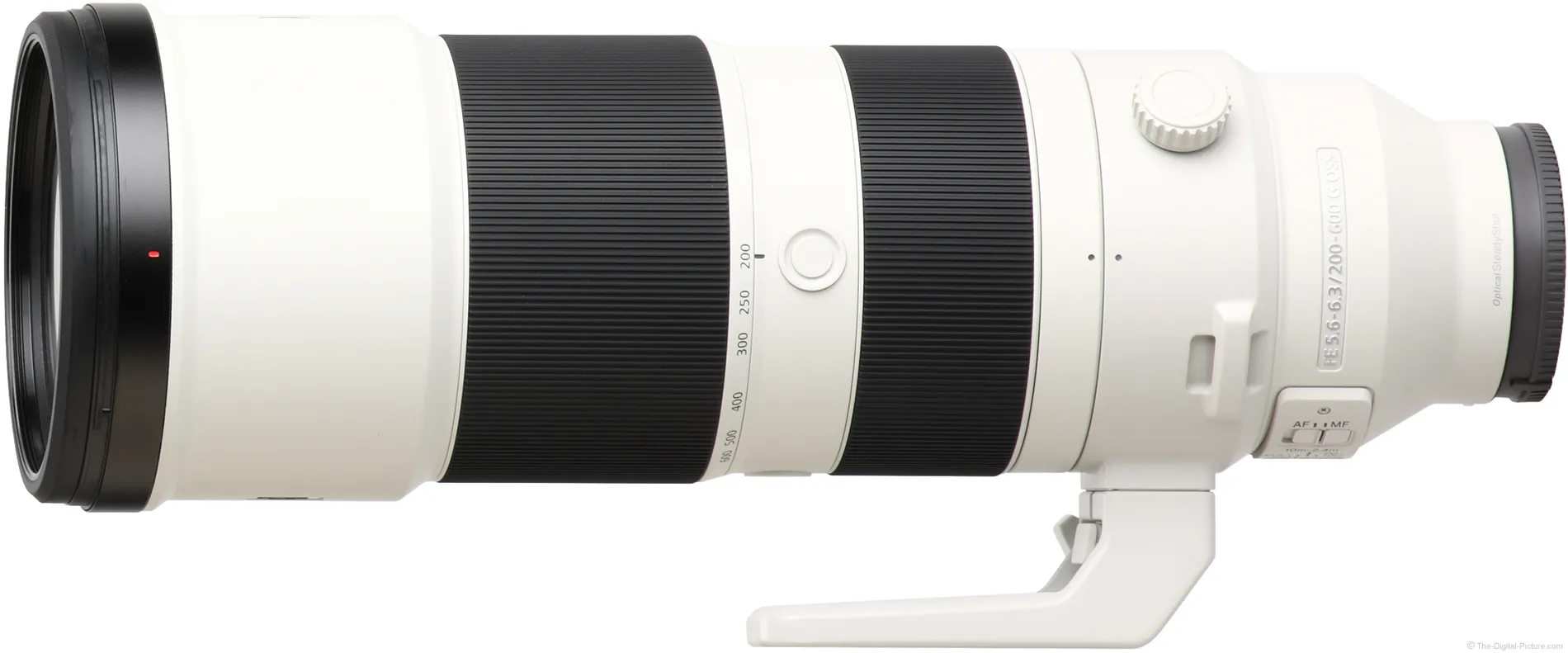
Overview
The FE 200-600mm F5.6-6.3 G OSS is Sony’s affordable answer to the “I need more reach” problem that every wildlife and bird photographer eventually runs into. It’s not a G Master, it’s not blazing fast at the long end, and it’s not small — but at roughly $2,000 it undercuts Sony’s supertelephoto primes by a factor of six or more while still delivering genuinely usable 600mm images. If you shoot birds, distant mammals, or sports and don’t have $13,000 sitting around for a 600mm f/4, this is the lens most E-mount shooters end up buying.
Key Specs
| Spec | Detail |
|---|---|
| Mount | Sony E-mount (full-frame) |
| Focal length | 200-600mm (300-900mm equivalent on APS-C) |
| Max aperture | f/5.6-6.3 |
| Min aperture | f/32-36 |
| Weight | 2,115g (4.66 lb) |
| Filter diameter | 95mm |
| Min focus distance | 2.4m |
| Max magnification | 0.2x |
| Aperture blades | 11 (circular) |
| Elements/groups | 24 elements / 17 groups |
| Stabilization | Optical SteadyShot (OSS), 3 modes |
| AF motor | Direct Drive SSM (DDSSM) |
| Teleconverter compatible | SEL14TC (280-840mm, f/8-9); SEL20TC (400-1200mm, f/11-13) |
| Weather sealing | Yes, dust/moisture resistant, fluorine front coating |

Build your Gear Closet
View all of your gear in one place, create packing lists and hit the trail with confidence. Available on iOS, Android and the web.
Get StartedPerformance
Sharpness. This is the lens’s strongest selling point. Multiple independent testers found it holds up well across the zoom range, with reviewers noting overall image quality from the 200-600mm is very convincing, with high sharpness even at the long end, pleasant contrast, and rare chromatic aberrations. Stopping down helps a bit — one hands-on tester found the lens performs well shooting wide open at f/6.3 at 600mm at minimum focusing distance, with sharpness and contrast slightly increasing at f8, though things don’t improve much beyond that. Bottom line: shoot it wide open with confidence, but if you have the light, f/8 is the sweet spot at the long end.
Autofocus. Paired with recent Sony bodies, AF tracking is a genuine strength. One long-term reviewer testing on the A7R, A6700, and A6400 reported that Sony’s direct drive supersonic wave motor focus system performs very well on this lens, with focusing performance and accuracy that manages to impress even in the toughest conditions. Another reviewer comparing it directly to the Sigma 150-600 Contemporary on an a7III noted the Sony’s AF appears to be slightly faster than its third-party competitor.
Handling and build. At 2,115g this isn’t a lens you forget you’re carrying, but it’s noticeably more manageable than the primes it’s meant to replace. It’s an internally-zooming design, meaning the lens doesn’t change length during zoom, which keeps balance consistent and dust from getting pumped into the barrel. The short-throw zoom ring is genuinely useful for birders — reviewers point out you can zoom out to find your target first and then zoom in to get better details, without putting your wrist into weird positions. One nitpick that comes up more than once: the focus ring placement isn’t ideal for shooters who want quick manual control, since it sits further from the camera body than some would like.
Teleconverter performance. The 1.4x extender is the one most people actually use, and it holds up. A reviewer who shot extensively with the SEL14TC on both full-frame and APS-C bodies said the results are really good except under low-light situations — which tracks, since you’re giving up light to f/9 at 840mm. The 2x converter pushes you to f/13, which is workable in bright sun but gets AF-hunty fast in anything less.
Low light. This is the lens’s real limitation. At 600mm you’re stuck at f/6.3, and one detailed test noted testers spent a lot of time shooting at 600mm — and therefore at a maximum aperture of f/6.3 — which meant relying on good natural light or bumping the ISO up. Overcast dawn/dusk bird sessions will push your ISO into the 6400+ range on anything but Sony’s best high-ISO bodies.
Value proposition. Everyone who’s used it circles back to the same conclusion. As one long-term bird photographer put it, it’s light, fast, affordable and yields quality results — and it’s compelling enough that it alone is strong enough to allure Canon or Nikon users to pick up Sony at least for their bird photography needs.
Pros & Cons
Pros
- Consistently sharp results from 200mm through 600mm, even wide open
- Fast, accurate AF that plays well with Sony’s tracking systems (birds-in-flight, eye-AF for animals)
- Internal zoom design keeps the lens sealed and balanced
- Teleconverter compatible without needing a separate lens
- Roughly a sixth the price of Sony’s 600mm f/4 GM prime
- Weather-sealed with fluorine coating on the front element
Cons
- 2,115g is still a lot to hand-hold for a full day of shooting
- f/6.3 at the long end limits you in low light and forces higher ISOs
- Focus ring placement isn’t ideal for photographers who rely heavily on manual override
- 2x teleconverter (f/13) is only really usable in bright conditions
- No optical stabilization advantage over competing third-party zooms in some users’ hands — the Sigma 150-600 Contemporary comparison shows it’s not a clean sweep on value
Who Should Buy This
This lens is built for the enthusiast or semi-pro wildlife and bird photographer on Sony E-mount who needs 600mm reach but can’t justify — or doesn’t want to carry — a supertelephoto prime. If you shoot in decent daylight, want a lens that travels reasonably well for its class, and plan to lean on teleconverters occasionally rather than constantly, this is close to the sweet spot for E-mount. If you shoot primarily at dawn/dusk or in dense forest canopy where light is scarce, budget for a faster prime or accept you’ll be shooting at high ISO often.
Verdict
The Sony FE 200-600mm G OSS earns its reputation as the default E-mount wildlife lens: sharp, reliably autofocusing, weather-sealed, and priced within reach of serious enthusiasts rather than just professionals. Its only real trade-offs are weight and a modest aperture at the long end — neither of which will surprise anyone shopping in this lens category. I’d rate it an 8.5/10: a clear buy for anyone building a Sony birding or wildlife kit, with the caveat that you should budget for good light or a high-ISO-capable body to get the most out of it.