Sigma 18-50mm F2.8 DC DN Contemporary Review
A compact, constant f/2.8 APS-C zoom that punches well above its 290g weight — here's how it holds up in real-world use.
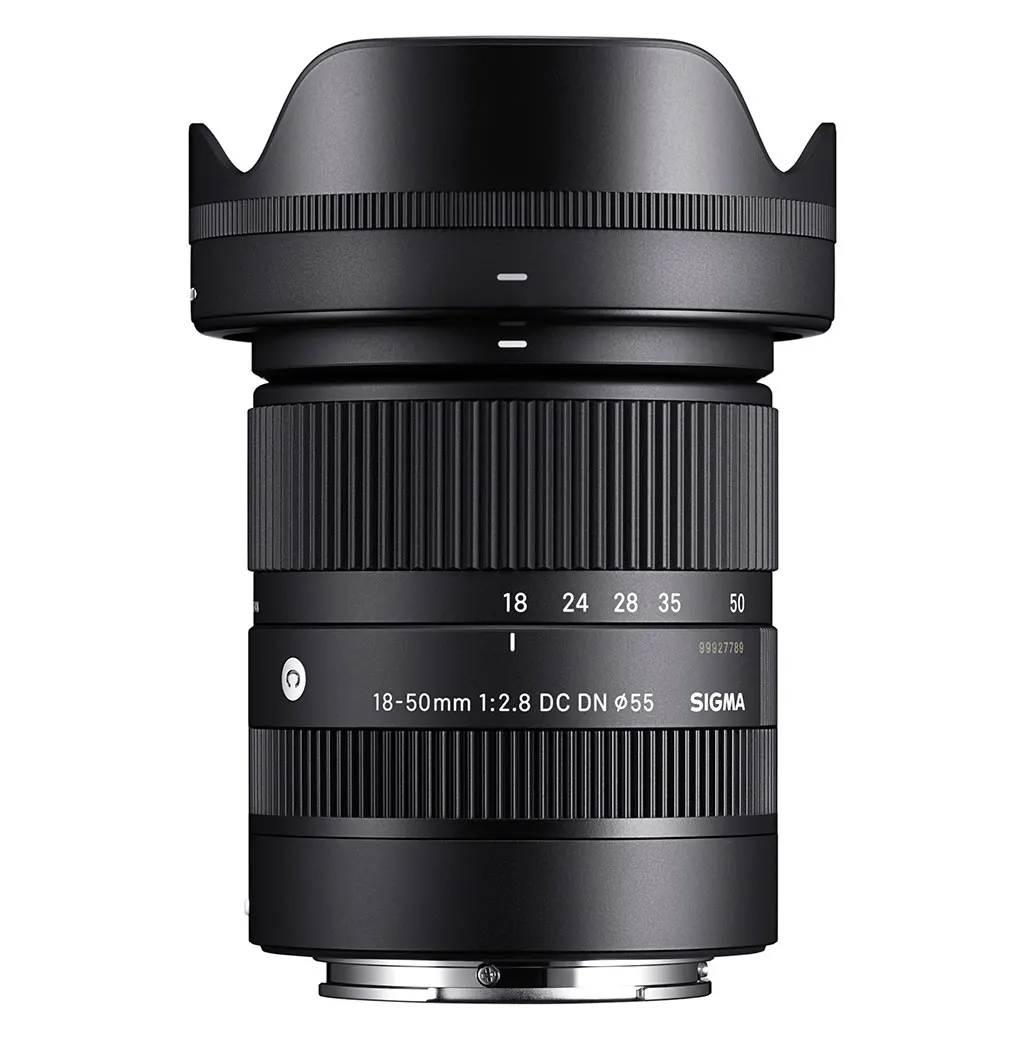
Overview
The Sigma 18-50mm F2.8 DC DN Contemporary is a fast, constant-aperture standard zoom built exclusively for APS-C mirrorless bodies (Sony E, L-mount, Fujifilm X, and Canon RF). It’s aimed at anyone who wants full-frame-equivalent 27-75mm coverage and f/2.8 speed without hauling around a lens that dwarfs a small crop-sensor body — a category that includes travel shooters, hybrid photo/video creators, and backpackers who want one lens to cover 90% of situations.
Key Specs
| Spec | Value |
|---|---|
| Focal Length | 18-50mm (27-75mm full-frame equivalent) |
| Max Aperture | F2.8 (constant) |
| Weight | 290g (10.2 oz) |
| Max Diameter | 65.4mm |
| Length | 74.5mm |
| Min Focusing Distance | 12.1cm (wide) / 30cm (tele) |
| Max Magnification | 1:2.8 (wide) / 1:5 (tele) |
| Autofocus Motor | Stepping motor (STM) |
| Filter Thread | 55mm |
| Construction | Thermally Stable Composite (TSC) + brass mount |
| Weather Sealing | Rubber mount seal only (not fully sealed) |
| Image Stabilization | None |

Would the 18-50mm F2.8 DC DN Contemporary earn its spot in your pack?
290 g · 10.2 ozAdd the Sigma 18-50mm F2.8 DC DN Contemporary to your Gear Closet and see exactly what it does to your base weight, then start packing for your next trip.
Free · No credit card · iOS, Android & web · Trusted by 3,000+ backpackers
Performance
The headline feature here isn’t really optical — it’s the size-to-speed ratio. A constant f/2.8 zoom that measures almost 7.6cm in length and weighs a mere 290g, yet still manages to maintain a constant aperture of F2.8 throughout the entire zoom range is genuinely unusual. Most fast zooms in this range from other brands run noticeably heavier and bulkier, which is exactly why reviewers keep circling back to the same point: it’s so small and light that it’s easy to forget you’re using a zoom lens with a constant f/2.8 aperture, since one would expect those specs in a much larger package.
Sharpness is the other strong suit. Testing across the zoom range found that at 18mm, central sharpness is excellent from f/2.8 to f/8, very good at f/11 and f/16 and soft at f/22, with similar behavior at 24mm, 35mm, and 50mm, where central sharpness stays excellent from f/2.8 to f/8, very good at f/11 and f/16, and drops off at f/22. In plain terms: shoot it wide open or stopped down a stop or two, and you’re in the sweet spot for the entire range — you don’t need to hunt for a “good” aperture like you do on some budget zooms. Diffraction at f/22 is real but expected on an APS-C sensor; as one reviewer put it, it’s better to have the option for those circumstances where depth of field is needed more than absolute sharpness.
Chromatic aberration is well-tamed centrally, though CA is very well controlled at the center all the way through the focal range, while the edges do show some CA that can be cleaned up with in-camera or software corrections. On the flip side, more rigorous lab testing found strong geometric distortion over much of the zoom range and noticeable color separation at the longer end — this is a lens that leans on in-camera or RAW-processing corrections rather than being distortion-free straight out of the box, which is fairly normal for this class but worth knowing if you shoot JPEG-only or with software that doesn’t have a correction profile loaded.
Autofocus draws consistent praise. It’s built around a stepping motor and reviewers across mounts describe it as fast and quiet — one review of the Canon RF version called autofocus fantastic, with image quality that looks great and the lens remaining very impressive despite its small size. That quiet, smooth focus motor also makes it a solid choice for video shooters doing focus pulls or vlogging, which lines up with why Sigma pairs it so often with content-creator-oriented bodies like the ZV-E10.
The close-focus performance is a nice surprise for a standard zoom — at the wide end you get 1:2.8 magnification, which is genuinely useful for casual macro-ish shots of camp stoves, gear details, or trailside flowers without swapping lenses. That said, magnification drops off at the tele end (1:5 at 50mm on E-mount, or 1:5 at 30cm on the RF version), so don’t expect true macro capability throughout the zoom range.
Where it clearly cuts corners: there’s no image stabilization, and build sealing is minimal. The lens isn’t weather-proof, other than the mount having a rubber seal, and it doesn’t have built-in image stabilization — the two main concessions made to keep it affordable and small. If your camera body has in-body stabilization (most modern APS-C mirrorless bodies do), this is largely a non-issue. If you’re on an older body without IBIS, handheld low-light and video work will show more shake than a stabilized lens would produce.
User reviews are largely consistent with the professional testing. Real owners describe it as a “daily driver” and note it’s a big step up from kit glass, though a few flagged that wide-open sharpness at 50mm softens up a bit until you stop down. Multiple owners also noted that 18mm isn’t quite wide enough for some use cases, which is a fair critique if you shoot a lot of interiors or tight landscapes — you may want a wider prime or zoom as a companion.
Pros & Cons
Pros:
- Remarkably light and compact for a constant f/2.8 zoom — genuinely doesn’t unbalance small APS-C bodies
- Excellent central sharpness from f/2.8 through f/8 across the entire zoom range
- Fast, quiet stepping-motor autofocus, good for both stills and video
- Useful close-focus capability (1:2.8 magnification at 18mm)
- Solid build quality with a metal mount despite the budget-friendly price
- Available across four major mounts (Sony E, L-mount, Fuji X, Canon RF)
Cons:
- No image stabilization — a real consideration on bodies without IBIS
- Noticeable geometric distortion and some color separation uncorrected
- Only a rubber mount seal, not fully weather-sealed — think “splash resistant,” not “storm-proof”
- 18mm wide end may feel tight for landscape or interior shooters used to going wider
- Edge sharpness at wide apertures lags behind the center
Who Should Buy This
This lens makes the most sense for APS-C mirrorless shooters who want a single, do-it-all zoom that covers everyday portrait, street, travel, and landscape work without carrying a bag full of primes. It’s a particularly good match for backpackers and thru-hikers doing photography on the trail, since the 290g weight and compact dimensions are far easier to justify in a pack than a typical f/2.8 zoom. If you’re shooting on a body with in-body stabilization, the lack of OS in the lens barely registers.
Verdict
The Sigma 18-50mm F2.8 DC DN Contemporary delivers a rare combination for its price and size class — constant f/2.8 speed, strong central sharpness, and fast autofocus in a package light enough to disappear on a camera strap or in a pack’s side pocket. The trade-offs (no stabilization, some distortion, minimal weather sealing) are the right ones to make for the size and price, and it’s earned its reputation as one of the best value standard zooms for APS-C mirrorless. I’d rate it an 8.5/10 — an easy recommendation for anyone who wants one lens to live on their camera most of the time.