Insta360 Ace Pro 2 Review
Insta360's flagship action camera pairs a Leica lens and 1/1.3-inch sensor with a big flip-up screen, at the cost of size and battery life.
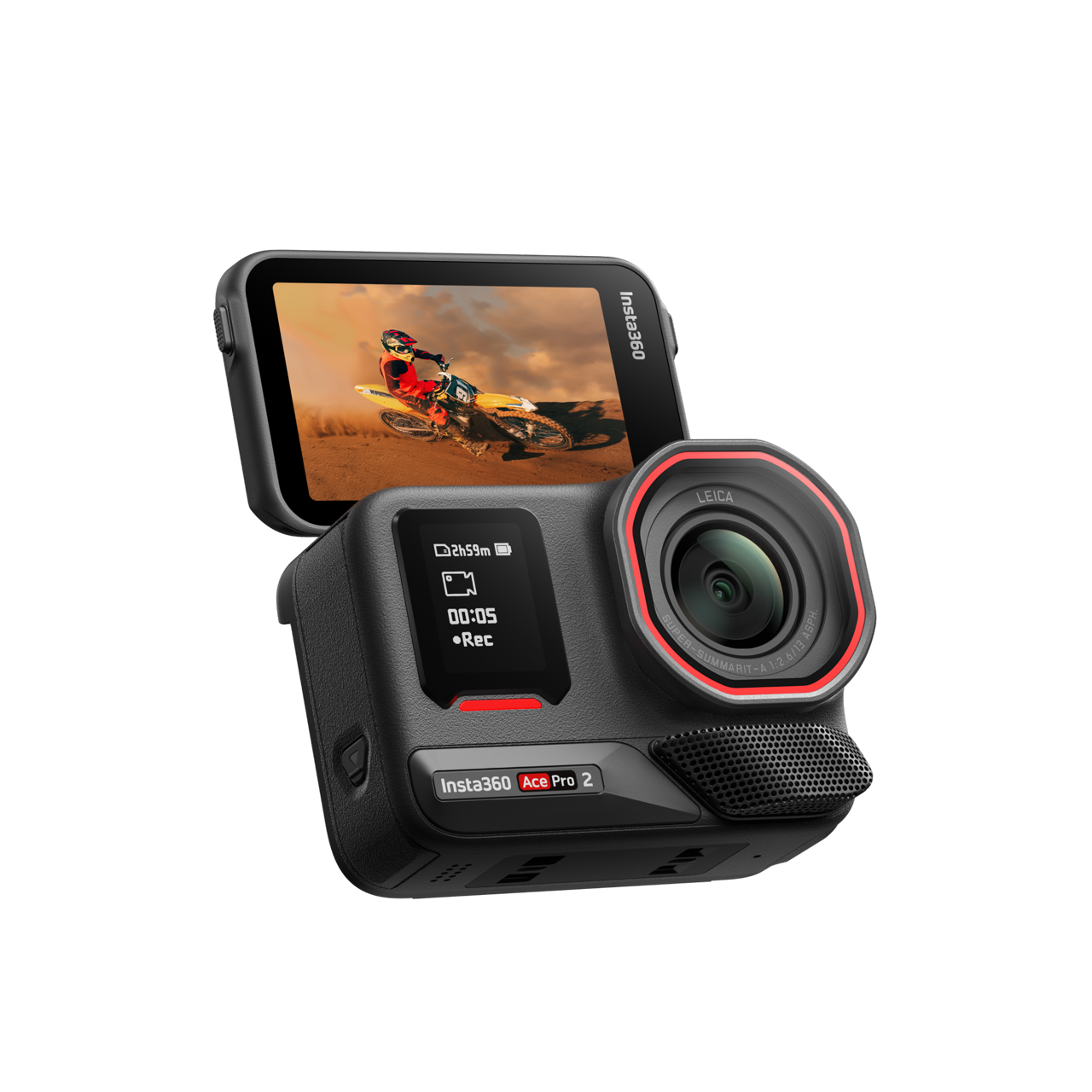
Overview
The Insta360 Ace Pro 2 is a flagship action camera built around a Leica-co-designed lens, a 1/1.3-inch sensor and a 2.5-inch flip-up touchscreen. It suits hikers who want trail footage that holds up in dim forest light and who care more about image quality than shaving ounces. The trade-off is plain. At 177.2 g, it is the biggest and heaviest of the three flagship action cams, and its battery is the weak point.
Key Specs
| Spec | Detail |
|---|---|
| Weight | 177.2 g (6.3 oz) |
| Dimensions (screen folded) | 71.9 x 52.15 x 38.0 mm |
| Dimensions (screen unfolded) | 71.9 x 99.05 x 38.0 mm |
| Sensor | 1/1.3-inch |
| Lens | Leica SUMMARIT, F2.6, 157° field of view |
| Max video | 8K (30 fps) |
| Max photo | 50 MP |
| Minimum focus distance | 0.37 m |
| Rear screen | 2.5-inch flip-up touchscreen |
| Battery | 1,800 mAh, rated up to 180 minutes |
| Charging | 47 minutes with 30W adapter; 75 minutes at 5V/3A |
| Waterproofing | 12 m (39 ft) without a case; 60 m with the dive case |
| Storage | microSD only, no internal memory |
| Launch price | $399 |

Would the Ace Pro 2 earn its spot in your pack?
177 g · 6.3 ozAdd the Insta360 Ace Pro 2 to your Gear Closet and see exactly what it does to your base weight, then start packing for your next trip.
Free · No credit card · iOS, Android & web · Trusted by 3,000+ backpackers
Performance
Image quality. Low light is where reviewers keep landing. The Ace Pro 2 adds a 5nm image-processing chip alongside the AI chip of the original Ace Pro. Red Shark News called its low-light results “staggering”, and TechRadar rated it strong in dim conditions by action-cam standards. Owners say the same, and a buyer on Adorama singled out low light as the reason the camera suited them. On a mountain bike, Singletracks noticed extra foliage detail and good dim-light footage.
The headline 8K mode gets less love. Tom’s Guide and TechRadar both treat it as a gimmick. TechRadar found the best results at 4K, which the camera can record at up to 60 fps, or 120 fps for slow motion. It also offers an I-Log profile for people willing to grade footage. Reddit owners flag the lack of 10-bit color, and some call the stills disappointing despite the 50 MP rating.
Screen and interface. The 2.5-inch rear screen is the camera’s best everyday feature. Testers describe it as bright, readable in sunlight and easy to use with gloves on. The interface is among the most responsive in the category, with smartphone-like speed and haptic feedback. The catch is that selfie framing needs the screen flipped up by hand. The small front display only shows settings. Tom’s Guide also noted the screen is not OLED.
Stabilization and audio. Road.cc and Singletracks both praise the stabilization, though a motovlogging review found it a little slow to settle. Wind noise suppression is a standout: road.cc called its handling of wind “very impressive”. Tom’s Guide also credits improved internal audio and support for external mics.
Battery. This is the sore spot. Insta360 rates the 1,800 mAh pack at up to 180 minutes, but that is a best case. One tester got roughly 30 to 45 minutes of straight recording. Road.cc and Tom’s Guide both name battery life as the main drawback against rivals. Recharging is quick, with 80% in 18 minutes on a 30W adapter. The pack swaps out, so a spare or two is the practical fix.
Durability and mounting. The camera is waterproof to 12 m without a case and rated for -20°C to 45°C. The lens protector can be removed and replaced if it’s damaged. Reddit owners report that the mounting system is bulky and fragile compared with DJI’s, which they call more rugged. A motovlogging reviewer also disliked the microSD slot placement in wet conditions.
Close focus. The minimum focus distance is 0.37 m, down from 0.4 m on the original Ace Pro. That is useful for gear shots and trailside details, but it is nowhere near true macro.
Pros & Cons
Pros
- Strong low-light video for an action camera
- Large, bright flip-up screen that works with gloves
- Fast, clear interface and well-regarded smartphone app
- Very good stabilization and effective wind noise reduction
- Wide 157° lens with a replaceable protector
- Fast charging, with 80% in 18 minutes on a 30W adapter
- $399 launch price, $50 below the original Ace Pro
Cons
- At 177.2 g, the heaviest and largest of the three flagship action cams
- Real-world battery life falls well short of the 180-minute rating at high-quality settings
- No 10-bit color, and stills draw criticism from owners
- No full front selfie screen
- Mounting system is bulkier and less rugged than DJI’s
- 8K adds little in practice
Who Should Buy This
This camera fits hikers, bikepackers and travelers who shoot a lot of vlog-style footage and trail video in forest, dawn and dusk light. They should be willing to carry a camera that weighs about 6 oz, plus at least one spare battery. The big flip screen also makes it a good fit for anyone who films themselves while walking.
Gram-counting thru-hikers should look elsewhere. A smaller camera, or the phone already in the pack, will cost less weight. Anyone who wants all-day recording without swapping batteries should also pass.
Verdict
The Ace Pro 2 delivers some of the best low-light video and the nicest screen among the flagship action cams. It does so with a heavy body and a battery that needs backup. Buy it if footage quality is the priority and the weight is tolerable. Skip it if the pack is built around a sub-10-lb base weight.