DJI Osmo Pocket 3 Review
DJI's 179 g gimbal camera pairs a 1-inch sensor with 4K/120 video, but it has no weather sealing and a built-in battery that limits long trips.
Overview
The Osmo Pocket 3 is a 179 g handheld camera with a three-axis mechanical gimbal built into its body. It aims at hikers who want smooth, cinematic trail footage without carrying a mirrorless body, a gimbal and a lens. The trade-off is durability: the camera has no water resistance, and its battery is built in, so a rainy, multi-day trip takes some planning.
Key Specs
| Spec | Detail |
|---|---|
| Weight | 179 g (6.3 oz), camera only |
| Dimensions | 139.7 × 42.2 × 33.5 mm |
| Sensor | 1-inch CMOS |
| Aperture | f/2.0 |
| Max video | 4K at 120 fps; 1080p at 240 fps |
| Color | 10-bit, D-Log M |
| Stabilization | 3-axis mechanical gimbal |
| Screen | 2-inch rotatable OLED touchscreen |
| Microphones | 3 |
| Battery | 1,300 mAh (10.01 Wh), built in, not swappable |
| Rated runtime | Up to 166 min at 1080p/24 fps, screen and Wi-Fi off |
| Charging | 80% in 16 min, 100% in 32 min with a 65W PD charger |
| Storage | microSD, up to 512 GB |
| Operating temperature | 0–40 °C |
| Water resistance | None |
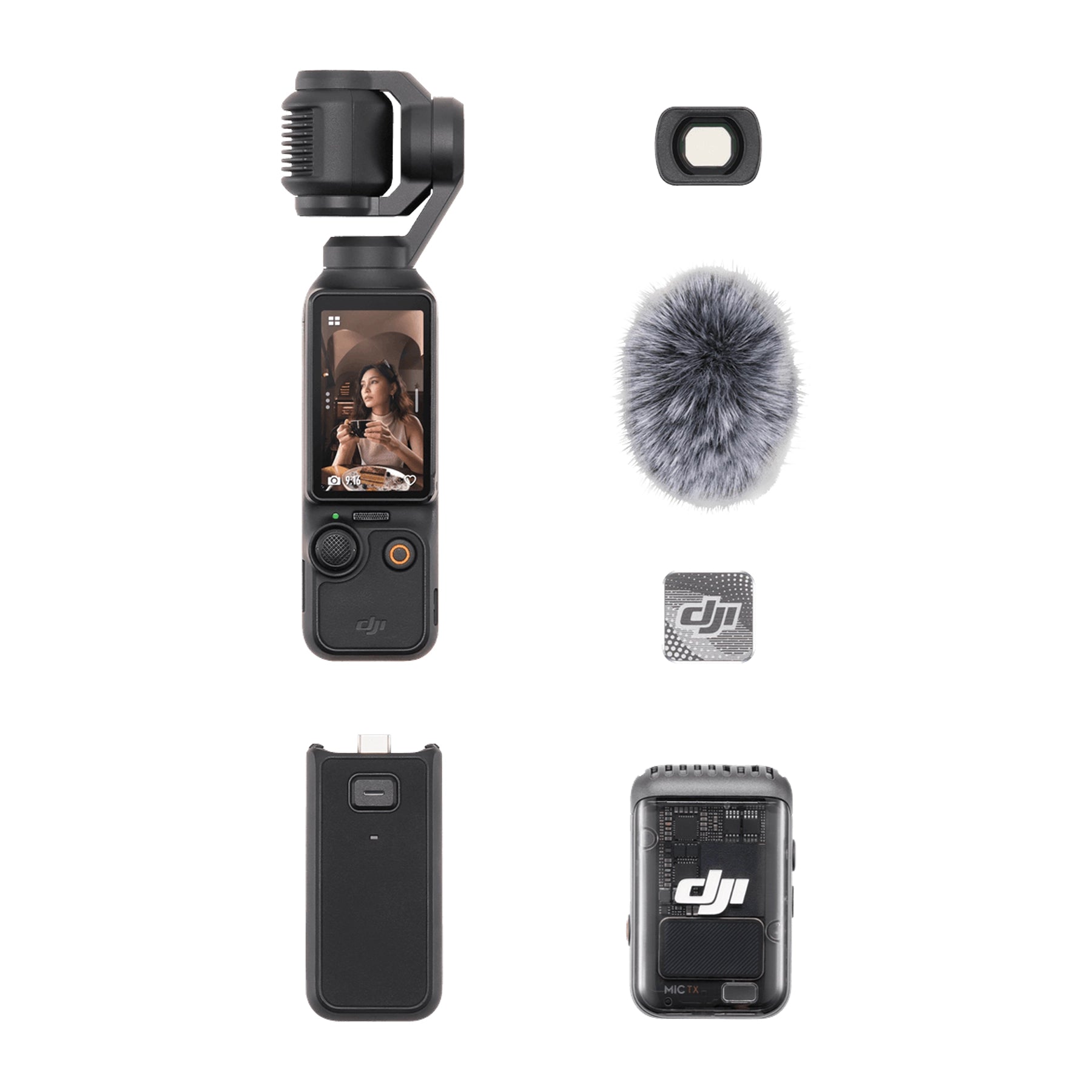
| Included in this kit | DJI Mic 2 transmitter, battery handle, mini tripod, carrying bag, wrist strap, protective cover, USB-C PD cable |

Build your Gear Closet
View all of your gear in one place, create packing lists and hit the trail with confidence. Available on iOS, Android and the web.
Get StartedPerformance
Image quality. The 1-inch sensor is the main reason to pick this over a phone clip or a small action camera. Reviewers at Tom’s Guide and Pro Video Coalition praise its low-light performance and dynamic range. One long-term owner calls it strong at dusk and in night markets, with little noise. For a hiker, that means usable footage at sunrise camp stoves and under forest canopy, where smaller sensors turn muddy. The 10-bit D-Log M profile gives editors room to grade flat alpine light. The sensor also shoots square and vertical, so one clip can serve both a YouTube edit and a phone-first feed.
Stabilization. The gimbal sets this camera apart. Footage shot while walking looks smooth, and the camera locks its axes automatically when it is switched off. On rocky descents the gimbal absorbs the bounce that would ruin phone video. Among the extras, Spin Shot rotates the camera 90 or 180 degrees with a tap, and Active Track follows a subject. The tracking and face-detection tools suit solo hikers filming themselves with a tripod or a chest mount.
Handling. The 2-inch OLED touchscreen rotates, so switching between horizontal and vertical framing takes a flick. Reviewers describe the body as a coat-pocket device rather than a jeans-pocket one. Hikers who film on the move can fit the camera to a pack shoulder strap with third-party mounts. One such mount fits straps 6.5–8.5 cm wide and holds the camera at chest height.
Battery. DJI rates the camera at 166 minutes at 1080p/24. Gigazine’s bench test, at full screen brightness with Wi-Fi on, recorded 136 minutes at 1080p/30. Tom’s Guide testers report a full day of mixed shooting, which means short clips with a few longer ones at 4K/24 and 4K/120. The battery handle in this kit holds 950 mAh and adds about 62% more runtime. In Gigazine’s test it stretched the 136 minutes to 224. Charging is quick. Even a 30W charger took the camera to 100% in under half an hour in that test, though it reached only 64% at the 16-minute mark. The battery is built in, so a dead cell can’t be swapped for a spare in the field. Backpackers will need a power bank. Cold matters too: the camera is rated for 0–40 °C and charges between 5 and 45 °C, so shoulder-season and winter trips mean keeping it in a jacket pocket.
Audio. The built-in microphones are described as acceptable but unremarkable. The included DJI Mic 2 transmitter fixes this. Owners who use it describe clear, clean voice capture. The catch, noted by Tom’s Guide, is that the camera does not support third-party wireless mics.
Weather. Tom’s Guide lists the camera with no water resistance. A gimbal motor and a moving arm are poor companions for rain and trail grit. Hikers describe stashing it in the carrying bag or a hip-belt pocket between shots, which defeats some of the grab-and-shoot appeal.
Pros & Cons
Pros
- 1-inch sensor delivers strong low-light and dynamic range for its size
- Three-axis gimbal gives smooth walking footage
- 4K/120 and 1080p/240 for slow motion
- 179 g body fits in a pocket
- Rotating touchscreen makes vertical shooting easy
- Very fast charging
- The Mic 2 transmitter in this kit improves audio
Cons
- No water resistance
- Built-in battery cannot be swapped
- Cold-weather operating limit of 0 °C
- Built-in microphones are average
- No third-party wireless mic support
- The app draws criticism from reviewers
- Battery handle, tripod and mic add weight and bulk beyond the 179 g body
Who Should Buy This
Thru-hikers, section hikers and bikepackers who make video, whether for a channel, a trip film or family memories, should buy it. It suits dry-weather and fair-weather trips where footage quality matters more than ruggedness. Anyone who films themselves while walking benefits from the gimbal and tracking. Skip it if you want a camera that survives rain, mud and drops without a case. A waterproof action camera is the better choice for wet-climate hikes, canyoneering or winter. Gram counters who only want stills and a few clips should stay with their phone.
Verdict
The Osmo Pocket 3 gives backpackers stabilized video that phones and action cameras struggle to match, at a weight most hikers will accept. Its lack of weather protection and its non-swappable battery are real limits, so it is best on fair-weather trips with a power bank. For video-focused hikers, it earns its place in the pack.