DJI Osmo Action 5 Pro Review
DJI's 146 g Osmo Action 5 Pro pairs a 1/1.3-inch sensor, dual OLED screens and 47GB of onboard storage in a small, rugged trail camera.
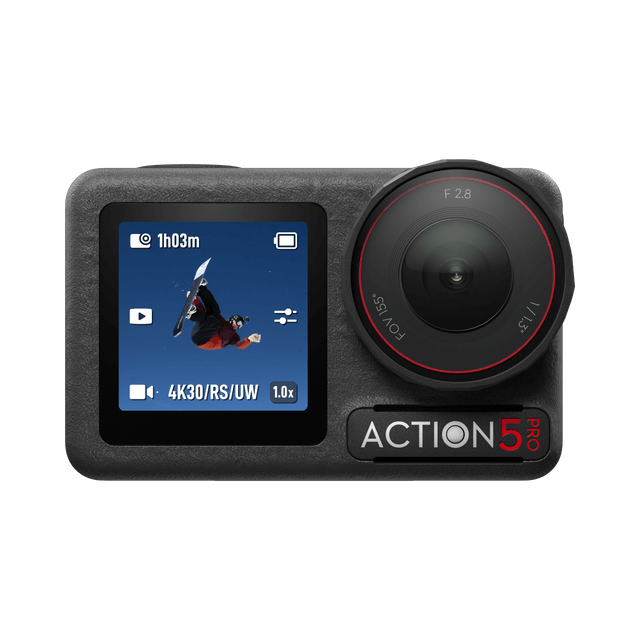
Overview
The Osmo Action 5 Pro is DJI’s flagship action camera: a 146 g, waterproof body built around a 40MP 1/1.3-inch sensor, with a screen on each face. It suits hikers who want better-than-phone footage of ridgelines, river crossings and camp life without carrying a mirrorless kit. The trade-off is the usual one for the category. It’s superb in good light, and it gets noticeably less impressive once the sun goes down or goes behind a cloud.
Key Specs
| Spec | Detail |
|---|---|
| Weight | 146 g (5.15 oz) |
| Dimensions | 70.5 x 44.2 x 32.8 mm |
| Sensor | 1/1.3-inch CMOS, 40MP stills |
| Lens | 155° field of view, f/2.8, focus from 0.35 m to infinity |
| Max video | 4K up to 120 fps (4:3 at 4K/120) |
| Dynamic range | Up to 13.5 stops (claimed) |
| Screens | Front 1.46-inch and rear 2.5-inch OLED touchscreens, 1,000 nits peak on the rear |
| Waterproofing | IP68; 20 m without a case, 60 m with the Waterproof Case |
| Storage | 47GB usable internal (64GB onboard), plus microSD up to 1TB |
| Battery | 1,950 mAh; up to 4 hours in DJI’s test conditions |
| Audio | 3 built-in microphones; wireless DJI Mic support |
| Connectivity | Wi-Fi 6, Bluetooth, USB-C (USB 3.0 speeds) |

Would the Osmo Action 5 Pro earn its spot in your pack?
146 g · 5.2 ozAdd the DJI Osmo Action 5 Pro to your Gear Closet and see exactly what it does to your base weight, then start packing for your next trip.
Free · No credit card · iOS, Android & web · Trusted by 3,000+ backpackers
Performance
Image quality. The headline is the sensor. DJI claims 13.5 stops of dynamic range, about 1.5 stops more than the Osmo Action 4. Reviewers at Tom’s Guide and TechRadar both rate the footage highly. TechRadar’s verdict puts it close on the heels of GoPro’s Hero13 Black. For hiking, that means sunrise ridgelines and shaded forest trail in the same frame hold up better than they do on most competitors.
Low light. The weak spot is dim conditions. DJI markets night modes, and Reddit owners praise the camera’s low-light performance overall. But a recurring thread among owners is that overcast days and dusk expose the limits of a small sensor, and that Insta360’s Ace Pro 2 does better there. Owners also flag a tendency toward lens flare and an auto white balance that can wander.
Battery. DJI quotes up to four hours, and that figure comes from a gentle test setup: 1080p at 24 fps, RockSteady on, Wi-Fi and screens off. Real mixed use on trail will be shorter. Still, the 1,950 mAh cell outlasts the Hero13 Black in most comparisons, and TechRadar notes it handles cold better than its rivals. Fast charging is quick, with DJI claiming roughly two hours of shooting from a 15-minute top-up. That suits a camp-stop or a town-day recharge.
Weight and handling. At 146 g, Tom’s Guide calls it the lightest of the three flagships (Hero13 Black, Insta360 Ace Pro 2) and the best for helmet mounting. It’s also about a quarter-inch shorter than the other two. On a shoulder strap or hip belt, the difference over a heavier GoPro is small, but it’s real. The magnetic quick-release system makes it easy to move between a chest mount, trekking pole and extension rod. One owner who took the Adventure Combo’s 1.5 m rod through three national parks compared the overhead shots to having “a mini-drone”.
Screens and controls. The dual OLEDs are bright enough to frame shots in direct sun, and the glass has a coating that keeps the touch controls responsive with wet hands. DJI’s menus are simpler than Insta360’s, and Tom’s Guide found enough manual control in video mode for anyone who looks for it. Subject tracking and horizon-leveling stabilization (HorizonSteady, a full 360° lock) are well-suited to scrambling and river crossings.
Durability. The 20 m body rating, without a case, is among the best in the category. A software pressure gauge gives a depth reading for swimmers and snorkelers. The 47GB of built-in storage is a practical bonus. It means a dead or forgotten microSD card doesn’t end the day.
Audio. Three internal mics are adequate for wind-free trail chat. Owners who pair it with a DJI wireless mic report seamless integration, which helps for narrated trip videos.
Pros & Cons
Pros
- 146 g, and compact by flagship standards
- Large 1/1.3-inch sensor with strong dynamic range in daylight
- Dual OLED touchscreens that stay readable in sun
- 47GB internal storage as a safety net
- Waterproof to 20 m without a case
- Long battery life, fast charging and good cold-weather behavior
- Strong wireless-mic integration
Cons
- Dim-light footage lags behind what the spec sheet suggests
- Reported lens flare and wandering auto white balance
- No built-in GPS; it needs an accessory
- Max video is 4K, while rivals offer 5.3K or 8K
- Extra weight accumulates fast once batteries, a mount and a rod are added
Who Should Buy This
Thru-hikers, section hikers and packrafters who want one rugged camera to document the trip, especially those who film in daylight and want the footage to look good on a big screen. It’s also an easy choice for anyone who already owns DJI’s wireless mic. Photographers who mainly shoot at dawn, dusk or inside a tent should look at the Insta360 Ace Pro 2 or just use a recent phone. Weight-obsessed hikers who only want occasional snapshots will find 146 g hard to justify against a phone they’re carrying anyway.
Verdict
The Osmo Action 5 Pro is one of the best-balanced action cameras for backcountry use: light, tough, long-lasting and sharp in good conditions. Buy it if the trip is about the footage. Skip it if a phone does the job.