Smartwater Review
The 1L Smartwater bottle weighs 34 g, threads straight onto a Sawyer Squeeze, and costs a couple of dollars. Thru-hikers still treat it as the default hard-sided bottle.
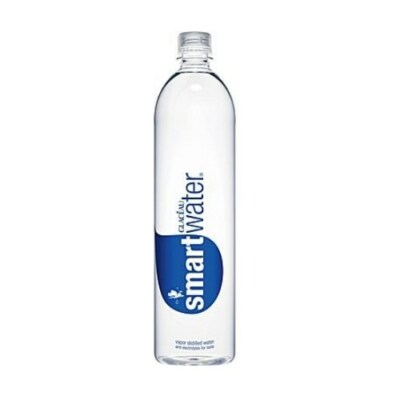
Overview
Walk through any trail town during hiker season and a grocery-store water bottle will turn up on nearly every pack. The 1-liter Smartwater is a disposable rPET bottle that thru-hikers adopted as a reusable one. It earned that place with a tiny weight penalty, standard 28 mm threads that fit Sawyer filters, and a price low enough that losing one is a shrug. The trade-off is that it’s a single-use container doing a multi-use job, with a narrow mouth and no tolerance for heat.
Key Specs
| Spec | Value |
|---|---|
| Weight | 34 g (1.2 oz) |
| Capacity | 1,000 mL |
| Material | rPET (recycled PET), BPA-free |
| Thread standard | 28 mm (fits Sawyer Squeeze and Sawyer MINI) |
| Hot liquids | Not suitable |
| Cost | A few dollars at retail, water included |

Build your Gear Closet
View all of your gear in one place, create packing lists and hit the trail with confidence. Available on iOS, Android and the web.
Get StartedPerformance
Weight and carry. At 34 g empty, the Smartwater is about as light as a rigid liter container gets. Purpose-built reusable bottles generally weigh more, and soft flasks trade away the rigidity. The shape matters as much as the weight: the bottle is tall and narrow, so it slides into the side pockets of most backpacks and two fit side by side. The same slimness has a downside. Hikers report that the bottle can work its way out of shallow pockets, particularly during off-trail scrambling or brush-bashing, and that a bottle lost that way is not a big financial loss.
Filter compatibility. This is why the bottle became a trail fixture. The 28 mm threads let a Sawyer Squeeze or Sawyer MINI screw directly onto the bottle, so it works as either a dirty-water reservoir or a clean-water bottle to drink from. Many hikers carry two: one to squeeze from and one to drink from. That setup skips the soft pouches supplied with the filter, which have a reputation for splitting at the seams. The rigid walls also help at the source. A Smartwater scoops water from a shallow pond or a slow trickle more easily than a floppy pouch does, and the plastic still flexes enough to push water through the filter.
A popular tweak is to take the sport cap from a 700 mL Smartwater and fit it on the 1L bottle. The push-pull cap allows one-handed sipping, which suits anyone using trekking poles. It also lets the bottle be used to backflush a Sawyer without the supplied plunger.
Durability. The “disposable” label is misleading. Thru-hikers regularly report carrying one bottle for months, including one Appalachian Trail hiker who kept the same bottle for about three months and retired it because it was dirty, not because it had failed. The bottles pick up creases and scars from drops and hard squeezing, but owners say they don’t leak. The wear that does accumulate comes from filtering. Squeezing a hard-sided bottle creates a vacuum that has to be released by burping the bottle, and over time the repeated flexing deforms the sidewalls. On a long hike that’s a reason to replace a bottle at a town stop, and replacement is easy because almost every gas station and grocery store stocks them.
Limitations. The narrow mouth is the most common complaint. Stirring in electrolyte powder or drink mix is awkward, and some SteriPen models won’t fit inside. Hikers who treat water with a UV pen or chemicals rather than a squeeze filter get less from the bottle. It cannot handle boiling water, which rules it out for snow melting or hot-bottle tricks on cold nights. Owners also note that it freezes faster than a wide-mouth Nalgene, so it isn’t the bottle for late-season or high-elevation trips. The cap is small, isn’t tethered, and is easy to drop or lose.
Health and ethics. Buying bottled water to reuse as gear sits awkwardly with some hikers. PET is not designed for long-term repeated use, and some hikers worry about chemical leaching and microplastic shedding from heavily scuffed bottles. The current bottles are made from recycled PET, which helps with the footprint but not with the underlying question of reusing a single-use container. Hikers who object on either ground can move to a purpose-built reusable bottle and accept a weight and price penalty.
Pros & Cons
Pros
- 34 g for a rigid 1L bottle
- 28 mm threads fit Sawyer Squeeze and Sawyer MINI directly
- Tall, narrow profile suits side pockets, and two bottles fit side by side
- Holds up for months of thru-hiking use despite the single-use label
- Sold at nearly every grocery store and gas station, so resupply is trivial
- Rigid enough to fill from shallow water, flexible enough to squeeze through a filter
- BPA-free and made from recycled PET
Cons
- Narrow mouth makes drink mixes awkward and excludes some SteriPen models
- Cannot take boiling water or hot liquids
- Freezes faster than a Nalgene, which makes it a poor choice for winter
- Sidewalls distort with repeated filter squeezing
- Small, untethered cap is easy to lose
- Reusing a single-use PET bottle raises health and ethical questions for some hikers
Who Should Buy This
Anyone running a Sawyer Squeeze or MINI and counting grams should carry these. That covers thru-hikers, ultralight weekend packers, and anyone building a two-bottle dirty/clean system on a budget. Cold-weather campers, hikers who treat water with UV or chemicals, and anyone who wants to mix drink powders or pour boiling water into the bottle should choose a wide-mouth reusable bottle instead. So should hikers who object to reusing single-use plastic.
Verdict
For Sawyer users, the Smartwater remains the default 1L bottle: it’s light, costs almost nothing, and fits the filter without adapters. Its limits are the narrow mouth, no hot liquids, and sidewalls that tire out after long stretches of squeezing, none of which matters much when a replacement costs a couple of dollars. It earns an 8.5 out of 10, with the missing points going to the cold-weather limits and the single-use-plastic question.