Katadyn BeFree Review
Katadyn's BeFree pairs a fast hollow-fiber filter with a collapsible Hydrapak flask in 0.6L, 1L and 3L sizes, but the thin flask and 1,000 L filter life limit it.

Overview
The Katadyn BeFree is a hollow-fiber filter that screws onto a collapsible Hydrapak soft flask, so the bottle used to scoop water is the same one used to drink from. It comes in 0.6L and 1L handheld sizes and a 3L version meant for hanging at camp. It suits trail runners, fastpackers and thru-hikers who pass water often and count grams. The headline trade-off is speed against durability: flow is hard to beat when the filter is clean, but the thin flask and finite filter life demand some care.
Key Specs
| Spec | Value |
|---|---|
| Weight | 59–100 g depending on size (complete system with flask) |
| Capacity | 0.6 L, 1 L or 3 L |
| Filter type | EZ-Clean hollow-fiber membrane |
| Pore size | 0.1 micron |
| Flow rate | Up to 2 L/min |
| Filter life | Up to 1,000 L, depending on water quality |
| Removes | Bacteria (99.9999%), protozoa (99.99%), sediment |
| Does not remove | Viruses |
| Flask | Hydrapak SoftFlask, TPU, BPA-free |
| Threads | 42 mm Hydrapak |
| Cleaning | Shake or swish in the field; no backflushing |
Versions compared
| Image | Version | Weight | vs. lightest |
|---|---|---|---|
| Water Filtration System 0.6L | 59 g (2.1 oz) | lightest |
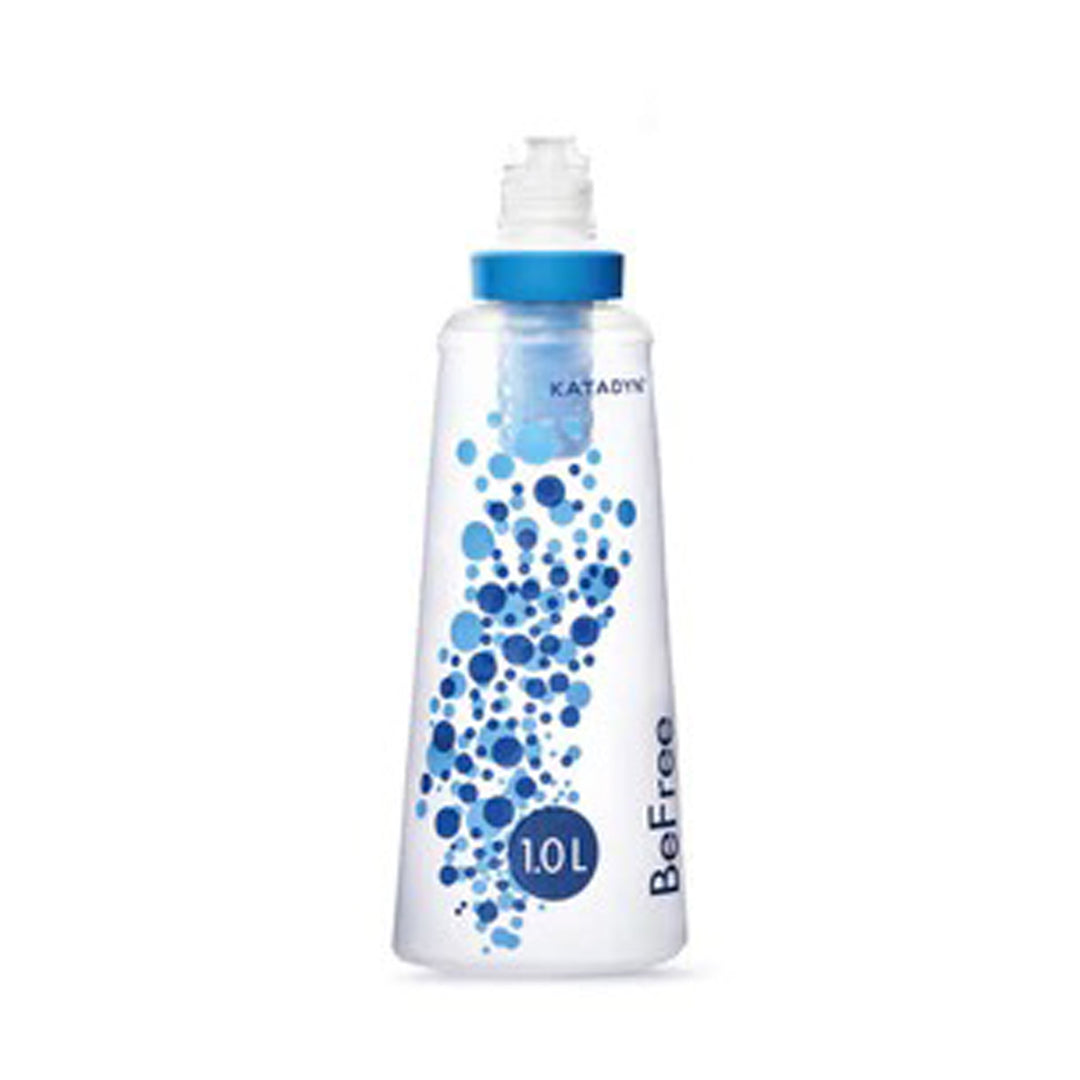 | Water Filtration System 1L | 63 g (2.2 oz) | +4 g |
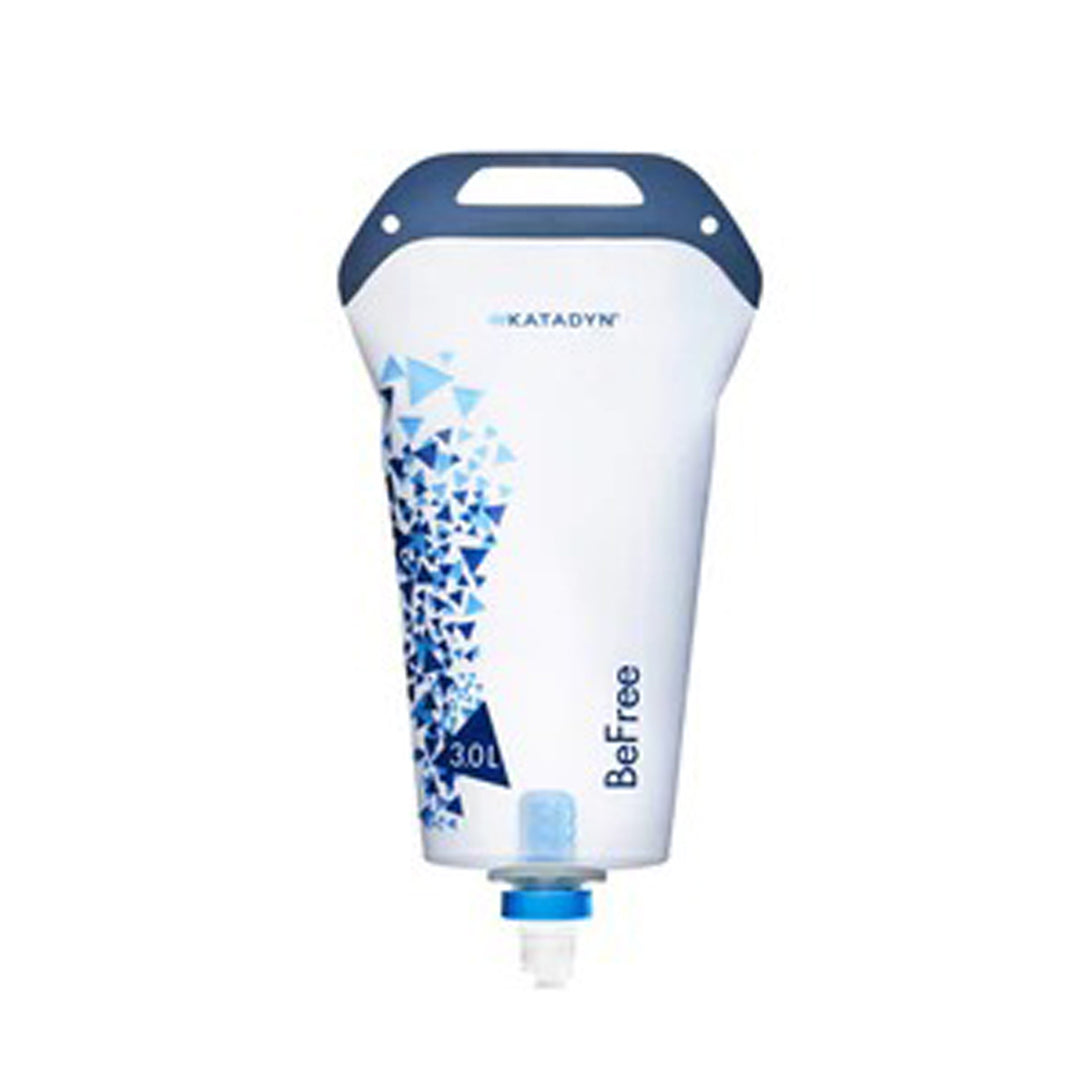 | 3.0L | 95 g (3.4 oz) | +36 g |
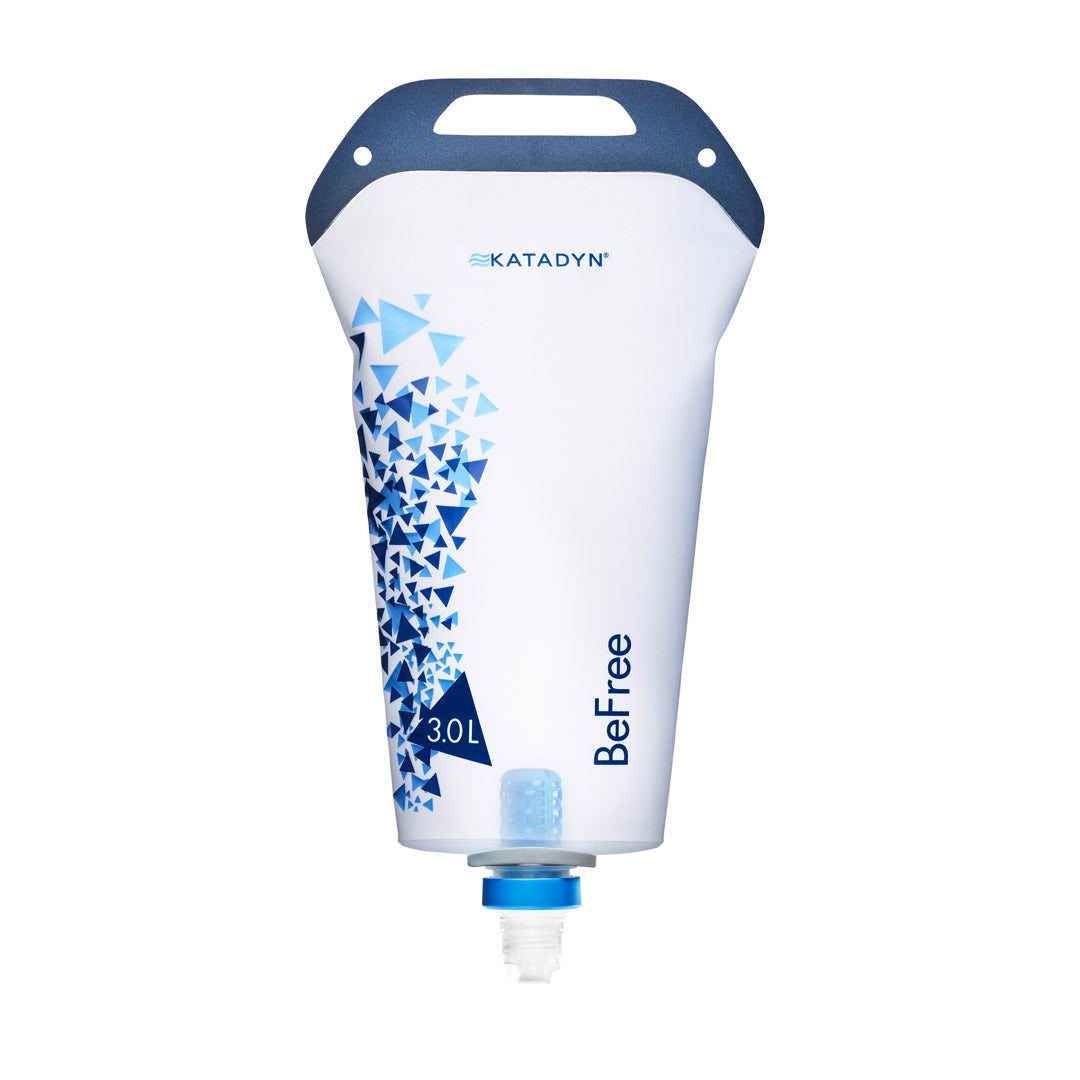 | Water Filtration System 3L | 100 g (3.5 oz) | +41 g |

Build your Gear Closet
View all of your gear in one place, create packing lists and hit the trail with confidence. Available on iOS, Android and the web.
Get StartedPerformance
Flow. Speed is why people buy the BeFree. Katadyn rates it at up to 2 liters per minute, and owners with a fresh filter report squeezing a liter through in roughly half a minute. That is well ahead of the Sawyer Squeeze, the baseline many thru-hikers compare against. The catch is that the number belongs to a new or freshly cleaned filter. Flow drops as sand, silt and algae load the fibers, and owners say it can fall to about half by mid-life. Clear alpine streams keep the filter quick for a long time. A few murky desert catchments will bring the slowdown on.
Filtration. The 0.1-micron membrane handles the usual North American backcountry threats: bacteria, Giardia and Cryptosporidium. It is a filter, not a purifier, so viruses pass through. On US and Canadian trips that rarely matters. For international travel or heavily used watersheds, hikers commonly add chlorine dioxide.
Use and cleaning. The routine is simple: dip the flask, screw on the filter, squeeze, and drink through the nozzle. Or filter into a separate bottle if that suits better. Cleaning means half-filling the flask, attaching the filter and shaking hard for about 30 seconds. The fibers sit exposed in a perforated tube rather than a sealed housing, which makes silt easier to dislodge. There is no backflush option, though. When the shake method stops restoring flow, the filter is near the end of its useful life.
Freeze risk. Like every hollow-fiber filter, the BeFree can be ruined by freezing, and the damage is invisible. Shoulder-season and alpine hikers need to sleep with it in the bag.
Durability. The stock flask is the most common owner complaint. It uses thin TPU, and pinhole leaks and splits turn up regularly in long-term reports. Outdoor Gear Lab’s testers liked the 3L version but gave its reliability a middling 5 out of 10 after the bottle broke twice. A popular fix is to thread the filter onto a sturdier 42 mm Hydrapak flask such as the Seeker.
Filter life. The 1,000-liter rating is shorter than the lifetime guarantees on some competitors. On a PCT-length hike at around five liters of filtered water a day, it gets used up quickly. Hikers in silty country sometimes replace the filter after a single two-week stretch. Thru-hikers should budget for a spare.
Choosing a Version
All versions use the same membrane and the same claimed flow and filter life. What changes is the flask and how the system is carried.
0.6L (59 g). The lightest option, and the one that fits a running vest or shorts pocket. It is a personal sipping bottle for runners and fastpackers who pass water every hour or two. Hikers who must carry water between distant sources will find it small and are better off pairing it with a larger bottle.
1L (63 g). Four grams heavier and the better default for most backpackers. It holds enough for a dry stretch and doubles as a scoop for filling other containers. Choose this if the BeFree is the only filter and bottle in the kit.
3L (95 g and 100 g). The 3L system is listed in two weights, 95 g and 100 g, both built around the same large flask and membrane. The flask adds a bail handle for easy filling through a wide mouth and a carry loop for hanging from a branch or clipping to a pack. It works as a squeeze filter for one person or as a hands-free camp filter for a couple or small group. Owners note that it has no tube to direct the flow, so pouring into a bottle with any precision usually means holding the bag by hand, and a full 3 liters gets heavy quickly. It packs down to about the size of a snack bag. Hikers who want a hose and quick-connect for filling bladders should look at Katadyn’s separate Gravity BeFree, which weighs about 192 g. The big flask is also the one Outdoor Gear Lab saw break. It suits couples and families more than solo ultralighters.
Pros & Cons
Pros
- Very fast flow when the filter is new or clean
- 59–100 g for a complete filter-and-flask system
- Flask collapses nearly flat and can be drunk from directly
- Field cleaning needs no tools or syringe
- 3L version hangs for hands-free filtering at camp
- Fits other 42 mm Hydrapak flasks
Cons
- Thin stock flask is prone to leaks and splits
- 1,000 L rated life is short for long thru-hikes
- Flow falls off in silty water and can’t be backflushed
- Freeze damage can’t be detected
- Does not remove viruses
- Limited to 42 mm Hydrapak threads, so it won’t fit Smartwater bottles
Who Should Buy This
The BeFree suits three-season hikers, trail runners and fastpackers who pass clear water often and want treatment to take almost no time. The 0.6L and 1L sizes fit those users; the 3L fits pairs and small groups who want a hang-and-forget camp filter. Hikers who want one filter to last a whole long trail should look at the Sawyer Squeeze or LifeStraw Peak Squeeze. So should anyone who often draws from silty sources, or who camps in freezing temperatures without a routine for protecting the filter overnight.
Verdict
The BeFree is among the fastest and lightest ways to get clean water on the trail, and the scoop-screw-drink routine is hard to fault. The thin flask, the lack of backflushing and the 1,000-liter life keep it from being a set-and-forget choice for long trails. Pick the 1L for general backpacking, the 0.6L for running, and the 3L for camp water for two or more.