Work Sharp Guided Field Sharpener Review
A compact, angle-guided 5-stage sharpening kit that puts a genuinely sharp edge on trail knives — reviewed for weight, usability, and thru-hike practicality.
Overview
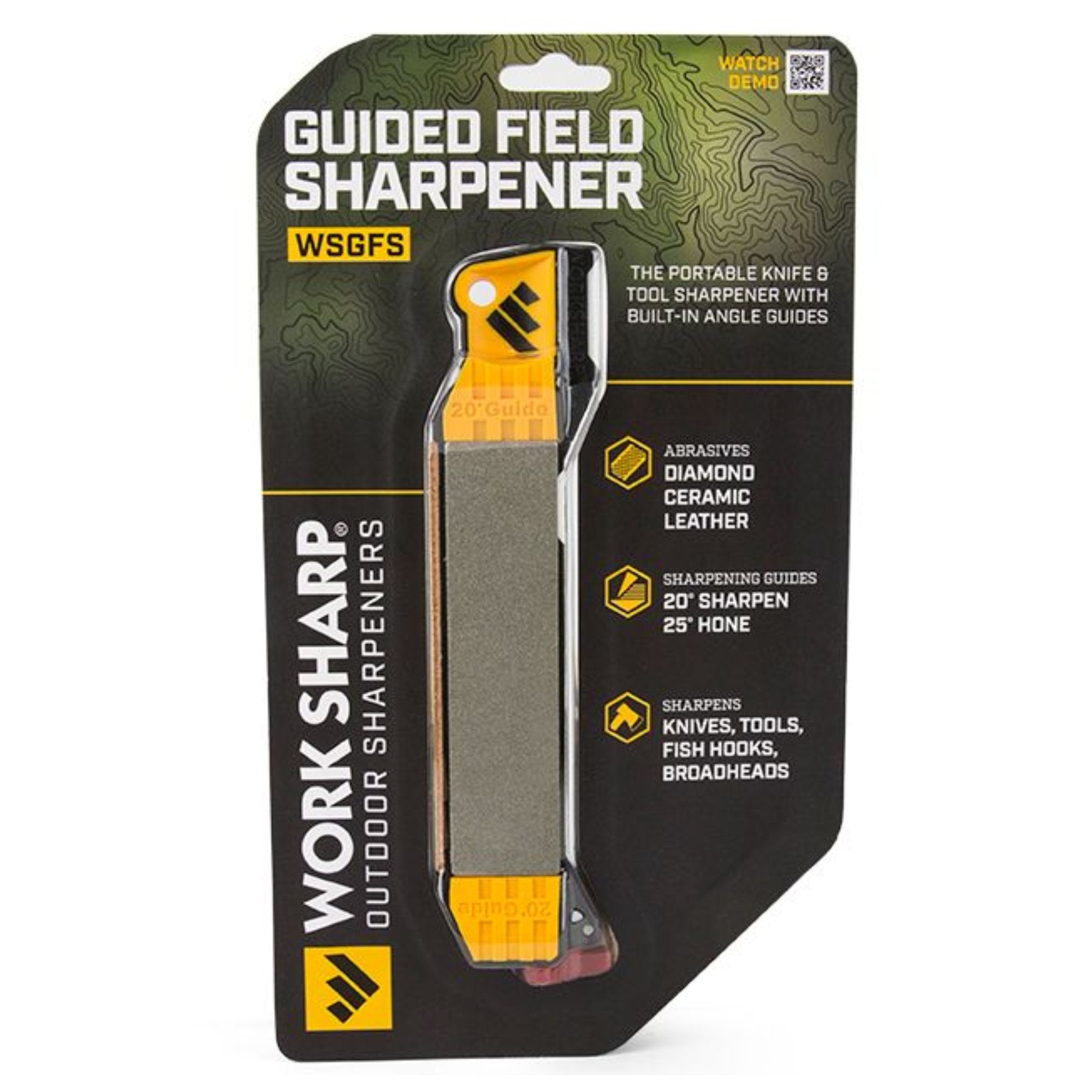
The Work Sharp Guided Field Sharpener is a pocket-sized, multi-stage sharpening kit built for hunters and backpackers who want to maintain a working edge without hauling a full bench setup. It packs two diamond plates, two ceramic rods, a leather strop, and a broadhead wrench into a single 130g unit with built-in angle guides — essentially a scaled-down version of Work Sharp’s shop sharpeners for people who need to touch up a knife at camp, not restore one from scratch.
Key Specs
| Spec | Detail |
|---|---|
| Weight | 130.0 g (4.6 oz) |
| Angle guides | 20° and 25° |
| Diamond plates | 200 coarse, 600 fine |
| Sharpening stages | 5 |
| Ceramic rods | 2 (large rod with 3 usable faces, small rod for serrations/hooks) |
| Finishing stage | Leather strop w/ micro-abrasive compound |
| Bonus tool | Broadhead wrench |
| Plate attachment | Magnetic (removable for cleaning) |

Build your Gear Closet
View all of your gear in one place, create packing lists and hit the trail with confidence. Available on iOS, Android and the web.
Get StartedPerformance
The core idea here is a five-stage progression: coarse diamond, fine diamond, coarse ceramic, fine ceramic, then leather strop. Each stage has an angle guide built into the housing, so instead of eyeballing 20 degrees per side, you rest the spine of the blade against the guide and pull through. It’s the same guided-angle concept Work Sharp uses on its bench sharpeners, just shrunk down.
In practice, this system is at its best for touch-ups, not full re-profiles. The first level starts at 220 grit, which is pretty rough — not something you’d use on every blade, but good if you need to re-profile a blade or your blade is duller than dull. For routine maintenance on a pocket or hunting knife that’s just lost its bite, most owners skip straight to the fine diamond plate and ceramic stages. One reviewer put it well: the coarse stone is a bit too coarse for any maintenance, so for maintaining knives it’s more practical to use just the fine grit and ceramic rods, finishing with the strop, and rarely touch the coarse plate.
Edge quality after a full pass is consistently the strongest praise point across owner reviews. Multiple users who describe themselves as poor at freehand sharpening report getting the best edge they’ve ever had on their knives after a session, crediting the angle guides for making the process simple. That tracks with what I’d expect from a guided system — the hard part of sharpening is holding a consistent angle over dozens of strokes, and offloading that to a physical guide removes most of the room for error.
The ceramic rod setup pulls double duty. The first narrow stage has a rotating ceramic rod with a coarse side and a smooth side, plus a small secondary ceramic rod specifically for sharpening serrated blades. That serration-specific rod is a genuinely useful inclusion — most compact sharpeners ignore serrated edges entirely, and re-sharpening a serrated hunting or rescue knife in the field is otherwise a real pain. Hook and broadhead maintenance also work as advertised; the ceramic rod includes a built-in fishhook sharpener, and testing it on old hooks got them sharpened to a point quickly.
The strop is the one component that draws consistent size complaints. The sharpening areas overall are great, but the leather strop area could stand to be larger even though it still works. On a full-size fixed blade you’ll be doing more, shorter passes than you would on a proper bench strop, but it still gets the job done for a final polish.
Build quality feedback is generally strong for the price point. Owners report good overall build quality with the edge guides holding up well over repeated use, and the plates are held on with magnets and can be removed for cleaning, which matters once you’ve got metal swarf building up on the diamond surfaces after a season of use. Work Sharp also sells replacement parts, so a worn plate or rod doesn’t mean replacing the whole unit.
Where it falls short: this is not the tool for a large fixed blade or machete that needs serious edge correction. It works well for smaller blades, but larger knives can have difficulty being sharpened effectively on the compact plates, and stability on a table or flat rock is aided by rubberized ends that make it stable when placed down, letting you maintain control with minimal effort as you run the blade across each stage — but you’re still working with a short plate length compared to a bench stone, which limits stroke length on longer blades.
Pros & Cons
Pros
- Angle guides genuinely help produce a consistent, sharp edge even for people who struggle with freehand sharpening
- Covers an unusually wide range of jobs for the weight: plain edges, serrations, fish hooks, and broadheads
- Magnetic, removable diamond plates simplify cleaning and are user-replaceable
- Compact enough to justify carrying on hunting trips or longer backcountry trips where a knife sees hard use
- Reasonable price point relative to Work Sharp’s bench sharpeners
Cons
- Coarse 200-grit plate is overkill for routine maintenance and better suited to re-profiling
- Struggles with longer fixed blades and machetes due to short plate/strop length
- Leather strop area is small; multiple owners wish it were larger
- At 130g it’s heavier than a simple ceramic rod or diamond card if all you need is a quick touch-up on an ultralight trip
Who Should Buy This
This sharpener makes the most sense for hunters, hard-use backcountry travelers, and anyone carrying a fixed-blade or folding knife that sees real cutting duty — skinning, food prep, cordage, batoning kindling — on multi-day trips where a dull edge is a real liability. It’s less essential for a typical ultralight thru-hiker whose knife only opens food packaging and cuts cordage; for that use case, a 10-gram diamond credit card or ceramic rod will save weight and cover the need. If you’re hunting, fishing, or otherwise putting real wear on a blade in the backcountry, though, the Guided Field Sharpener’s versatility justifies its pack weight.
Verdict
The Work Sharp Guided Field Sharpener does what it promises: it takes the guesswork out of maintaining a sharp edge in the field, and the angle-guided design genuinely helps if freehand sharpening isn’t your strength. It’s not a replacement for a full sharpening setup on large blades, and the coarse plate and strop have real size limitations, but for hunters and backpackers who need a reliable, packable edge-maintenance tool, it earns its spot. I’d rate it an 8/10 — excellent for its intended use case, with the caveat that ultralight hikers with minimal cutting needs can likely get away with something smaller and lighter.