TheTentLab Deuce #2 Review
TheTentLab's 17 g Deuce #2 is a 7075-T6 aluminum cathole trowel with a serrated DirtSaw edge: tough and nearly weightless, but it rewards technique.
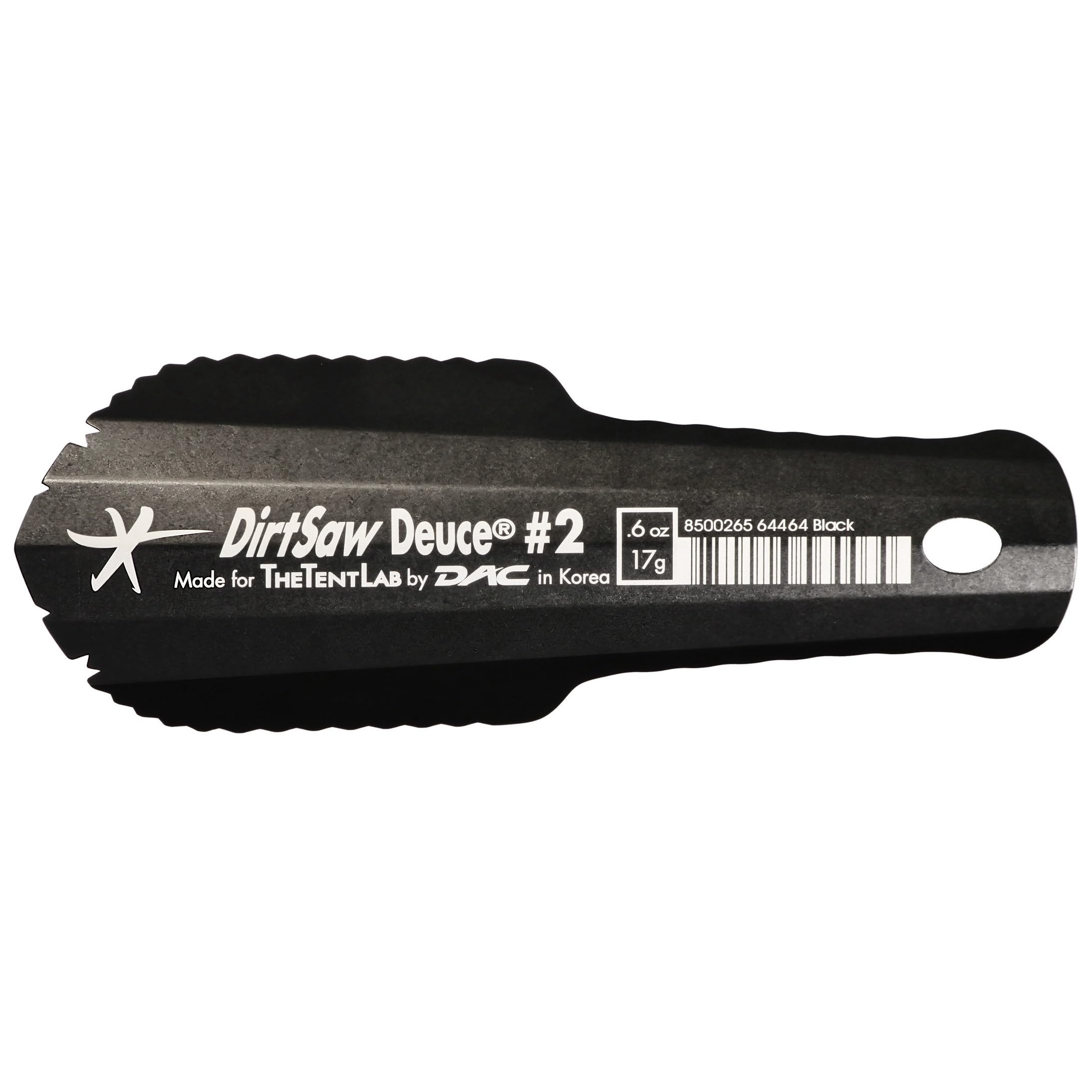
Overview
The Deuce #2 is TheTentLab’s best-selling cathole trowel, sitting between the 13 g Deuce #1 and the 27 g Deuce #3. At 17 g (0.6 oz), it is built for thru-hikers and weight-conscious backpackers who want a real digging tool without a noticeable cost on the scale. The trade-off is that this is a trowel you have to learn: used like a garden spade, it underwhelms; used the way its designer intended, it digs well beyond what its size suggests.
Key Specs
| Spec | Detail |
|---|---|
| Weight | 17 g / 0.6 oz |
| Dimensions | 2.5” wide × 6.8” long |
| Material | 7075-T6 aluminum (aerospace grade, AMS4045) |
| Edge | DirtSaw serrated leading edge |
| Finish | Anodized, tumbled and deburred |
| Price | $21.95 (DirtSaw version) |
| Warranty | Lifetime; replacement for the cost of postage |

Build your Gear Closet
View all of your gear in one place, create packing lists and hit the trail with confidence. Available on iOS, Android and the web.
Get StartedPerformance
Technique is the whole game. Owners who pick up the Deuce and hold it like a conventional trowel tend to come away disappointed. TheTentLab’s instructions describe a two-ended approach: use the handle end to break up hard soil, then switch to the scoop end to pry and lift. That method also produces a clean “top plug” of duff and soil that can be set back over the hole. When ground is especially stubborn, flipping the tool and tracing the circumference of the cathole with the handle end breaks up compacted soil, and the inverted grip puts more pressure on the point.
The DirtSaw edge. The leading edge carries four wide, smooth-profiled grooves meant to saw through dirt like a serrated knife without grabbing roots or threatening the user’s hand. Reviewers on Trailspace report that the notches help catch and cut small roots when digging through duff. TheTentLab notes the teeth are broad enough to touch up in the field, and that half of a fine-grained river rock does the job. The teeth also work best once they have rounded slightly with use.
Digging in tough ground. Results vary with terrain and with how well the user has absorbed the technique. Some owners report the trowel only digs comfortably in sand or loose soil. Others have used it in the rocky ground of Olympic National Park, where a plastic trowel would likely have failed. Trailspace reviewers rate the whole Deuce line as reasonably effective at digging catholes, but less forgiving than longer, heavier tools like the U-Dig-It Pro. The thin blade does not bend when force is applied in different directions to work around and dislodge rocks.
Hand comfort. This is the most consistent complaint. In rocky or rooty soil, the trowel can dig into the palm during hard digging or chopping, and some users carry a light glove for granite country. TheTentLab left off handle bumpers on purpose, since a bumper and a longer handle would get in the way of the digging modes the design relies on. Ripples on the handle add grip and surface area.
Durability. The 7075-T6 alloy meets AMS4045 and springs back well under hard use. The tool’s strength comes from its curved U-section: levering against the bottom of the U is very strong, while prying against the open side is much weaker. One reviewer using the older Deuce of Spades, digging for a group of five in rocky northeast Yellowstone soil, snapped the tip on a rock. The current DirtSaw #2 adds Ray-bend reinforcements, which TheTentLab says make it 65% stronger against bending at the middle and nearly three times stronger at the hole. Anodizing guards against corrosion and keeps aluminum smudge off hands, and every edge is tumbled and deburred. Anyone who does bend or break one gets a replacement for the cost of postage.
Packability. At under 7 inches, the Deuce rides in a side pocket next to a standard Smartwater bottle and clears TSA carry-on rules. A small hole in the handle allows external clipping. The length also doubles as a depth gauge: when the blade is buried, the cathole is deep enough.
Pros & Cons
Pros
- At 17 g, the weight penalty is negligible
- 7075-T6 aluminum and Ray-bend reinforcement give it real strength for its size
- Two-ended design expands what a tiny trowel can do
- Length works as a built-in cathole depth gauge
- DirtSaw teeth can be touched up in the field with a river rock
- Tumbled, deburred and anodized: no sharp edges, no aluminum smudge
- Lifetime warranty with postage-only replacement
- Slim enough for a bottle pocket; carry-on legal
Cons
- Performance depends heavily on learning the technique
- No handle bumpers, so the edge can bite into the hand in rocky or rooty soil
- Thinner and more flexible than the #3, so heavy prying in angular rock requires care
- Struggles in very hard or root-choked ground
- Less user-friendly than longer, heavier trowels like the U-Dig-It Pro
- $21.95 is steep for a 17 g piece of metal
Who Should Buy This
The Deuce #2 suits thru-hikers and weekend backpackers who dig catholes regularly and are willing to spend five minutes with the instructions. It is the sensible middle of the lineup: light enough to be an easy inclusion, strong enough for typical backcountry soils. Hikers who routinely face dense Sierra granite or heavily rooted eastern forest should spend the extra 10 g on the Deuce #3 for more leverage and a more comfortable grip. Those who want a trowel that works like a garden spade without any learning, or who dislike gloves in rough soil, should look at a longer, heavier option. The #1 makes sense only for hikers who already know the technique and are counting every gram.
Verdict
The Deuce #2 is among the best-engineered cathole trowels at its weight, with strong alloy, a smart two-ended design and a lifetime warranty behind it. It asks for technique and a little hand discomfort in rough ground, and it returns a tool that handles more terrain than 17 g should. Recommended for anyone prepared to learn it.