Primus PowerLighter Review
The Primus PowerLighter is a refillable butane jet lighter for backpacking and camping — a clever concept let down by recurring reliability concerns.
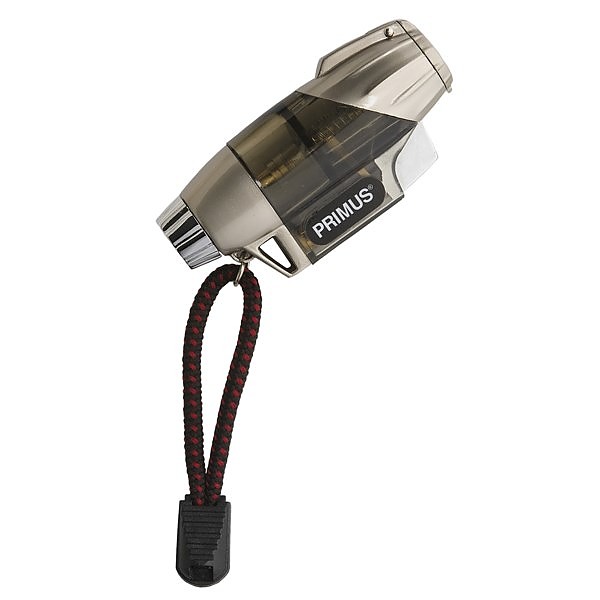
Overview
The Primus PowerLighter is a compact, refillable butane lighter designed for lighting stoves and campfires in rough weather. Its narrow precision jet flame reaches up to 1,300°C, which makes it capable of igniting most combustible materials — including temperamental liquid fuels — in bad weather. It’s aimed at backpackers, mountaineers, and campers who want something more purposeful than a grocery-store BIC, and who are already carrying a Primus gas canister they can refuel from.
Key Specs
| Spec | Value |
|---|---|
| Weight | 67 g (empty) |
| Dimensions | 80 × 50 × 20 mm |
| Flame Temperature | 1,300°C |
| Refillable | Yes |
| Gas Included | No |
| Ignition | Piezo electric |
| Colors | Red, Black |

Would the PowerLighter earn its spot in your pack?
67 g · 2.4 ozAdd the Primus PowerLighter to your Gear Closet and see exactly what it does to your base weight, then start packing for your next trip.
Free · No credit card · iOS, Android & web · Trusted by 3,000+ backpackers
Performance
Flame & Ignition
On paper, the PowerLighter’s design is genuinely useful for a backpacker. Unlike a standard lighter whose flame always points up, the jet flame here points whichever direction you steer it, so you don’t have to worry about it licking your fingertips at awkward angles. Operation is simple: flip up the cap and depress the piezo ignition switch, and you get a flame rated at around 1,300°C.
Once dialed in, the flame intensity adjustment screw at the base mostly stays set — there’s a knob at the bottom where you can dial in the right setting for reliable ignition, and most users find that once it’s calibrated, it doesn’t need adjustment even after refilling. That said, the adjustment screw can be tricky to set because it requires something narrow and flat, and without proper adjustment, the lighter can be inefficient.
Wind Resistance
This is where the marketing and reality diverge. Primus bills it as wind resistant, but real-world users consistently disagree. One tester noted that Primus claims wind resistance, but the flame can be easily blown out with a birthday-candle-strength breath from 8 inches away. It’s a jet flame that looks windproof, and it will handle a light breeze better than a standard lighter, but don’t count on it in any serious wind without cupping it in your hands.
Cold Weather
While it can ignite easily in strong winds when conditions are otherwise reasonable, it will not operate reliably in cold temperatures if the lighter and its gas can cool to below freezing.
This is simply the physics of butane — it’s not a knock unique to Primus — but it’s worth knowing if you’re heading into shoulder-season or alpine conditions. Keeping the lighter in a chest pocket goes a long way.
Refueling
The PowerLighter can be refilled even on the trail, and Primus offers a filling adapter that attaches to a standard butane camp stove canister, saving you from carrying separate canisters for the lighter and the stove.
In practice that’s a genuinely smart system.
The lighter ships in an empty state, so you need gas before it’s usable at all.
The adapter itself is sold separately and adds cost to the kit.
The fuel level indicator window is also quite small, making it difficult to tell reliably whether the lighter is full or empty.
Longevity and Reliability
This is the uncomfortable part of the review. The pattern across multiple independent user communities is hard to ignore. Of five lighters tested by one long-term review team, two inexplicably stopped working despite correct gas, correct outdoor temperatures, and normal use. The most common failure mode is the piezo ignitor stopping spark generation entirely — the button depresses smoothly with no sound and no flame. In many cases this seems to surface after roughly a year of hard use.
On the warranty side, the experience is mixed. At least one user reported that Primus shipped a replacement lighter the next business day after reporting a malfunction — genuinely good service. Others encountered a loop of being bounced between the retailer and Primus without resolution. Warranty responsiveness appears inconsistent depending on region.
Pros & Cons
Pros
- Directional jet flame — usable at any angle without burning your fingers
- Refillable from your stove’s canister via optional adapter, cutting down on separate fuel items
- Compact footprint: 80 × 50 × 20 mm slots easily into a hip belt pocket
- Adjustable flame intensity with a small screw
- 67 g empty — lighter than many comparable jet lighters
- Primus warranty has come through for some users
Cons
- Ships empty; no gas included and no adapter in the box
- Filling adapter (required for canister refueling) sold separately
- Wind resistance is noticeably overstated — not suitable in real gusts without shielding
- Unreliable in cold temperatures below freezing
- Piezo igniter failure is a well-documented and recurring issue across multiple user bases
- Fuel level window is too small to read accurately
- Flame intensity screw requires a narrow flat tool to adjust — fiddly in the field
Who Should Buy This
The PowerLighter makes most sense for three-season campers and backpackers who already carry Primus isobutane canisters and want to refill the lighter from the same fuel source. Its one-handed ergonomics and compact format are genuinely appealing for casual weekend use. It’s less suited as a sole fire-starting tool for remote or alpine trips where reliability is non-negotiable — the documented failure rate makes it a poor choice as your only fire source, and you should always bring at least a backup. If you’re doing serious winter travel or high-altitude mountaineering, look elsewhere.
Verdict
The Primus PowerLighter has a lot going for it on paper: directional jet flame, refillable from your stove canister, reasonable weight, and one-handed operation. But the recurring piezo igniter failures reported across multiple reviewers and platforms are a real problem for a piece of gear that’s supposed to be your fire insurance. It’s the kind of product you want to like, and will like — right up until the day it stops working. Carry a backup, and perhaps reconsider whether a BIC and a windproof torch lighter between them aren’t simply more trustworthy. 6/10.