Opinel No. 8 INOX Review
The Opinel No. 8 INOX is a 45 g French folder with a thin stainless blade and a twist-ring lock. It's a cheap, sharp camp-kitchen knife, but not a tough one.
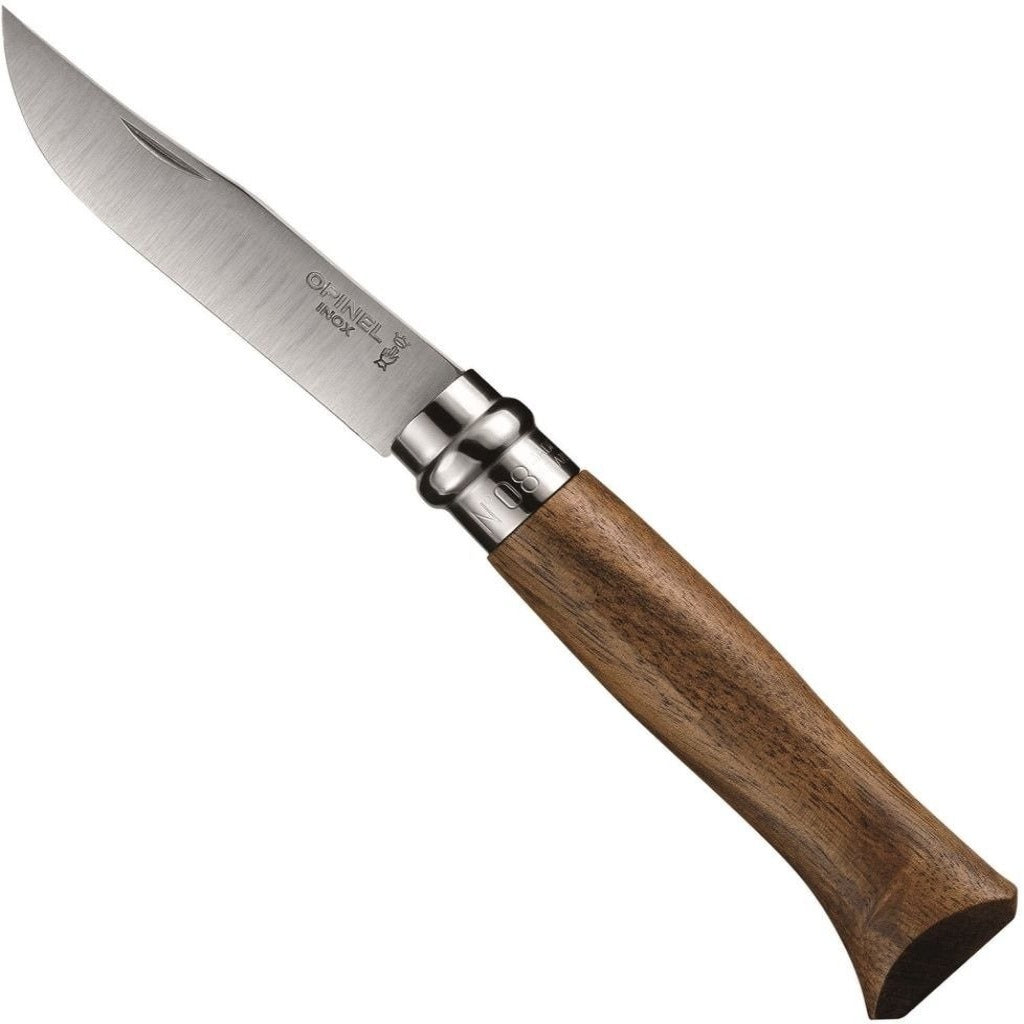
Overview
The Opinel No. 8 INOX has barely changed in more than a century: a beechwood handle, a slim blade, and a rotating steel ring that locks everything in place. It weighs 45 g and costs around $20, which puts it among the lightest and cheapest real knives a hiker can carry. The trade-off is that it’s a slicer, not a prybar. Treat it as a food-and-string knife and it performs well beyond its price.
Key Specs
| Spec | Detail |
|---|---|
| Weight | 45 g |
| Blade steel | Sandvik 12C27 stainless (marked INOX) |
| Blade length | 82 mm |
| Overall length, open | 194 mm |
| Overall length, closed | 110 mm |
| Handle | Beechwood |
| Lock | Virobloc rotating safety ring (locks open and closed) |
| Opening | Two-handed (no thumb stud or hole) |
| Pocket clip / sheath | None |
| Made in | France |

Build your Gear Closet
View all of your gear in one place, create packing lists and hit the trail with confidence. Available on iOS, Android and the web.
Get StartedPerformance
Cutting. The Opinel’s reputation rests on its blade geometry. The profile is thin and narrow, and the grind is a shallow convex that runs very fine behind the edge. A forum tester who measured one found roughly 0.006 inch of steel behind the edge, and in a cardboard-slicing comparison it landed a close second to a purpose-built slicer. CleverHiker’s testers describe it as excelling at soft foods, and Gear Junkie’s reviewer praised its out-of-the-box sharpness. Cheese, salami, tomatoes, apples and bread are the intended targets. On a thru-hike, that covers most of what a knife is asked to do.
Edge retention and sharpening. Sandvik 12C27 is a common, low-cost Swedish stainless. It’s easy to put an edge on and easy to touch up, but it won’t match premium steels for edge life. CleverHiker found that it holds an edge adequately but needs honing more often than pricier knives. Gear Junkie scored the steel a modest 6.8 out of 10, and the knife an 8.2 overall. The convex grind trips up guided sharpening systems, so a stone, a strop or a pocket sharpener like the Lansky Quick Fix suits it better. Retailer listings put the hardness around 55–57 HRC. That’s soft enough to sharpen easily and, as owners find, soft enough to dull on abrasive work.
Lock and safety. The Virobloc ring is the knife’s signature. Twist it to lock the blade open, and since a 2000 update, twist it again to pin the blade closed, so it can’t open in a pack lid pocket. Testers describe it as simple and reliable, and CleverHiker measured little blade wobble under pressure. The catch is that the lock is manual. If the ring isn’t turned, the blade can fold on the fingers. Reviewers also note that the knife needs two hands to open, which is a slow, fiddly business with cold or wet fingers.
Strength. This isn’t a baton-and-pry knife. The blade is thin, and reviewers warn it can bend under heavy lateral pressure. Gear Junkie’s testers made the same point about folding knives in general, with the Opinel at the light end of the spectrum. A knife this size has no business splitting kindling, and owners who try it tend to learn that once.
Weather and care. The stainless blade doesn’t patina or rust the way Opinel’s carbon-steel version does, which is the main reason hikers choose INOX. Moisture is still a concern for the rest of the knife. CleverHiker found the beechwood handle is susceptible to moisture, and the collar and grooves can trap debris and water. Owners report that a swollen handle or a wet ring can make the lock stiff. The fix is to let the knife dry before locking it closed, and to wipe it down after cutting food. That’s a small tax for a 45 g tool.
Carry. At 110 mm closed, the knife is slim and round, with no clip, no sheath and no hole for a lanyard. It slides into a hip-belt pocket or a food bag without notice. Compare that with a Buck 110 at over 7 ounces, and the Opinel is a fraction of the weight for the same camp-kitchen duties.
Pros & Cons
Pros
- 45 g, among the lightest full-size folding knives available
- Thin blade slices food cleanly and arrives very sharp
- Stainless steel needs far less care than the carbon version
- Simple lock that secures the blade both open and closed
- Typically about $18–22
- Easy to resharpen in the field
Cons
- Two-handed opening is slow, especially in gloves or the cold
- Manual lock must be turned each time; the blade can fold if it isn’t
- Thin blade is not suited to prying, twisting or heavy cutting
- Wooden handle and ring need drying to avoid swelling and stiffness
- 12C27 needs more frequent honing than premium steels
- No clip, sheath or lanyard hole
Who Should Buy This
This knife suits the ultralight and thru-hiker who wants a real blade for cheese, sausage, fruit, cord and the occasional cuticle fix, without carrying a multi-tool or a heavy lock-back. It also suits anyone who prefers a proper full-size handle to a keychain knife. Hikers who expect to batton wood, pry, or work with gloves on should look at a fixed blade or a sturdier folder with one-hand opening. Anyone who wants to cut as little weight as possible might try the smaller No. 6 or No. 7, but the No. 8’s handle fills the hand in a way those don’t.
Verdict
The Opinel No. 8 INOX does a narrow job at a price that is hard to argue with. It’s light, sharp, simple and forgiving of neglect, as long as the handle gets dried. For camp kitchen and general cutting, it earns a place in most ultralight kits.