Opinel No. 06 Stainless Steel Folding Knife Review
A 28g ultralight French folding knife with a 70mm Sandvik 12C27 blade — hard to beat for trail food prep at any price.
Overview
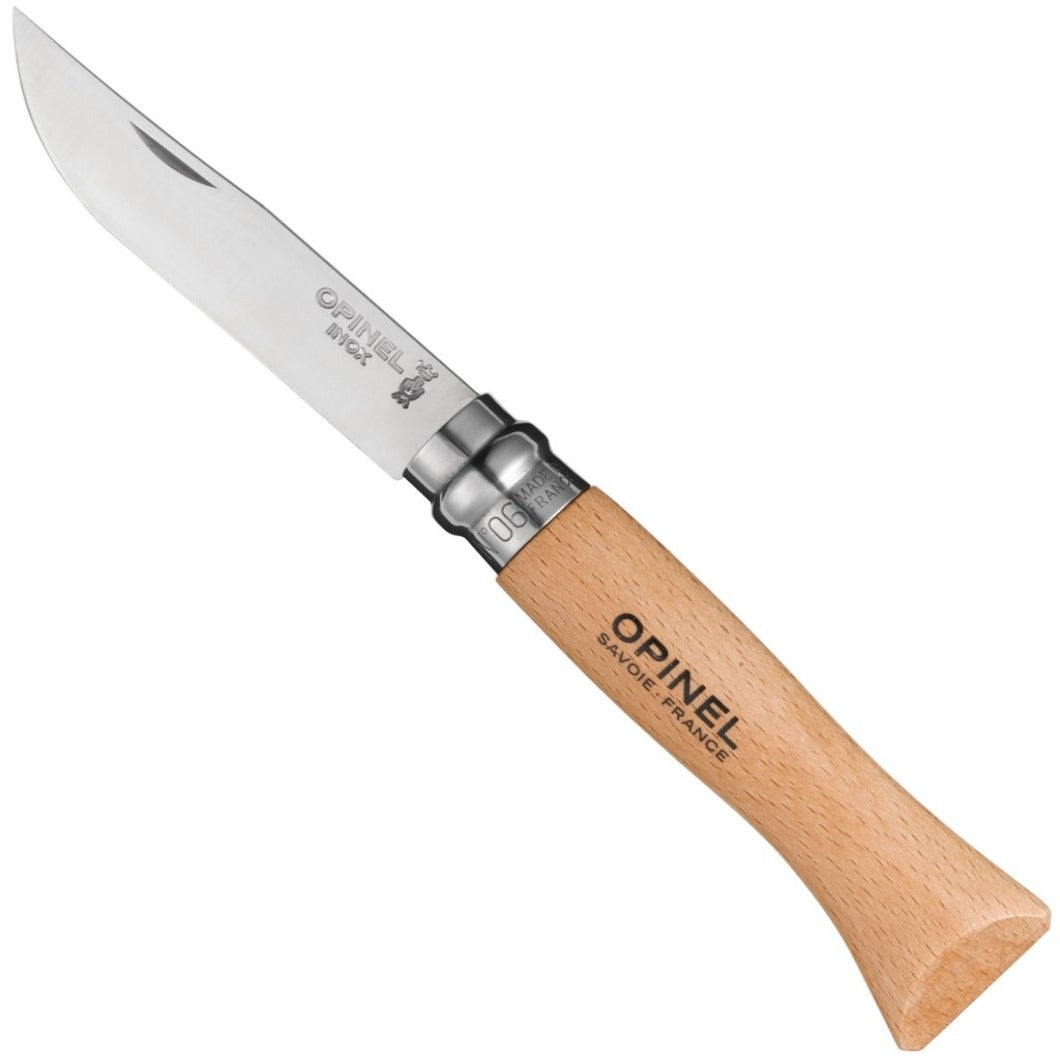
The Opinel No. 06 is a single-blade folding knife that has existed, essentially unchanged in concept, since Joseph Opinel started cutting metal in the French Alps in 1890. When Opinel designed his first pocket knife, he created a tool that was robust, simple, and beautiful — and 130-plus years later, that’s still a fair description. At 28g with a 70mm blade, the No. 06 stainless is aimed squarely at ultralight backpackers, day hikers, and anyone who wants a real cutting tool without carrying real weight.
Key Specs
| Spec | Value |
|---|---|
| Weight | 28g (1.0 oz) |
| Blade Length | 70mm (2.75 in) |
| Overall Length (Open) | 168mm (6.6 in) |
| Overall Length (Closed) | 94mm (3.7 in) |
| Blade Thickness | 1.4mm |
| Blade Steel | Sandvik 12C27 stainless |
| Hardness | 55–57 HRC |
| Handle Material | Beechwood |
| Locking Mechanism | Virobloc® safety ring |
| Made In | France |
| Price | ~$15 |

Would the No. 06 Stainless Steel Folding Knife earn its spot in your pack?
28 g · 1.0 ozAdd the Opinel No. 06 Stainless Steel Folding Knife to your Gear Closet and see exactly what it does to your base weight, then start packing for your next trip.
Free · No credit card · iOS, Android & web · Trusted by 3,000+ backpackers
Performance
Cutting Performance
This is where the No. 06 earns its reputation. The blade is designed for one thing: cutting. The blade stock is remarkably thin, and a full-height convex grind ensures exceptional slicing performance. In practice, that geometry means the knife glides through cheese, salami, apple slices, and bread with almost embarrassing ease for something that weighs less than five nickels. For backpacking, day walks, or fishing, this little knife does everything one could ask for — from cutting slices of cheese to cutting cordage.
The 70mm blade length is a genuine conversation in the ultralight community. The Opinel No. 6’s 70mm (2.75 inch) blade hits the sweet spot for most backpackers. That said, if your trail cooking leans toward block vegetables or whole onions, the shorter blade demands more patience than the No. 08’s 85mm would. The length can be a little limiting — it’s perfectly suitable for food prep while camping, but if you’re cooking with bigger ingredients, you may want something larger.
Steel: Sandvik 12C27
Opinel’s choice of Sandvik 12C27 for the stainless version is a solid one for the trail context. Compared with other stainless steels in its class, 12C27 favors strength and consistency over extreme edge retention. It doesn’t wear as slowly as high-vanadium or powder metallurgy steels, but it sharpens faster and holds a clean edge longer than softer alloys like 420HC. This balance keeps it relevant for users who want quality performance from a conventional stainless steel.
Practically speaking, Sandvik 12C27 retains its sharpness well, the chrome content ensures it is highly resistant to rust and stains, and it can easily be used in humid environments. Despite its hardness, it’s relatively easy to sharpen. The HRC sits at 55–57 on this knife — the lower end of the steel’s achievable range — which means edge-touching in the field is straightforward with even a ceramic rod or the smooth bottom of a mug. If you’ve been burned by cheap knives that won’t take or hold an edge, 12C27 is a meaningful step up without requiring exotic sharpening tools.
The flip side: edge retention falls short of modern powder-metallurgy steels, requiring more frequent maintenance for users who cut abrasive materials regularly. For trail tasks — food prep, cutting cord, occasional first aid duties — that’s rarely a problem on trips under a week.
The Virobloc Ring
The locking function is simple but impressive — Opinel calls this its Virobloc double safety ring, and it consists of a shiny metal ring that is easy to rotate.
To lock, simply twist the locking ring clockwise into the closed position during transport; turn counterclockwise to prevent the blade from folding during use.
The honest critique: the Virobloc collar is simple enough to use, though it’s arguably impractical for quick use. There is enough friction and lack of grip to dissuade the user from engaging the lock for a simple task — but for extended use, carving, or similar work, it’s certainly a benefit. I’d put it this way: you won’t lock and unlock it every time you cut a piece of food, but you’ll absolutely engage it before the knife goes into your hip belt pocket. That’s a reasonable compromise.
Also worth noting: there’s no thumb stud or flipper. Opening requires two hands and the small nail nick. Not ideal in conditions where your other hand is occupied.
The Beechwood Handle and Moisture
This is the No. 06’s most-discussed weakness, and it deserves a straight answer. The No. 6 can swell and become tough to open when it gets thoroughly wet. If you have concerns, the first thing you should do is seal the wood, especially the exposed end grain where most moisture is introduced and causes swelling. You can use linseed oil, mineral oil, melted wax, wood sealer, or shellac. A coat of mineral oil before your first trip takes about five minutes and dramatically reduces the risk. Done right, even submerging the knife in water for up to half an hour hasn’t made treated examples too tight to open — they get a bit stiff, but still doable, and after a few hours the wood dries out.
The handle grip itself is comfortable and warm in hand. The slim, rounded beechwood profile suits light slicing work well, but it’s not ideal for heavy-duty tasks — if your daily life involves building wilderness shelters, batoning firewood, or rope access, you’ll need a different product.
Pros & Cons
Pros
-
Genuinely ultralight at 28g — it weighs a negligible 27–28 grams, competitive with almost any folding knife on the market
-
Exceptional blade geometry for slicing; the thin, convex grind outcuts knives costing five times as much on food prep tasks
-
Remarkable affordability — around $15–19 for the stainless steel version
, low enough that loss or damage isn’t a catastrophe
-
12C27 stainless is field-sharpenable with basic tools and holds up better in wet conditions than the carbon version
-
Manufactured in Chambéry, France with consistent quality control
-
Virobloc locks the blade both open and closed — a safety feature many ring-lock designs skip
Cons
- Beechwood handle swells in sustained wet conditions without pre-treatment — a real field issue, not a theoretical one
- No one-handed opening; two-hand operation only via the nail nick
- No pocket clip; you’re carrying it loose in a pocket or hip belt pouch
- The Virobloc ring offers limited grip and can discourage consistent use of the open-lock during quick tasks
- 70mm blade is slightly short for ambitious camp cooking compared to the No. 07 or No. 08
- Not suited for prying, batoning, or any task requiring lateral force on the blade tang
Who Should Buy This
This knife makes most sense for traditionalists, camp/bushcraft enthusiasts, ultralight backpackers, and people looking for a solid knife at a very affordable price.
More specifically: if your trail knife duties are primarily food prep, cord cutting, and occasional first aid use — and you want to carry under an ounce — the No. 06 stainless is hard to argue with.
If all you’re after is a straight cutting blade, the Opinel range provides a better blade-to-weight ratio than competing options at the same price.
Pre-treat the handle before your first wet trip, and you’re unlikely to be disappointed. Step up to the No. 07 or No. 08 if you want a slightly longer blade for more ambitious cooking without sacrificing the design’s core virtues.
Verdict
The Opinel No. 06 stainless is one of those rare pieces of gear where the value-to-performance ratio is genuinely difficult to find fault with. At 28g and around $15, it slices better than knives at three times the price, the Sandvik 12C27 steel is honest and field-serviceable, and the Virobloc lock works as advertised. The beechwood swelling issue and two-handed opening are real limitations — treat the wood and manage your expectations on one-handed deployment. For ultralight hikers who want a dedicated slicing blade and nothing more, this earns an 8/10.