Opinel No. 06 INOX Review
The Opinel No. 06 INOX is a 34 g French folder with a thin convex-ground 12C27 blade and a locking ring. It's a trail kitchen knife at a pocket-change price.
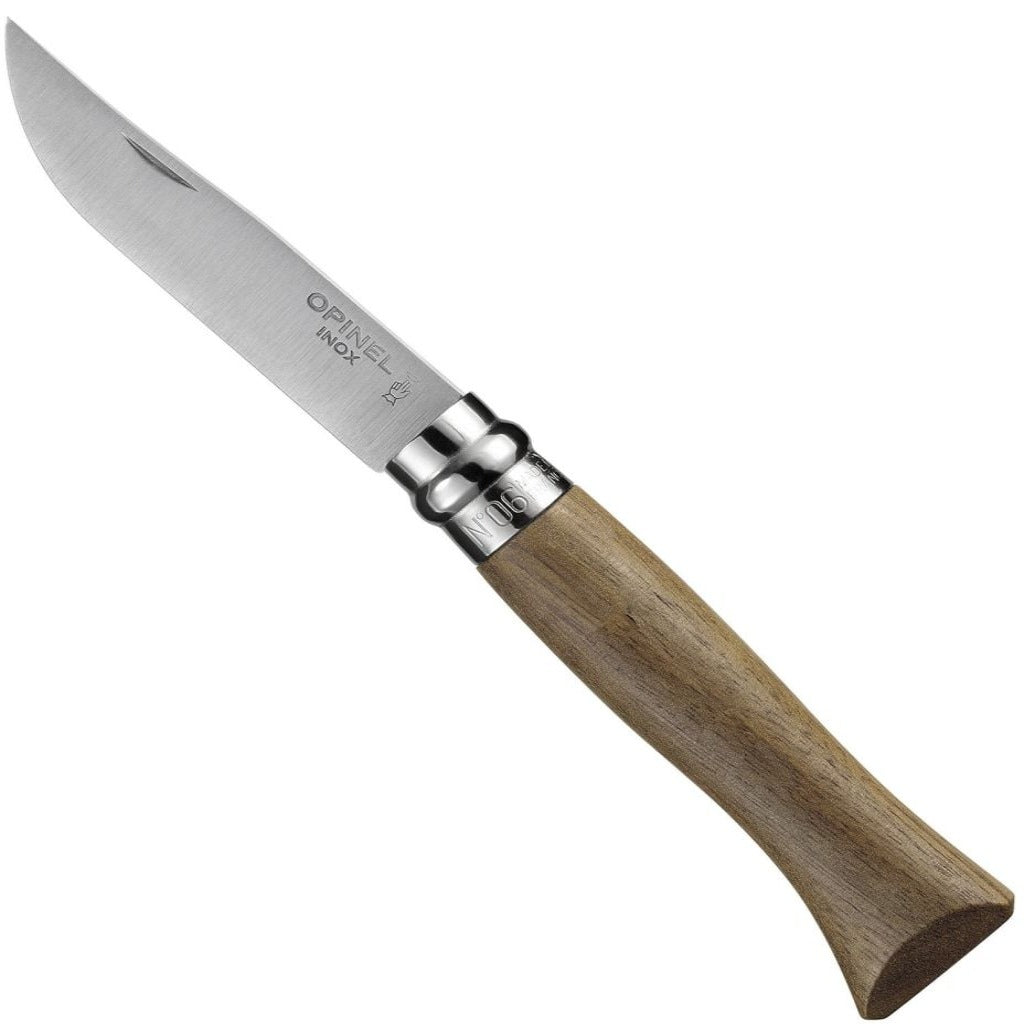
Overview
The Opinel No. 06 INOX is the smallest knife in the French company’s line to carry the Virobloc locking ring. It pairs a stainless Sandvik 12C27 blade with a varnished beechwood handle, in a design that has barely changed in a century. It suits backpackers who want a real slicing tool for cheese, salami and cordage without paying a weight penalty. The trade-off is that the blade is tuned for cutting, not prying, batoning or one-handed fiddling.
Key Specs
| Spec | Value |
|---|---|
| Weight | 34 g (1.2 oz) |
| Blade length | 2.87 in |
| Overall length (open) | 6.5 in |
| Closed length | 3.63 in |
| Blade steel | Sandvik 12C27 modified stainless |
| Hardness | 55–57 HRC |
| Blade grind | Full convex |
| Lock | Virobloc safety ring (locks open and closed) |
| Handle | Varnished beechwood |
| Origin | France |
| List price | about $19 |

Would the No. 06 INOX earn its spot in your pack?
34 g · 1.2 ozAdd the Opinel No. 06 INOX to your Gear Closet and see exactly what it does to your base weight, then start packing for your next trip.
Free · No credit card · iOS, Android & web · Trusted by 3,000+ backpackers
Performance
Cutting. The No. 06 earns its reputation on the blade. The stock is thin and the grind is convex from spine to edge, so the knife slices where thicker-bladed folders wedge. Owners on Blade Forums describe it as thin enough to out-slice the other folders in their collections. On the trail, that means cheese, salami, apples, bread and the occasional length of cord are handled with little effort. Reviewers who have used it for bushcraft and camp chores say it does the everyday jobs a hiker is likely to ask of a small knife.
Steel. Opinel’s stainless blades use Sandvik 12C27 modified stainless, hardened to 55–57 HRC. The company says the chromium content makes the blade corrosion-resistant and that it needs no special maintenance. The carbon content of at least 0.40% gives a keen edge that is easy to sharpen. That fits the trail context. The steel will not hold an edge as long as a high-vanadium or powder-metallurgy alloy. But it is simple to touch up in the field with a small stone or ceramic rod, and it does not rust the way Opinel’s carbon-steel version does. Carbon-steel loyalists praise their blades’ ease of sharpening and edge-holding. They also accept darkening, or “patina”, as the price of ownership. Hikers who spend days in rain, salt air or acidic foods will find the INOX the lower-maintenance option.
Weight and carry. At 34 g, the No. 06 is about the weight of a few packets of electrolyte mix. Owners repeatedly say they forget it is in the pocket, and it folds to 3.63 inches. Few folding knives with a locking blade and a full-size handle get this light. The beech handle is slim and rounded, and it feels warm in the hand. It is comfortable for light-to-moderate cutting, though the thin profile will tire a hand during long carving sessions.
Lock and opening. The Virobloc is a stainless ring with a fixed section and a sliding section, invented by Marcel Opinel in 1955. Rotating it locks the blade in either the open or closed position. It is simple and resists jamming from sand, salt or fruit juice. There is no thumb stud or flipper: the blade opens by pinching a nail nick, and the ring must be twisted by hand. That is slower than a modern clip-and-flick folder. It is also with gloves on, in cold fingers, or one-handed with a pack strap in the other. The ring is also a strength limit. The knife is a slicer, not a pry bar, and the thin blade should not be twisted in wood.
Moisture. Wooden handles swell. Owners report that a damp spell can leave the blade stiff to open. The usual fix is to pinch the blade out and let the knife dry. The retailer guidance is to dry the blade before folding it. A varnished beech handle protects against moisture and dirt. It is not waterproof, so the knife should not be left soaking in a wet pack pocket day after day.
Pros & Cons
Pros
- 34 g with a full-length 2.87-inch blade and a true locking mechanism
- Thin convex blade slices food and cord with very little effort
- Stainless 12C27 resists rust and sharpens easily in the field
- Virobloc locks the blade both open and closed, and resists grit
- Around $19, with a long record as a camp and trail knife
- Made in France; the company offers a limited lifetime warranty
Cons
- No thumb stud or flipper; opening takes two hands, or a practiced pinch
- Ring lock is awkward with gloves or cold hands
- Beechwood handle can swell when damp and make opening stiff
- Moderate edge retention compared with premium steels
- Thin blade is not suited to prying, batoning or heavy carving
- Short blade is slow on whole onions or large vegetables
Who Should Buy This
This is the knife for the ultralight hiker whose cutting list is food, cord, moleskin, a bit of gear repair and the occasional package. Thru-hikers who already carry a bladed tool they rarely use will find it a lighter, sharper replacement. Weekend campers and bushcraft hobbyists get a cheap, sharp second knife that earns its keep. Anyone who wants rust resistance with no patina management should choose this INOX version over the carbon-steel No. 06.
Those who expect to baton kindling, pry lids or open a blade with one hand should look elsewhere, perhaps at a fixed blade or a modern lockback with a thumb stud. Hikers who regularly prepare whole vegetables will find the larger No. 08 more comfortable, at the cost of extra grams.
Verdict
The No. 06 INOX does one job, slicing, and does it better than most knives that cost several times as much and weigh more. The ring lock and wood handle ask for a bit of care and a bit of patience. For an ultralight kit, though, the weight-to-sharpness ratio is hard to beat. It earns a strong recommendation for anyone whose trail knife is mainly a kitchen tool.