Opinel N°08 Olive Wood Review
Packstack is reader-supported. When you buy through links on our site, we may earn an affiliate commission. This does not affect the independence or objectivity of our reviews.
A review of the Opinel N°08 Olive Wood folding knife — a French icon with a stunning handle, razor-sharp Sandvik 12C27 blade, and real-world limitations for wet-weather backpacking.
Overview
Opinel has been crafting knives in the heart of the French Alps for over 130 years, still manufacturing products from their factory in Chambéry, France.
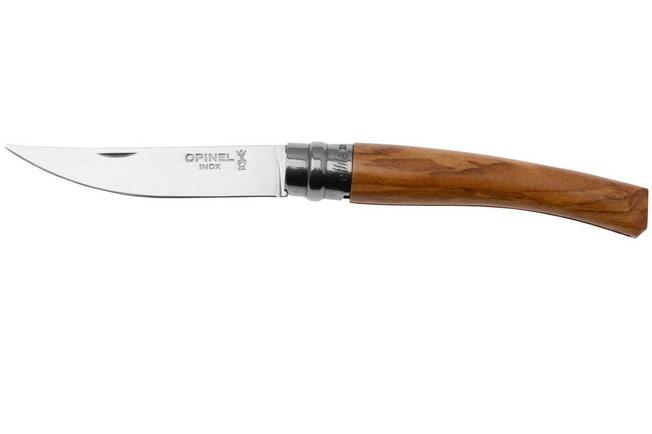
The N°08 Olive Wood is the brand’s most popular size dressed up in its “luxury” finish —
the unique olive wood grain gives this Savoyard knife a distinctly Mediterranean feel
while the underlying knife remains the same stripped-down folder generations of hikers, farmers, and chefs have relied on. At 50 g with a Virobloc-locked 8.5 cm blade, it’s squarely aimed at backpackers and day hikers who want a capable food-prep knife that doubles as a pocket carry without weighing anything worth worrying about.
Key Specs
| Spec | Value |
|---|---|
| Weight | 50 g (1.76 oz) |
| Blade Length | 8.5 cm (3.35 in) |
| Overall Length | 19.5 cm (7.68 in) |
| Blade Steel | Sandvik 12C27 stainless |
| Blade Hardness | 55–57 HRC |
| Handle Material | Olive wood (varnished) |
| Locking Mechanism | Virobloc® safety ring |
| Country of Origin | France |
Would the N°08 Olive Wood earn its spot in your pack?
50 g · 1.8 ozAdd the Opinel N°08 Olive Wood to your gear closet and see exactly what it does to your base weight — then build your next packing list around it. Free, in about two minutes.
Free · No credit card · iOS & Android · Trusted by 3,000+ backpackers
Performance
Cutting ability
This is where the Opinel earns its reputation. Opinel’s result is a thin, convex-ground, clip-point blade shape; the stainless straight-edge blade holds an edge but responds well to attentive resharpening. Out of the box the factory edge is genuinely impressive — the out-of-the-box sharpness is surprisingly good, better than some more expensive knives. On trail, this translates to a knife that handles camp food prep better than almost anything else in the folding-knife category. This knife is a dream for cutting food and other softer items — the blade virtually cuts under its own low weight. The thin, slightly hollow grind means it passes through cheese, salami, and fruit with almost no lateral pressure. For heavier work, the limits show up quickly: for tougher tasks like cutting rope and webbing, the narrowness of the blade, the friction-hinge, and the natural give in a wooden handle feel a little flexible — it does the job, but it sometimes feels as if you are pushing harder than the knife is designed for.
Blade steel and sharpening
Sandvik 12C27 is a stainless steel with a hardness of 55–57 HRC — fairly abrasion resistant and able to hold a decent edge for an extended period, and also fairly easy to sharpen when the time comes.
That said,
Sandvik 12C27 could stand to retain its edge a bit longer.
This is the honest trade-off: the steel isn’t in the same league as CPM-S30V or VG-10 for edge retention, but the flip side is that
it’s incredibly easy to sharpen in the field with a basic stone.
Opinel recommends an 18–20° sharpening angle, and even a cheap pocket diamond rod will have it biting again in minutes.
The Virobloc lock
Invented by Marcel Opinel in 1955, the Virobloc safety ring is fitted to all folding knives from the N°06 — cut out of stainless steel, it has two sections (one fixed, one sliding) that lock the blade both open and closed.
In dry conditions it’s smooth and intuitive: twist to lock open before use, twist back to lock closed for transport. Sand and grit can jam the rotation, which is something to keep in mind if you’re carrying this through sandy or particularly gritty terrain. A quick rinse and dry solves it, but it’s worth knowing before a high-use multi-day.
The olive wood handle and moisture sensitivity
The handle in olive wood is hard, resistant, and offers a pleasant grip.
Olive wood has a yellow to orange appearance with a dense and often tortuous veining; it is soft to the touch with a nice polish, and the handle is varnished to protect it from moisture and dirt.
In dry conditions the round, slightly bulbous shape is comfortable for extended cutting sessions — no hot spots, no sharp edges.
Here is the catch that every prospective owner needs to understand: humidity, atmospheric conditions, and the wood used for the handle can all affect the folding mechanism — as wood contracts and expands due to humidity it will hold the blade tighter or looser. Opinels will swell and the blade can become almost impossible to open; just wait for it to dry, and it will return to normal. The olive wood and its factory varnish offer somewhat better moisture resistance than raw beech, but they are not immune. There is also a practical reason the olive wood version ships exclusively in stainless: olive wood contains oils that are very corrosive and would simply deteriorate a carbon blade regardless of how well you maintain it. The stainless pairing is not a style decision — it’s a necessary one. If you’re heading into a consistently wet environment, pre-treat the exposed end grain with mineral oil, linseed oil, or beeswax before your trip. It makes a meaningful difference.
Portability
At 1.5–1.76 ounces, the weight is barely noticeable, though the round profile handle takes up more pocket space than a flatter-handled style.
The main disadvantage is that there is no pocket clip or lanyard hole — the only viable way to carry it is loose in your pocket, but thankfully the low weight and smooth wooden external profile make this a reasonable proposition.
That smooth varnished olive wood does get slicker when your hands are wet, which is worth factoring in for rain or cooking cleanup situations.
Opening mechanism
This is a two-hand opener, full stop. There is a nail slot in the blade, and that is how you open it. If you want a knife that can be opened with one hand, the Opinel No. 8 may not be the best fit. This is a genuine ergonomic limitation on the trail, especially with cold or gloved hands. There is a well-known workaround — tap the heel of the handle firmly on a hard surface with the locking ring open, and the blade pops out just enough to grip — but it is not a one-handed draw in any meaningful sense.
Pros & Cons
Pros
- Absurdly light for a knife with an 8.5 cm blade — 50 g all-in
- Factory edge is genuinely sharp out of the box
- Sandvik 12C27 is fast and easy to restore in the field with a basic stone
- The Virobloc locks blade open and closed — genuinely useful for pack carry
- Olive wood handle is one of the most attractive handles in this price category
- Varnished finish adds meaningful moisture protection over raw beech
- Stainless-only pairing with olive wood is the correct choice
- Made in France; design essentially unchanged for over 135 years
- Widely available; very affordable even in the “luxury” olive wood variant
Cons
- Two-hand-only opening is a real limitation for cold, wet, or gloved conditions
- No pocket clip or lanyard hole
- Wood swelling in high humidity can lock the blade — requires proactive treatment or drying time
- Smooth varnished handle reduces grip when wet
- Sandvik 12C27 needs more frequent sharpening than premium steels (S30V, VG-10, etc.)
-
Its vulnerability to moisture makes it risky for a long, wet thru-hike
- Not suited for heavy-duty cutting tasks; the thin blade flex is noticeable under hard use
Who Should Buy This
This knife was built for the camp cook, not the bushcrafter. If your backpacking knife use is 90% food prep — slicing cheese, bread, and fruit at camp — and 10% cutting cordage or opening packages, the N°08 Olive Wood performs that role better than almost any folder in its price range. It cuts food better than knives costing ten times as much, making it a solid primary knife for hiking and backpacking when conditions are reasonable. It also excels as a picnic or travel knife — available almost anywhere knives are sold and inexpensive enough that it’s not the end of the world if you’re required to ditch it at an airport. The olive wood version adds a premium aesthetic that makes it a genuine pleasure to carry. Skip it if you’re thru-hiking somewhere reliably rainy (think: the Olympics, the AT in spring), or if you need one-handed deployment.
Verdict
The Opinel N°08 Olive Wood is a near-perfect camp kitchen knife dressed in one of the most beautiful handles in the folding-knife category at this price. The moisture sensitivity and two-handed opening are real constraints for serious backcountry use — not dealbreakers, but honest limitations that determine whether this knife is the right tool for your particular kit. Buy it, treat the wood before your first trip, keep it dry, and it will outlast most of the gear around it. Rating: 7/10.