MSR Mini-Groundhog Stakes Review
The MSR Mini-Groundhog Stakes offer the trusted Y-beam holding power of the full Groundhog at 9.4g per stake — a smart, lightweight upgrade for most backpacking shelters.
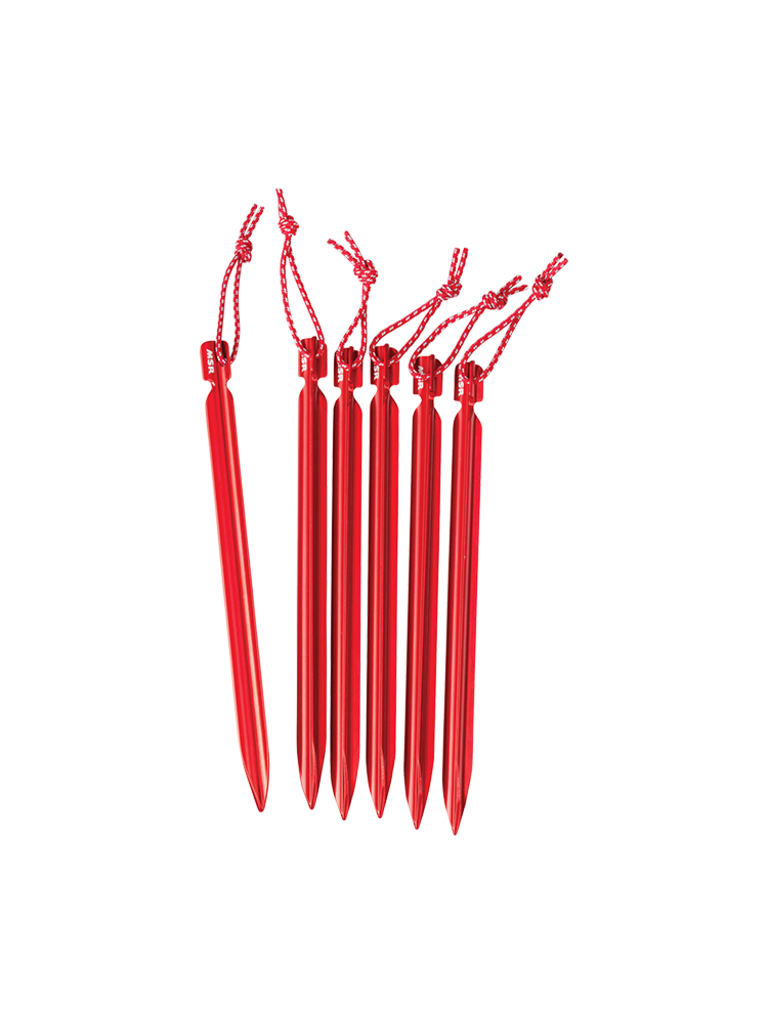
Overview
The MSR Mini-Groundhog is a 6-inch, 7000-series aluminum Y-beam stake sold in a kit of 6, aimed squarely at weight-conscious backpackers who want a meaningful upgrade over the shepherd-hook stakes their tent shipped with. It’s a smaller, lighter version of MSR’s popular Groundhog stake, designed to save weight while offering the reliable performance of the original. At 9.4g per stake, it threads a real needle: light enough to justify replacing standard included stakes, strong enough to actually hold your shelter in the conditions most thru-hikers encounter.
Key Specs
| Spec | Detail |
|---|---|
| Weight per stake | 9.4g (0.33 oz) |
| Kit weight | 56.4g (2.0 oz) for 6 stakes |
| Length | 6 in (15 cm) |
| Material | 7000-series aluminum |
| Cross-section | Y-beam |
| Kit quantity | 6 stakes |
| Removal aid | Pull loop (cord) |
Would the Mini-Groundhog Stakes earn its spot in your pack?
56 g · 2.0 ozAdd the MSR Mini-Groundhog Stakes to your gear closet and see exactly what it does to your base weight — then build your next packing list around it. Free, in about two minutes.
Free · No credit card · iOS & Android · Trusted by 3,000+ backpackers
Performance
Holding Power
The proven Y-beam design penetrates and holds in medium to firm soil.
That caveat — medium to firm — is the most important spec on the page. In hard-packed dirt, rocky trail soil, and compacted forest floors, these things dig in and stay put.
Users have run them in hard soil in the Colorado Rockies without a single failure.
They’ve been tested in many different soil conditions with solid results, excelling in hard-packed ground.
The Y cross-section is what separates these from the cheap stakes that come standard with most tents. The equal-sided Y shape, with guy-line notches on all three legs, is lightweight, fairly compact, and offers better than average holding power. It’s also non-directional — you don’t have to fumble with orientation in low light, which is a genuinely useful detail at the end of a long day. Y-stakes pack a lot of surface area into a fairly light weight, giving them excellent ability to grip the soil.
One quantified pull-out test found the Mini Groundhog competitive with stakes of similar weight class, though it holds about as well as other stakes of similar weight — stakes in this weight class obviously don’t have the holding power of heavier options like the full Groundhog or Easton 8”. That’s fair and expected. The trade-off is conscious and worthwhile for most applications.
Stake Angle Matters More at 6 Inches
The biggest real-world limitation isn’t the Y-beam design — it’s the 6-inch length. Angle becomes very important with these shorter models. In firm soil that’s no problem; push them in at roughly 45 degrees from vertical, angled away from the load, and they’ll hold. But in deep, loose duff that’s soft for several inches, the short ones won’t cut it. If your routes include boggy forest floors, coastal sand, or deep organic soil, bring the full-size Groundhog (7.5”) or plan to supplement with rocks and natural anchors.
A common and practical solution in the community: use full-size Groundhogs for main stake points and Mini-Groundhogs for lower-tension guylines to save weight.
Durability and the Weak Point
Made of 7000-series aluminum, the Mini-Groundhogs feel very light in hand but can take a fair amount of punishment — and if looked after, they’ll last a very long time.
7000-series aluminum is meaningfully more resistant to bending and denting than 6000-series.
That said, there is a known failure mode to be aware of: the aluminum construction makes them more prone to breaking or bending than titanium alternatives, and the thin neck at the notch that helps keep guylines in place is an obvious weak point. One hiker on the JMT bought 4 of them in Mammoth and broke 2 during the hike, both at the narrowing of the stake. That typically happens when you hammer them aggressively into frozen or extremely rocky ground — you should never hammer ultralight stakes. Use foot pressure or moderate rock tapping; if the ground won’t accept a stake without serious force, it’s telling you something.
One user reported a mini stake breaking when trying to drive into frozen soil
— not a surprise given the design, but worth flagging if you’re venturing into early-season alpine terrain.
The Pull Loop
A pull loop allows for easy removal. In practice, users are split: in firm soil, the loop earns its keep; in very hard ground, you may need to work at it regardless.
The pull loops can come off a couple of times in heavy use — re-tying them with a more secure knot keeps them in place.
A minor durability gripe, not a dealbreaker.
Visibility
The red anodized finish is a practical plus. The bright color makes it easy to spot stakes if you happen to misplace any. This is a legitimate benefit versus bare-metal titanium hooks, which are genuinely easy to leave behind in leaf litter.
Pros & Cons
Pros
- 9.4g per stake is genuinely ultralight for a Y-beam design
-
Strong hold for such a short, light stake with overall versatility across multiple ground types
- Non-directional Y cross-section; easy to orient and set in the dark
- Red anodized finish aids campsite visibility and stake retrieval
- 7000-series aluminum resists bending better than cheaper alloys
- Sold as a kit of 6 — enough for most tarp and single-wall tent setups
Cons
- Only rated for medium to firm soil — soft sand, deep duff, and snow will beat them
- 6-inch length means placement angle is more critical than with the 7.5” full Groundhog
- Thin neck at the wire notch is a break risk if hammered into frozen or rocky ground
- Pull cord loop can loosen and require re-tying after heavy use
-
Can be hard to remove by hand in firm, hard soil despite the help of the pull cord
- Per-stake cost is higher than generic Y-stake clones; six stakes add up
Who Should Buy This
The Mini-Groundhog is the right stake for a weight-conscious backpacker running a single-wall tent, a trekking-pole shelter, or a tarp on routes with typical trail soil — hard-packed dirt paths, alpine rock, or compacted forest floors. It’s a smart pick for PCT, JMT, and Rockies terrain where firm ground is the norm. If your routes regularly include soft coastal soil, boggy forest, or snow camping, reach for the full-size Groundhog instead, or use the minis only for lower-tension guylines.
Verdict
The MSR Mini-Groundhog earns its reputation as a near-consensus “baseline” stake in the ultralight community. At 9.4g with legitimate holding power in firm soil, it beats shepherd hooks on grip and beats heavier Y-stakes on weight — and the 7000-series aluminum construction means they’ll outlast most of what they’re competing against. The 6-inch length and soft-soil limitations are real constraints, not marketing fine print, so match them to your terrain. For most three-season routes, they’re the sensible default. Rating: 8/10.