Light My Fire Swedish FireSteel BIO Scout 2in1 Review
Light My Fire's 38 g Scout FireSteel pairs a 3,000-strike ferrocerium rod with a stainless striker and 120 dB whistle, a durable backup to a lighter.
Overview
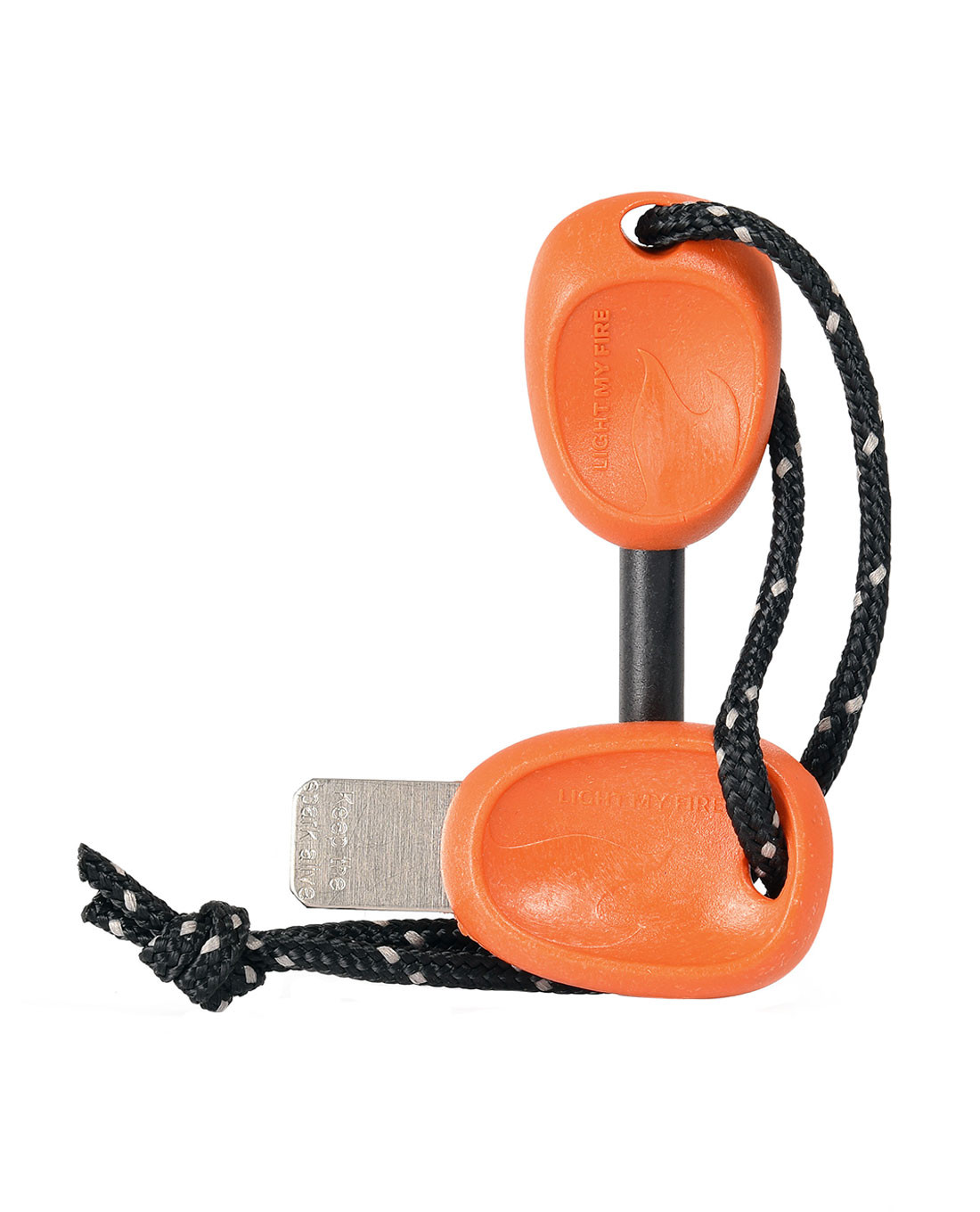
The Swedish FireSteel BIO Scout 2in1 is Light My Fire’s small-format ferrocerium rod. It pairs a stainless steel striker with a built-in emergency whistle, and its handles are molded from bio-based plastic. It suits backpackers who want a fire source that works wet, at altitude, and after years at the bottom of a pack. The trade-off is plain: it weighs about 16 g more than a mini Bic and asks for some technique in return.
Key Specs
| Spec | Detail |
|---|---|
| Weight | 38 g |
| Dimensions | 77 x 25 x 15 mm |
| Rated strikes | Up to 3,000 |
| Spark temperature | 2,980°C / 5,400°F |
| Rod material | Pyrophoric alloy (iron, magnesium, lanthanum, cerium) |
| Striker material | Stainless steel 12C27 |
| Handle material | Terralene bio-plastic |
| Whistle | 120 dB, built into the striker |
| Made in | Sweden |
| Price | About $15 at the official store |

Build your Gear Closet
View all of your gear in one place, create packing lists and hit the trail with confidence. Available on iOS, Android and the web.
Get StartedPerformance
A ferro rod doesn’t run out of fuel, doesn’t care about humidity, and doesn’t need a dry pocket. Those are the Scout’s strengths. Light My Fire’s design is simple. The striker is scraped down the rod, which shaves off tiny particles of pyrophoric alloy that burn as bright sparks. The company says the sparks reach roughly 3,000°C. The rod works wet and at any altitude, which a butane lighter can’t promise in the cold.
Owner reports describe a learning curve that is short but real. One Australian hiker who takes the Scout on nearly every overnight trip said it took some fiddling to find the right motion. After that, he got a spark in one or two strikes, even after months in the pack. Trailspace reviewers say the same thing in other words. Firm, committed scrapes produce the best sparks, and “baby scrapes” don’t. The rod ships with a protective coating that has to be scraped off before the first real use.
The sparks are only part of making a fire. Sparks are not a flame. Trailspace users note that tinder has to be fine for the sparks to catch. One user lit a downpour-soaked patch of dry grass after about 20 strikes. Another, who used the Scout in dry, breezy and wet conditions, said it lit a fire every time but took more work in some conditions than in others. In practice, that means carrying real tinder, such as cotton, fatwood or a commercial fire cube. It also means practicing at home, not at 2 a.m. in sleet.
Durability is the Scout’s other selling point. Light My Fire rates the rod at around 3,000 strikes. Its larger Army sibling is rated at about 12,000. For a backpacker lighting a stove or the occasional fire, 3,000 strikes is more than a lifetime of trips. One Trailspace owner reported that repeated use hardly smoothed the rod’s surface. The striker’s sharp-ground stainless edge is also designed to throw sparks efficiently without chewing up a knife spine.
The whistle is a useful extra, not a reason to buy. The 120 dB whistle is built into the striker. Backpackers who already carry a whistle on a sternum strap can drop that one and save the weight. Others may find it redundant, a point the Australian reviewer made himself.
On weight, the Scout is not the lightest option. At 38 g, it is about 16 g heavier than a compact Bic at roughly 22 g. Some Trailspace users say the form factor could be smaller. Gram counters who carry both a lighter and a ferro rod pay a weight penalty for the redundancy. Many ultralighters respond by carrying a lighter and leaving the Scout at home for short trips. The Scout makes more sense as the backup layer on trips where weather and remoteness raise the stakes.
The plastic handles are comfortable in the hand and give a decent grip for firm scrapes. The mix of materials is practical too, with Swedish manufacturing and a plant-based plastic that is fully recyclable.
Pros & Cons
Pros
- Works wet, in wind and at altitude, with no fuel to run out
- Rated for up to 3,000 strikes, enough for years of trips
- Integrated 120 dB whistle can replace a separate one
- Handles are grippy and the rod sits comfortably in the hand
- Made in Sweden from bio-based plastic, about $15 at the official store
- Also lights alcohol and gas stoves directly
Cons
- At 38 g, it is heavier than a mini Bic lighter
- Needs practice and firm technique to get good sparks
- Needs fine, dry tinder; sparks alone won’t light damp sticks
- The protective coating must be scraped off before first use
- The whistle is useful but not a deciding factor
Who Should Buy This
This is for backpackers and thru-hikers who want a reliable backup fire source that survives rain, cold and neglect. Weekend campers who light stoves and fires will also get years of use. It is also a good fit for scouts and for anyone assembling an emergency kit, where the rod and whistle go in a pouch and stay there. Gram-counting hikers who never light fires and rely on stove-only cooking should skip it and carry a lighter. Anyone who has never practiced with a ferro rod should expect to spend an evening learning the stroke before relying on it.
Verdict
The Scout is a durable and reliable fire starter at a fair price, and the whistle makes the 38 g easier to justify. It won’t replace a lighter for everyday stove use, but as a backup that works when everything else is soaked, it earns its pocket. Buy it, practice with it, and pair it with good tinder.