DAC J-Stake Review
A deep dive into the DAC J-Stake — the ultralight TH72M aluminum tent stake that ships with some of the best lightweight tents on the market.
Overview
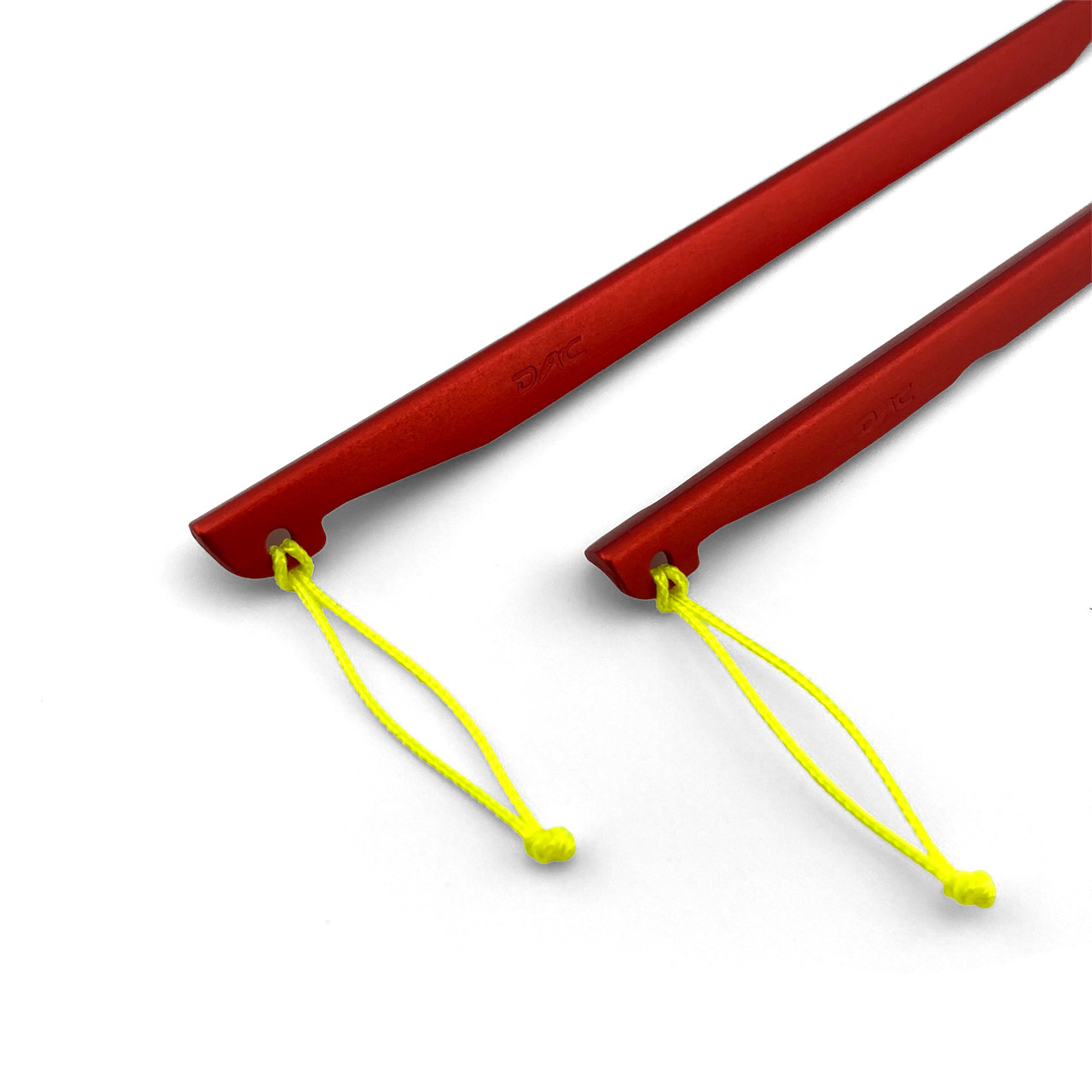
The DAC J-Stake is the tent stake equivalent of a quiet workhorse — you’ve almost certainly used one without knowing it. DAC is world-renowned for aluminum pole technology; if you have a tent with aluminum poles, they were likely made by DAC. Applying that same materials expertise to stakes, DAC created a lightweight, durable stake to complement their lightweight pole designs, making it from their proprietary alloy TH72M. The result is a V-profile stake that hits a sweet spot between weight savings and real-world holding power for 3-season backpacking.
Key Specs
| Spec | Details |
|---|---|
| Weight | ~12 g (S), ~16.2 g (M) per stake |
| Lengths | S: 6.3 in (16 cm) · M: 7.9 in (20 cm) · L: ~7.9 in, wider · T: 12 in (30 cm) |
| Material | TH72M proprietary aluminum alloy |
| Yield Strength | >84,000 psi |
| Profile | V-shape with thick center spine |
| Features | Wide thin wings, stackable curved design, pull-loop hole (ø3.5 mm) |
| Sizes Available | S, M, L, T |

Build your Gear Closet
View all of your gear in one place, create packing lists and hit the trail with confidence. Available on iOS, Android and the web.
Get StartedPerformance
The Alloy Is the Story
Before getting into dirt time, it’s worth understanding what TH72M actually is. The TH72M alloy is formed via high-pressure extrusion for remarkable strength, with a yield strength exceeding 84,000 psi. For context, TH72M matches the performance of the absolute strongest aerospace aluminum alloys in the world today. In practical terms, this means a stake that’s genuinely hard to accidentally bend when it clips a buried rock — which matters more than almost any other spec.
Holding Power Across Soil Types
The small size provides a decent balance between weight and holding power and works well in a variety of ground types, but they’re best in medium to firm ground.
Firm trail-camp soil, packed forest duff, consolidated alpine dirt — this is where the S and M sizes earn their reputation.
They offer much better hold in regular soil than any nail-styled peg.
The large (L) size provides excellent holding power in many conditions, including loose, dry ground and firm, consolidated snow, and also works great as a dead-man anchor in snow.
If you’re pitching in snow or loose desert sand, that’s the size you want — or step all the way up to the T. At a whopping 12 inches, the T is DAC’s largest stake and is designed for serious loads or very soft ground.
Design Wins
The stake uses a thick center to increase vertical load capacity through rigidity, with wide thin wings to aid in placing into the ground and keeping position, and they stack together to take up less room.
That stackability is genuinely useful when you’re cramming a stake bag into a hip belt pocket.
The curved line on the wing of the stake allows it to be loaded and detached easily, and the curved design has the advantage of keeping the stakes dry, which makes them more durable.
Cleaning is also underrated here. They penetrate the ground more easily and it’s easier to clean them after use — the soil collects in a single groove versus three grooves at once with Y-stakes. Scrape one stake inside the V-groove of another and you’re done.
Limitations
These stakes are not invincible, and you should know their edges. For large tents their hold is not always enough, in sandy soil they may be less reliable than larger Y-pegs, and in rocky ground these pegs may be damaged by hammering. One reviewer reported that on extremely hard-packed terrain, hammering with a rock caused the stake to bend at the neck — the head-to-body junction is the weak point under heavy percussion. In cases where too much hammering with a rock may be needed, substituting with titanium nails for very hard ground is a sensible backup.
There’s also a notch near the head, intended for situations where you can’t drive the stake fully in. Resist using it as a guyline hook at half-depth — a stumble over a stick protruding at ankle height is no fun.
How It Compares
The DAC J-Stakes are cheaper and lighter than MSR Groundhog stakes.
The MSR Groundhog Mini weighs about 11 g per stake and runs around $3–4 each; the DAC S is in the same weight class but available for less if you shop around.
The J-Stakes are extremely strong compared to “shepherd hooks” made of aluminum rod, which bend too easily.
For most 3-season applications on a 1-2P shelter, you’re not giving anything up by choosing the J-Stake over the Groundhog.
Pros & Cons
Pros
- TH72M alloy is exceptionally strong for its weight — genuinely hard to accidentally bend
- V-profile cleans easily, stacks flat, penetrates firm ground without a hammer in most cases
- Four size options let you match the stake to actual conditions
- Pull-loop hole is a practical, lightweight alternative to a bulky pull hook
- Ships standard with many quality tents (North Face, Big Agnes, Hilleberg, SlingFin) — field-proven across millions of nights
- No rust, ever
Cons
- S and M sizes struggle in loose sand or unconsolidated snow — you’ll need L or T
- Head-to-body junction can bend under heavy repeated hammer blows on rocky/frozen soil
- No pull cord included from DAC directly — you’ll need to source and thread your own
- Not ideal for very large 3P+ freestanding tents with high wind loads
- At 12 g (S), they’re not the absolute lightest aluminum stakes available, though they’re close
Who Should Buy This
The DAC J-Stake S or M is the right call for ultralight and lightweight backpackers running 1-2P shelters on typical 3-season terrain — think established trail corridors with packed soil, not beach camping or winter mountaineering. If you’re retiring a set of shepherd hooks or the mystery steel stakes that came with a car camping tent, this is a clear, meaningful upgrade. The L is worth considering for shoulder-season trips with soft spring ground, and the T belongs in any kit that includes sand, snow, or a big dome shelter.
Verdict
The DAC J-Stake earns its reputation as a default choice for a reason: the TH72M alloy is legitimately stronger than most competing aluminum stakes at comparable weight, the V-profile handles firm to moderate soil without complaint, and four size variants cover nearly every camping scenario between them. The one real caveat is that no single size is a universal solution — pick the wrong size for your ground and you’ll know it by morning. Get the right size for your typical terrain and these stakes largely disappear from your decision-making process, which is exactly what a good stake should do.