Cascade Mountain Tech Aluminum Quick Lock Trekking Pole Review
Cascade Mountain Tech's $30 aluminum quick-lock poles weigh about 298 g each and tolerate abuse well, but lever locks need tuning and carbon poles run lighter.
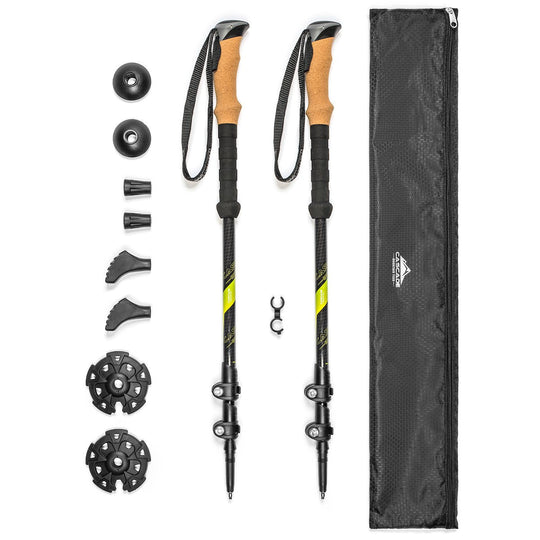
Overview
The Cascade Mountain Tech Aluminum Quick Lock is a three-section, lever-locking trekking pole that lists for $29.99 a pair at the manufacturer, with some retailers charging closer to $40. It is built for first-time pole buyers, budget-minded section hikers and anyone who wants a beater set that can take a bend. The trade-off is straightforward: at roughly 298 g per pole, it is light for aluminum and heavy for a pole sold to ultralight backpackers.
Key Specs
| Spec | Detail |
|---|---|
| Weight | 298 g (10.5 oz) per pole, about 596 g per pair; the manufacturer lists 10.4 oz with tips |
| Shaft material | Aircraft-grade 6061 aluminum |
| Sections | 3 |
| Adjustment range | 26” to 54” |
| Lock type | Lever-style quick lock with adjustable tension |
| Grip | Cork, with extended EVA down grip |
| Tip | Tungsten carbide |
| Section lengths (disassembled) | 20.75” upper, 20” middle, 21.25” lower |
| Sold as | Pair |
| Included | Carry case, wrist straps, rubber tip covers, boot tips, mud/sand baskets, snow baskets |

Build your Gear Closet
View all of your gear in one place, create packing lists and hit the trail with confidence. Available on iOS, Android and the web.
Get StartedPerformance
Weight and swing feel. A pair comes to about 1.3 lb, which is respectable for aluminum at this price. It is also a good 100 g or more per pole heavier than the carbon sticks that thru-hikers have come to expect. Cascade Mountain Tech’s own carbon quick-lock models are listed at 7.8 oz per pole, roughly 2.6 oz lighter each, for about $65. Over a 20-mile day the difference shows up in the shoulders and in swing weight, not on the scale in the gear closet.
Locks. The lever locks are the pole’s most discussed feature. Reviewers report they are quick to operate and work with gloves on, and graduated height markings make it easy to repeat a setting. They also arrive a touch loose. Camp Hike Live California advised tightening the tension adjusters before the first outing, and Hiking Insights, after 100-plus miles, described a lock giving slightly under full body weight on steep, rough ground until the tension screw was firmed up. That screw takes a coin or a screwdriver and under a minute. Once dialed in, the same tester found the locks held. Not every owner gets there: one blogger reported the poles creeping shorter over time even when the levers were fully closed. The pattern is consistent. These locks are fine if checked and adjusted, and annoying if set once and forgotten.
Durability. Aluminum is the point of this pole. Testers who leaned on the poles hard or used them to catch stumbles reported no bending and only light cosmetic wear on the lower sections. A buyer on a nine-day mountain trek stepped on a pole and bent it, and a guide straightened it well enough to finish the trip, which is the failure mode aluminum offers and carbon doesn’t. Replacement upper, middle and lower sections are sold separately, so a bent or broken pole doesn’t mean a new set. Tungsten carbide tips grip rock and root reliably, and the supplied rubber tips, boot tips and baskets cover pavement, mud and snow.
Grip and comfort. The cork handle stays comfortable when hands sweat and, per owners, does a decent job damping vibration. The EVA extension below the grip is useful on steep sidehills and climbs, when choking down is faster than shortening the pole. Two caveats come up. Cork is less insulating than foam or rubber in cold weather, and one reviewer found the grip small for larger hands. Aluminum also transmits more buzz than carbon on rocky trail, and some testers noted a faint rattle compared with beefier poles. The wrist straps are adjustable and soft-touch but basic.
Packability. Three sections collapse to a 26” storage length, longer than the Z-fold poles favored by trail runners and by shelter-pole users. They fit along a pack side pocket or lash to the outside, and the included case helps for flights. Those who pitch a trekking-pole shelter should note the 54” maximum, which suits most tarps and many tents but not every design. Owners have reported pitching a tent with them without trouble.
Pros & Cons
Pros
- Roughly $30 a pair, with a full tip and basket kit included
- Aluminum shafts bend rather than snap, a plus on rocky, off-trail routes
- Cork grip with EVA extension handles sweat and steep terrain
- Lever locks work with gloves and have a tension screw for adjustment
- Replacement sections sold individually
- Tungsten carbide tips
Cons
- At roughly 298 g each, noticeably heavier than carbon poles
- Locks can ship loose and may creep without periodic tightening
- 26” collapsed length is long compared with folding poles
- Aluminum transmits more vibration than carbon
- Cork is cold to the touch in winter and may feel small in large hands
Who Should Buy This
This is the right pole for a first set, a spare pair for guests or kids’ trips, a travel pole you won’t mind losing, or the hiker who bushwhacks and wants shafts that won’t splinter. It also suits shoulder-season day hikers who will use the baskets. Gram-counting thru-hikers, trekking-pole-tent users who want a minimal setup, and anyone logging big weeks should look at a carbon pole, including Cascade Mountain Tech’s own, or a folding model that packs smaller.
Verdict
The Aluminum Quick Lock does the basic job of a trekking pole at a price that makes replacing it painless, and it survives abuse better than most carbon poles at any price. Spend five minutes on the lock tension and it is a dependable workhorse. It is not a pole for people who count grams.