Black Diamond Trail Ergo Cork Trekking Poles Review
A durable, comfortable aluminum pole with a unique 15° ergonomic grip angle — but at 510g/pair, ultralight hikers should look elsewhere.
Overview
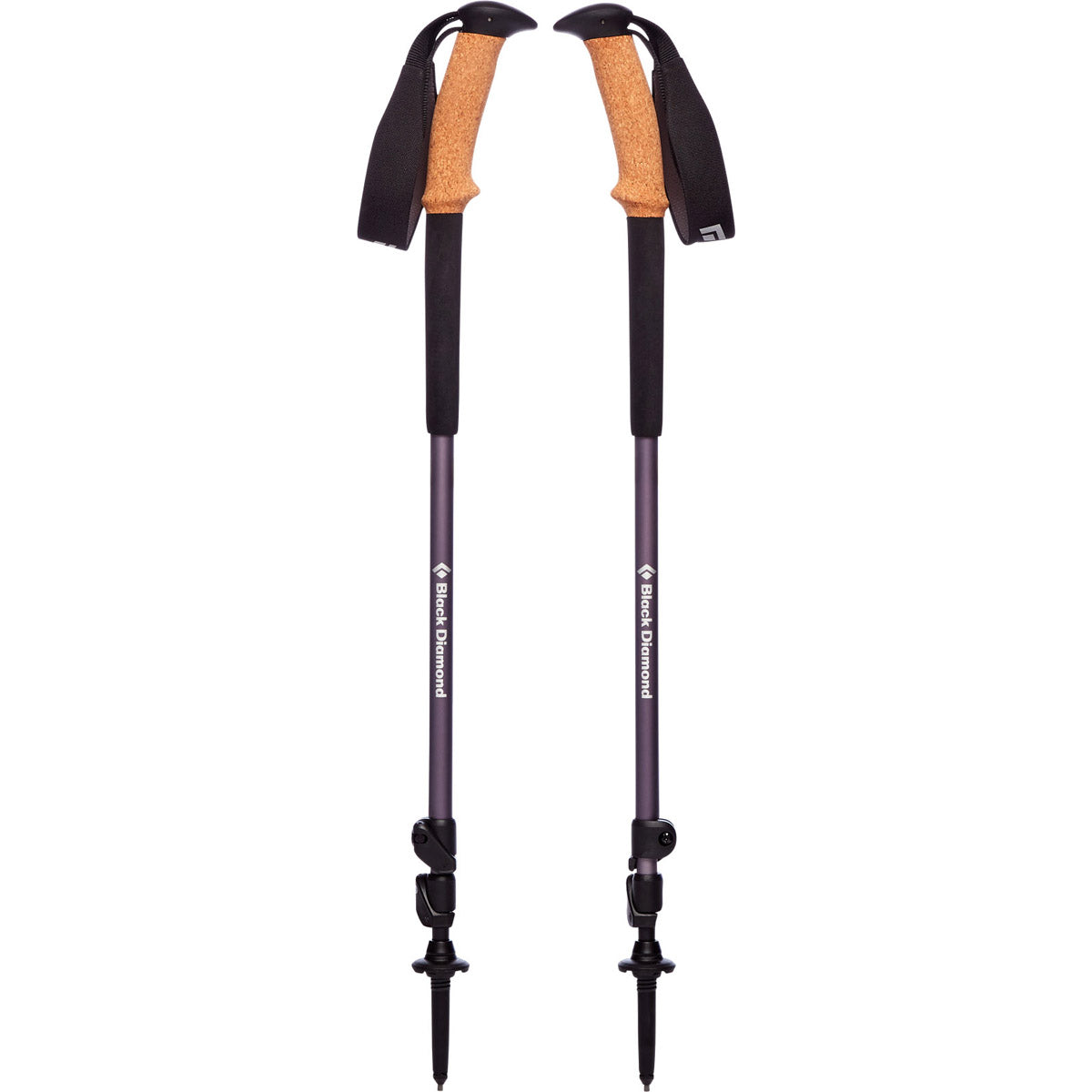
The Black Diamond Trail Ergo Cork is a three-section, 7075 aluminum telescoping pole built around two main ideas: a 15-degree forward-angled cork grip and the dependable dual FlickLock® adjustment system. It’s aimed squarely at four-season day hikers and recreational backpackers who want bulletproof durability and all-day grip comfort, and are willing to carry a bit of extra weight to get there. If you’re counting grams for a long trail push, this pole isn’t for you — but if you want something that’ll survive years of hard, varied terrain without demanding much fuss, the Trail Ergo Cork is worth a close look.
Key Specs
| Spec | Detail |
|---|---|
| Weight | 510 g (18 oz) per pair |
| Shaft Material | 7075 aluminum |
| Grip Material | 100% natural cork |
| Grip Angle | 15° ergonomic forward angle |
| Adjustability | Dual FlickLock® |
| Collapsed Length | 69 cm (27 in) |
| Usable Length | 74–140 cm (29–55 in) |
| Baskets Included | Trekking + snow baskets |
| Sold As | Pair |

Would the Trail Ergo Cork Trekking Poles earn its spot in your pack?
510 g · 18.0 ozAdd the Black Diamond Trail Ergo Cork Trekking Poles to your Gear Closet and see exactly what it does to your base weight, then start packing for your next trip.
Free · No credit card · iOS, Android & web · Trusted by 3,000+ backpackers
Performance
The Ergo Grip: Marketing or Merit?
The 15-degree forward grip angle is the headline feature, and the honest answer on whether it works is: it depends on who’s holding it. The theory is that angling the grip forward keeps your wrist in a more neutral position during a normal stride, reducing fatigue and repetitive-stress risk. One reviewer at The Big Outside found that the angle “naturally places the pole tips in the ground behind my feet, where they deliver the most power.” Outdoor Gear Lab’s testers, on the other hand, ran blind tests and reported they “couldn’t identify the angulation at all.” My take: if you already have wrist issues or have never gotten comfortable with standard poles, this feature might be a genuine revelation. If your wrists feel fine on conventional poles, you probably won’t notice the difference.
One important detail: the grips are handed — left and right are mirror images of each other. It’s easy to absentmindedly swap them, and when you do, the angle works against you rather than for you.
Cork Grip and Strap System
This is where the poles genuinely earn their keep. Cork wicks moisture rather than absorbing it, so your grip stays solid even with sweaty hands — and after extended use it molds to the contours of your hand over time. Unlike foam grips, cork stays temperature-neutral in both heat and cold; it won’t feel like you’re gripping a hot pan in July or a block of ice in November. There’s also a secondary foam grip below the main handle for choking up during steep uphill sections, and the wrist straps are noticeably wider than average, which spreads load and reduces hot spots on long days.
One legitimate concern: cork chips more easily than foam or rubber. Outdoor Gear Lab reported damaging one cork handle during regular use, and cork is known to attract curious rodents in camp — worth keeping in mind if you lean your poles against your shelter overnight.
FlickLock Adjustability
The dual FlickLock levers are a highlight. They’re quick to flip open and snap shut, hold length reliably under load, and work fine with gloves on. The tension is adjustable with a Phillips-head screwdriver — which some competing brands handle tool-free, so that’s a minor inconvenience. Some users report the levers arriving under-tensioned from the factory and slowly letting the poles creep shorter under sustained pressure, but a few turns of a screwdriver fixes it permanently. After that initial adjustment, multiple long-term users report zero slippage across thousands of kilometers of use.
The adjustability range — 74 to 140 cm — is notably generous, wide enough to accommodate hikers from very short to very tall, and also makes it easy to shorten the poles for snowshoeing or steeper terrain.
Weight and Packability
Here’s where the Trail Ergo Cork struggles for a backpacking audience. At 510g (18 oz) for the pair, these are among the heavier poles on the market. The Black Diamond Distance Carbon Z, for comparison, comes in around 318g (11.2 oz). The swing weight becomes noticeable after hours of continuous hiking, and reviewers who’ve tested both aluminum and carbon options consistently report feeling the difference by the end of a long day. The collapsed length of 69 cm also means these poles stick up above the top of most daypacks and won’t disappear cleanly inside a bag for travel or technical terrain where you need your hands free.
That said, the weight penalty is the flip side of real durability. Aluminum bends rather than shatters under shock loads, which matters when you’re catching a stumble at full pack weight on rocky terrain. One user reported taking a direct fall onto a pole on a rock-studded trail and finding “minimal damage, just a few scratches” — try that with a carbon fiber Z-pole.
Four-Season Versatility
The included snow baskets and wide adjustability range make these a genuine four-season option without buying additional accessories. Field testing reported on The Big Outside covered everything from icy winter day hikes to a 94-mile backpacking traverse through Glacier National Park, with the poles holding up across all of it.
Pros & Cons
Pros
- Cork grips wick moisture, mold to your hand, and stay comfortable in heat and cold
- 7075 aluminum shafts take real abuse without catastrophic failure
- Wide adjustability range (74–140 cm) fits a huge range of heights
- FlickLock system is glove-friendly, reliable, and field-repairable with a multitool
- Both trekking and snow baskets included out of the box
- Wider-than-average wrist straps reduce hand fatigue on long days
- Secondary foam grip section useful for side-hilling and steep climbs
Cons
- 510g/pair is heavy by any measure — you feel it after a full day
- Collapsed length (69 cm) limits packability; won’t stow inside a bag or disappear on a pack
- The 15-degree ergo angle is genuinely polarizing — many users can’t detect the benefit
- Cork can chip with hard use and attracts rodents in camp
- FlickLock tension screws may need initial tightening out of the box
- Plastic lever locks could crack under hard impact against rocks
- Reported availability issues in some markets — worth confirming stock before ordering
Who Should Buy This
This pole is a good fit for recreational hikers and backpackers who prioritize durability and grip comfort over low weight — weekend warriors, hikers on rugged technical terrain, and anyone who’s snapped a carbon pole and doesn’t want to repeat the experience. The wide adjustment range also makes it a solid choice for families sharing a pair or for hikers with wrist discomfort who want to try the ergo angle. Thru-hikers, trail runners, and weight-conscious ultralight packers should look at lighter options like the BD Alpine Carbon Cork or the Distance Carbon Z.
Verdict
The Trail Ergo Cork is an honest, durable pole that does a lot of things right — comfortable grip, reliable locking system, four-season versatility — but the 510g pair weight and 69 cm collapsed length are real trade-offs that limit its appeal for anyone covering serious mileage. For casual day hiking and moderate backpacking trips where reliability trumps every other consideration, it earns its place. For thru-hiking or weight-sensitive applications, the extra 200g per pair is hard to justify given what else is on the market at a similar or lower price point. 6.5/10.