Forclaz Trek 900 Down Sleeping Bag Review
Decathlon's Forclaz Trek 900 pairs 800-fill down with a snug alpine cut at roughly half the price of boutique bags. The catch is a tight fit and a weight that trails cottage-brand bags.
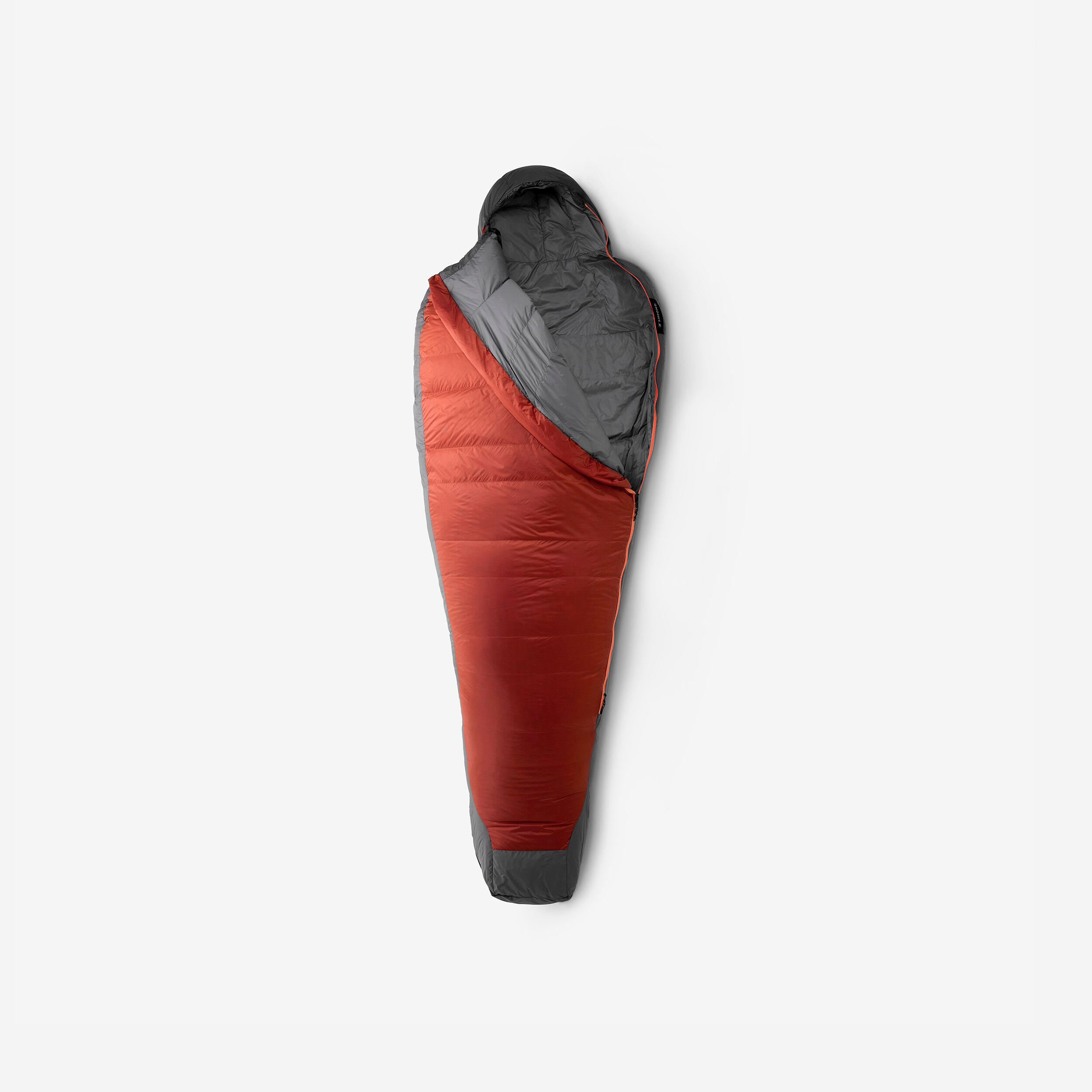
Overview
The Forclaz Trek 900 is Decathlon’s house-brand down mummy for three-season and shoulder-season backpacking. It was designed and tested at the company’s mountain headquarters in the Mont Blanc Valley, and it earned Backpacker’s Best Value sleeping bag pick in 2019. The trade-off is plain: it delivers 800-fill warmth and real compressibility for about $150, but it weighs more than the cottage-industry bags that thru-hikers pay twice as much for, and the cut runs narrow.
Key Specs
| Spec | Detail |
|---|---|
| Fill | 800-fill duck down (roughly 85–90% down, 10–15% feather depending on model) |
| Weight | About 880–985 g depending on size and model (Backpacker listed 1 lb 15 oz; the large was stated at 985 g) |
| Temperature rating | 23°F in Backpacker’s listing; 0°C comfort on the model tested by Tentlife |
| Packed size | Roughly a large loaf of bread; the large is stated at 34 × 17 cm |
| Shoulder girth | 59 in |
| Footbox girth | 34 in |
| Zipper | Two-way, double slider |
| Hood | Fitted, ergonomic |
| Warranty | 5 years |
| Price | About $150 at launch |

Would the Trek 900 Down Sleeping Bag earn its spot in your pack?
80 g · 2.8 ozAdd the Forclaz (Decathlon) Trek 900 Down Sleeping Bag to your Gear Closet and see exactly what it does to your base weight, then start packing for your next trip.
Free · No credit card · iOS, Android & web · Trusted by 3,000+ backpackers
Performance
Warmth. Backpacker’s testers found that the bag does not behave like a budget pick and does especially well in shoulder-season temperatures. One tester slept through subfreezing spring nights in Denali after a long day of bushwhacking through willows, without stirring. A UK reviewer at Tentlife took the 0°C version to Scotland’s Isle of Arran, where the porch thermometer read 0.3°C one night. Inside the bag, on an Exped insulated mat, the tester reported being comfortable. Owners of the current MT900 generation tend to reach the stated limit rating only when they add a liner, so it’s sensible to treat the comfort number as honest rather than generous.
Fit and cut. The alpine cut, 59 inches around the shoulders and 34 inches at the footbox, is what saves weight and eliminates dead air. It is also the bag’s most common complaint. Backpacker noted that the regular size runs tight, especially in the footbox. The magazine’s 6-foot tester moved up to the XL, which cost only 3 ounces. Side sleepers who like to draw their knees up will feel the narrowness. A reviewer at Advnture, testing the lighter MT900 5°C bag, also needed time to get used to the restrictive cut. Tentlife’s tester, by contrast, found the large roomy across the shoulders, with space to fold arms.
Weight and packed size. Weight sits in the middle of the pack, not at the front. Backpacker clocked the bag at 1 lb 15 oz, and Tentlife’s large weighed 945 g on a home scale against a stated 985 g. That is competitive against synthetic bags and generic down at this price, but it trails the sub-two-pound 20°F bags from cottage makers. Compressibility is better than the weight suggests. Backpacker’s testers compared the packed size to a large loaf of bread, and Tentlife’s tester squeezed the large down to 26 × 17 cm, shorter than the stated 34 × 17 cm. It occupied little room in a 65-liter pack, next to a mat, liner and inflatable pillow.
Features and durability. The two-way zipper lets a sleeper vent from the foot end, and Tentlife’s reviewer found it easy to work in the dark. Backpacker praised the fitted hood for a snug, warm seal. Decathlon’s in-house down bags use a more robust shell than elite ultralight designs. A review of the current 0°C MT900 describes a 20D polyamide face fabric, which resists abrasion better than the 7D–10D shells common on premium bags. The same review credits a water-repellent treatment on the down. A five-year warranty backs it up.
Pros & Cons
Pros
- 800-fill duck down at roughly half the price of comparable boutique bags
- Warm for its weight, with a fitted hood that seals out drafts
- Packs to about the size of a large loaf of bread
- Two-way zipper and a five-year warranty
- Tougher shell fabric than most ultralight bags
Cons
- Regular size runs narrow, particularly at the footbox
- Heavier than premium sub-two-pound bags with a similar rating
- Availability depends on Decathlon’s stock and regional listings
- Rating varies by model, so buyers need to check the exact variant
Who Should Buy This
Three-season backpackers, weekend hikers and first-time down buyers who want real loft without paying $300 or more will get the most from it. It also suits bikepackers and anyone who sleeps rough on their kit and wants a shell that tolerates abrasion. Side sleepers and wider-shouldered hikers should size up, or look at a quilt or a roomier bag. Gram-counting thru-hikers chasing a base weight under 8 pounds will find lighter options, and so will anyone who needs a bag rated well below freezing.
Verdict
The Forclaz Trek 900 is a warm, well-built down bag that costs much less than it should, and Backpacker’s Best Value label holds up. Buy it if the price matters more than shaving the last 200 grams, and size up if the regular looks snug. Weight-obsessed hikers should spend more elsewhere.