Zpacks Plex Solo Review
The Zpacks Plex Solo is a 394 g Dyneema trekking-pole tent with a full floor and bug netting. It's roomy and storm-ready, but pricey and fussy to pitch.
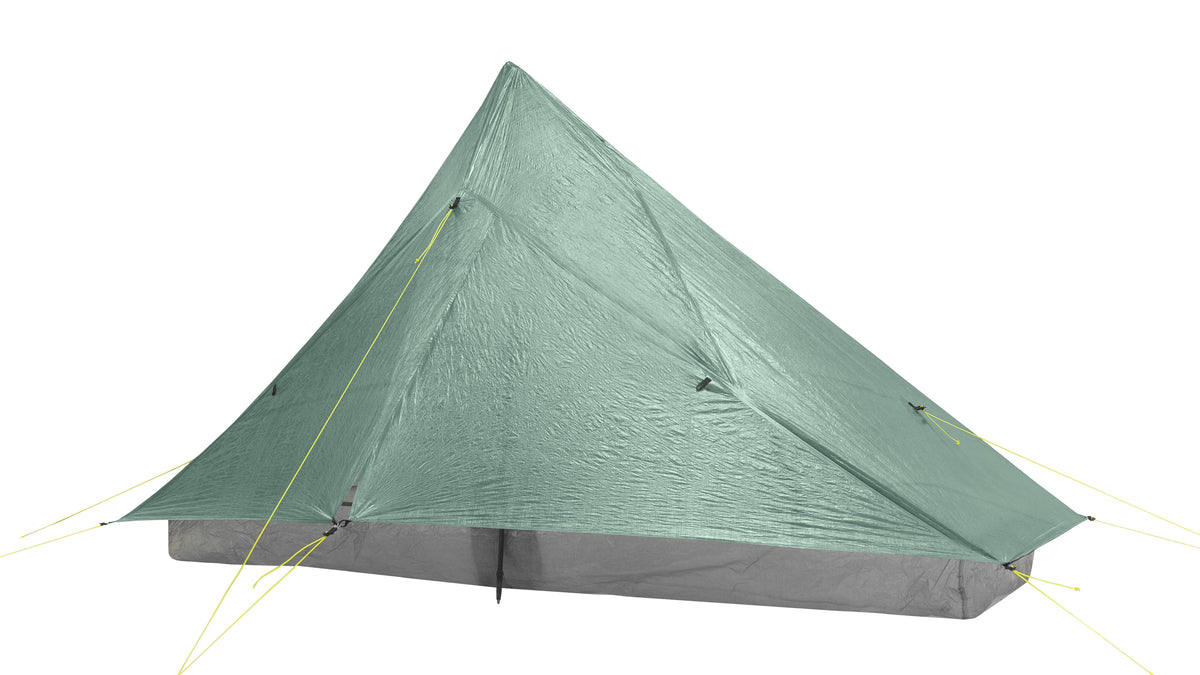
Overview
The Zpacks Plex Solo is a single-wall, one-person pyramid-style tent cut from Dyneema Composite Fabric (DCF) and held up by a single trekking pole. At 394 g (13.9 oz) with a bathtub floor, insect netting and a front vestibule, it weighs about what some hikers’ tarp-and-bivy combinations do. The trade-off is a high price and a pitch that rewards practice over luck.
Key Specs
| Spec | Detail |
|---|---|
| Capacity | 1 person |
| Weight | 394 g (13.9 oz), without poles or stakes |
| Packed size | 5 x 11 in (12.7 x 28 cm) |
| Peak height | 52 in (132 cm) |
| Floor length | 90 in (229 cm) |
| Floor width | 28–38 in (71–97 cm) |
| Material | Dyneema Composite Fabric (DCF) |
| Poles required | 1 trekking pole, 52 in (132 cm) |
| Stakes required | 6–10 (not included) |
| Construction | Single wall, non-freestanding, bathtub floor, built-in bug netting |

Would the Plex Solo earn its spot in your pack?
394 g · 13.9 ozAdd the Zpacks Plex Solo to your Gear Closet and see exactly what it does to your base weight, then start packing for your next trip.
Free · No credit card · iOS, Android & web · Trusted by 3,000+ backpackers
Performance
Weight and packability. The headline number holds up. Reviewers at Backwoods Pursuit called it the lightest floored one-person tent they had tested, and noted it sheds about two ounces from Zpacks’ own Altaplex. CleverHiker’s testers recorded 14.2 oz on their scale. Because the tent has no poles of its own, it stuffs into a roughly Nalgene-sized bundle, and it fills the odd gaps in a pack that rigid-pole tents can’t.
Livability. The 52-inch peak and the 90-inch floor give a tall hiker room to sit up and stretch out. CleverHiker reports that the height is comfortable for hikers up to about six feet, and that taller hikers are better served by the Altaplex. Zpacks keeps the length and trims the width, so the Plex Solo gives up only a little floor area to the Altaplex. Reviewers describe the interior as generous for the weight, and the ventilation as strong. Those vents help the single wall limit condensation, though no single-wall shelter eliminates it.
Weather. Owners describe the Plex Solo as stable in wind. One Reddit user pitched it in winds of 80–90 km/h and had to reset a few lines. A companion’s freestanding tent lost its poles that night. Another owner took it above the Arctic Circle and called it bunker-like in a blow. The shelter has 10 guyout points, and DuskHiker’s reviewers note that staking all of them out improves storm performance and cuts condensation. The seams are fully taped and the DCF doesn’t absorb water, so the tent doesn’t sag or gain weight in a downpour. An AT thru-hiker who slept in it for roughly 100 nights reported that it stayed protective through some heavy rain.
Pitching. This is where opinions split. Setup is simple in principle: stake the rectangular base, raise the pole, then tension the guylines. DuskHiker’s reviewers say the rectangle of body guyouts makes it easier than some other pyramids. SectionHiker, however, found that a taut pitch can take a fair amount of adjustment. One Lunar Solo-versus-Plex owner on r/Ultralight never got the bathtub floor to form, and said it was awkward to fit into tight campsites. Experienced users say the learning curve flattens after a handful of nights. Hikers whose trekking poles don’t reach 52 inches will lose peak height, and a short pole is the most common stumbling block.
Durability. DCF is the reason. Zpacks uses a lighter 0.55 oz/yd² Dyneema for the canopy and a heavier 1.0 oz/yd² for the floor, putting the extra material where abrasion happens. Treeline Review’s testers logged more than 1,200 miles without visible wear. They also stuffed the tent loosely each morning rather than folding it the same way every day, to avoid pinholes along repeated creases. Zpacks says the tent should last one full 2,500-mile thru-hike or many years of casual use with care.
Pros & Cons
Pros
- 394 g with a full floor, netting and a door
- Packs to roughly the size of a one-liter bottle
- Stable in high wind when all guylines are staked
- Roomy for its weight, with a 90-inch floor
- Waterproof DCF doesn’t stretch or absorb water; reviewers report no wear over 1,200+ miles
- Needs only one trekking pole
Cons
- Expensive. SectionHiker listed it at $599
- Pitching takes practice, and some owners never get a clean bathtub floor
- Needs a 52-inch trekking pole to reach full height
- Non-freestanding, so it needs stakeable ground
- Single wall, so condensation needs managing
- Stakes not included, and the footprint is long for tight sites
Who Should Buy This
Solo thru-hikers, fastpackers and bikepackers who already hike with trekking poles will get the most from it. It suits anyone chasing a sub-10-pound base weight who wants walls and bug protection rather than a tarp. It is also a strong choice for above-treeline summer and fall trips, where wind matters more than snow load.
Hikers who don’t carry poles, or whose poles top out under 52 inches, should look elsewhere. So should anyone who wants a quick, forgiving pitch on rocky or sandy ground, and anyone on a budget. Hikers who need more headroom should step up to the Altaplex.
Verdict
The Plex Solo delivers nearly all of a conventional one-person tent’s protection in less than a pound. Its price and its pitching learning curve are real, but owners who put in the first few nights tend to keep it for thousands of miles. Trekking-pole users with a thru-hike budget should buy it.