Tarptent ProTrail Li Review
The Tarptent ProTrail Li is a 16 oz single-wall DCF trekking pole shelter that delivers best-in-class packability and a roomy floor — if you're willing to manage condensation and master precise staking.
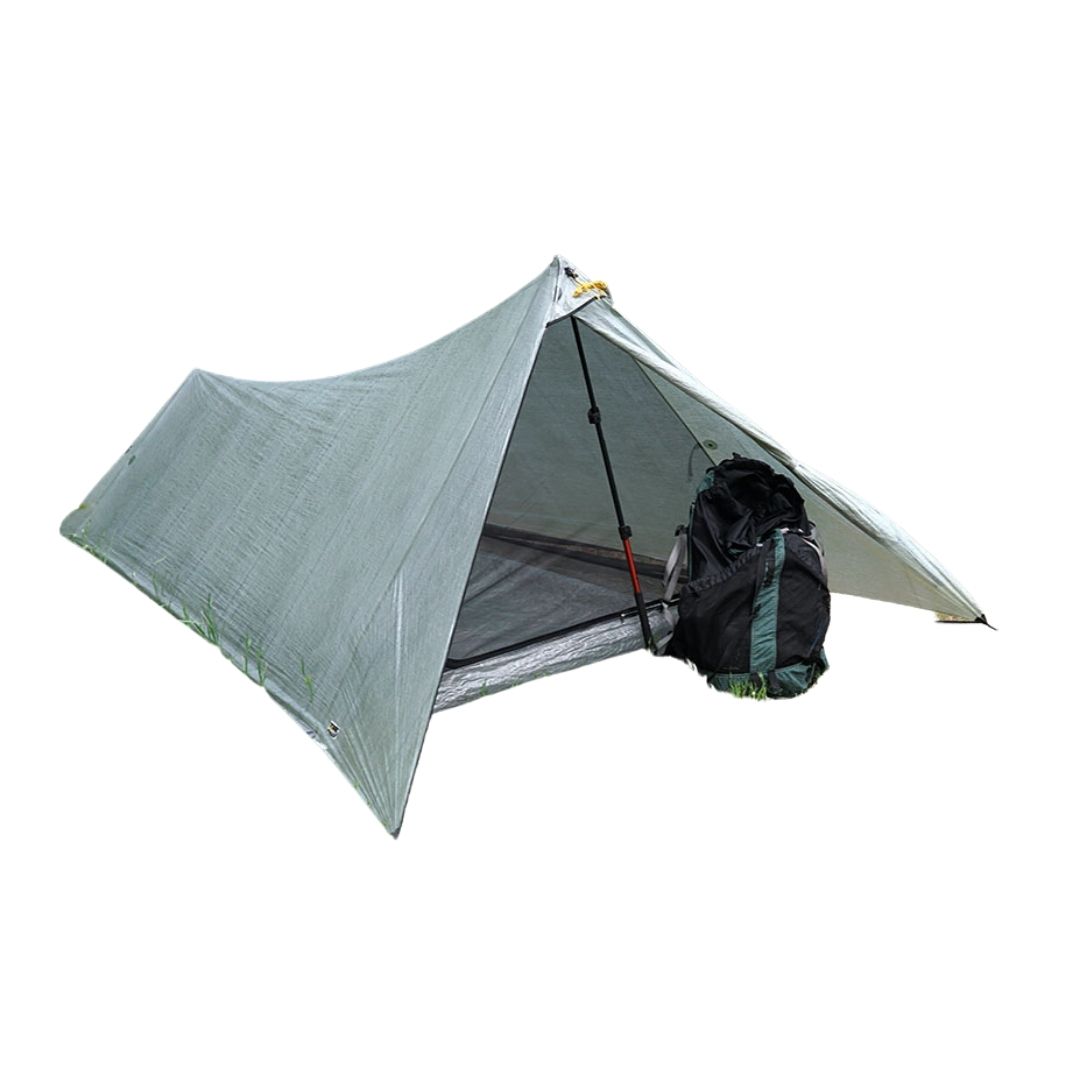
Overview
At just 16 oz / 454g, the ProTrail Li is Tarptent’s simplest, lightest, and least expensive Dyneema shelter, ideal for trekking pole users who want the ultimate in minimalist ultralight protection.
It’s essentially a very simple A-frame style rainfly with a floating bathtub floor attached to the sidewalls and ends with no-see-um mesh — a configuration that lets you pitch the fly “high” so air can flow through the mesh, or “low” to prevent windswept rain from being blown inside.
This is a shelter purpose-built for experienced three-season backpackers who already carry trekking poles and want a sub-pound tent that disappears into their pack.
Key Specs
| Spec | Detail |
|---|---|
| Weight | 454 g / 16 oz |
| Capacity | 1 person |
| Packed Size | 12 × 4 × 4 in (30 × 10 × 10 cm) |
| Fly Material | 0.51 oz/yd² Dyneema® DCF |
| Floor Material | 1.0 oz/yd² Dyneema® DCF |
| Poles Required | 2 trekking poles (107–120 cm) |
| Seasons | 3-season |
| Seam Sealing | Fully factory seam-taped |
| Max User Height | 6 ft 8 in / 203 cm |
| Stakes Required | 4 (included) |
| Price | $599 |

Would the ProTrail Li earn its spot in your pack?
454 g · 16.0 ozAdd the Tarptent ProTrail Li to your Gear Closet and see exactly what it does to your base weight, then start packing for your next trip.
Free · No credit card · iOS, Android & web · Trusted by 3,000+ backpackers
Performance
Setup
Setup is faster than most tents you’ve owned — with practice, it’s easy to pitch in well under two minutes.
The fly-first design means you can get the shell up before you crawl inside, which is a genuine advantage in rain.
While the four-stake pitch is simple in theory once mastered, it’s fiddly to perfect. The short guylines, especially at the back of the tent, leave almost no flexibility in stake placement — if a rock or root is where a stake needs to go, achieving a taut pitch is genuinely difficult.
Bring a few extra shepherd’s hook stakes if you’re heading into rocky terrain.
Packability
One of the ProTrail Li’s most significant features is its strutless design. Tarptent often uses fixed-length carbon fiber struts to create interior volume, but the ProTrail Li’s lack of rigid components allows it to be folded and rolled into a small and narrow package, making it easy to fit horizontally in even the slimmest backpacks.
A 12 × 4 × 4 in roll is genuinely impressive — this thing slides into a side pocket on many 40L packs.
Weather Protection
The tent is constructed from Dyneema® Composite Fabric (DCF), a material known for being extremely lightweight, waterproof, and for not sagging or stretching when it gets wet — meaning the pitch stays taut overnight, even in rain.
That non-sag behavior is a real advantage over silnylon:
with the silnylon ProTrail, many users find it necessary to guy out the center of the sidewalls to counteract sagging in wet weather — that’s not needed at all with the ProTrail Li, which stays drumhead tight.
Wind performance is decent in sheltered sites. In real-world use the tent is very rock solid at 20 mph or less, but above 30 mph gusts it’s probably not the right tool for a super exposed site. The ProTrail Li’s biggest weakness in high wind is its long, flat, unsupported side panels, which offer a large surface area to crosswinds. Add the optional side guylines if you’re heading anywhere exposed. The tent’s low-profile design has no problem managing 30 mph gusts, but the taut DCF walls create a formidable cacophony of sound during windy nights — without earplugs, sleeping could be difficult.
Condensation
This is the conversation every single-wall tent buyer has to have, and the ProTrail Li is no exception. Condensation is an inherent characteristic of any single-wall tent, and success with the ProTrail Li requires a proactive approach. In the right conditions — with a breeze and good site selection — condensation is often just a light film of moisture easily wiped away in the morning. However, in calm, humid, or foggy conditions, significant condensation can and will form. The key is management: pitching the fly high, keeping the front and rear vents open whenever possible, and orienting the tent to catch a breeze keeps it to a minimum. A small microfiber cloth or Swedish dishcloth is worth adding to your kit.
Interior Space & Livability
The floor has a width of a comfortable 30 inches at its narrowest point — a Nemo Tensor Regular Wide fits comfortably with several inches of room on either side.
Tarptent rates it for users up to 6 ft 8 in / 203 cm.
Headroom is where you pay for the weight savings. Trying to sit up is a cramped affair. With the sharply sloping roof, you can only sit fully upright by cramming yourself against the front door, head and shoulders brushing against the walls. This makes changing clothes or waiting out a storm uncomfortable.
When the front door is zippered closed, it’s flat and doesn’t form a triangular front vestibule like many other front entrance tents. While this is less aerodynamic, it provides more usable storage space and makes it much easier to get in and out of the tent.
The front pole can be angled to widen the doorway.
The door can be unzipped, rolled up, and tied back using a magnetized toggle — these are much less frustrating to use than the dowels and elastic loops found on many comparable tents.
The DCF Translucency Factor
The thin DCF fabric makes the sun super bright when it shines on the tent. In direct overhead sun, the interior temperature runs roughly 10–15°F hotter than outside.
The fly lets in a fair amount of light and heat if you set it up in direct sunlight — both are factors in tent site selection.
Night owls: the full moon through DCF is also quite something.
Pros & Cons
Pros
- Exceptional weight-to-protection ratio at 16 oz for a fully seam-taped DCF shelter
- Strutless design packs to 12 × 4 × 4 in — fits horizontally in nearly any pack
- DCF offers a 38% weight savings over silnylon and doesn’t sag at night or when wet
- Generous 30-inch floor width accommodates wide pads and tall users
- Fly-first setup keeps interior dry in rain; very fast once practiced
- Magnetic door tie-backs are a thoughtful detail, especially with cold hands
- If you do manage to wear a hole in the floor, DCF is easy to repair with a patch supplied free from Tarptent
- Condensation-catching gutters and foot-end load lifters help prevent accidental contact with the canopy
Cons
-
Single-wall condensation management is non-negotiable — not a set-it-and-forget-it shelter
-
Low headroom makes sitting up, changing clothes, and storm-waiting genuinely uncomfortable
-
Short guylines leave almost no flexibility in stake placement
— rocky ground is a real challenge
-
Flat side panels are vulnerable to sustained strong crosswinds
-
Translucent DCF creates a greenhouse effect in direct sunlight
-
Front entry requires some practice and agility to navigate efficiently
-
$599 is a significant investment — the silnylon ProTrail delivers the same floor space for $239
Who Should Buy This
The ProTrail Li is the right call for an experienced solo backpacker who already carries two trekking poles, has a handle on single-wall condensation management, and wants the lightest fully waterproofed DCF tent they can put in a small pack. If it sounds like one step up from sleeping under a tarp and in a bug bivy, that’s exactly how you should be thinking about it. It thrives on PCT-style arid and semi-arid routes, long-distance trails where packability is a daily quality-of-life concern, and fastpacking trips where shelter weight is the biggest line item. It’s not the right shelter for beginners, anyone camping in exposed, high-wind areas, or those who value interior comfort — for those hikers, a more forgiving double-wall tent is a far better choice.
Verdict
The ProTrail Li is one of the most refined expressions of the minimalist trekking pole shelter concept — a genuinely excellent shelter for the right user. The DCF execution over the standard ProTrail pays dividends every single day in weight saved, non-sag performance in rain, and a packed size that embarrasses most of the competition. The trade-offs — active condensation management, limited sitting headroom, and fussy staking on uneven ground — are real, but they’re the honest price of admission to the sub-pound club. If you know what you’re buying, this is an 8/10 shelter that will outlast most of the hikers who use it.