Salewa Litetrek II Tent Review
A balanced review of the Salewa Litetrek II — a self-supporting, semi-geodesic 3-season alpine tent weighing 2,100g (min) with strong weather protection and a smart setup system.
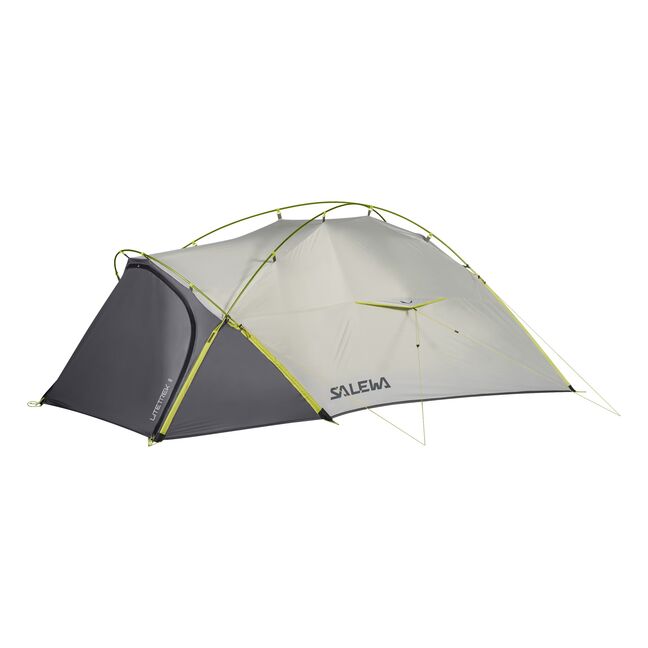
Overview
The Salewa Litetrek II is a 2-person, 3-season double-wall tent built specifically for alpine trekking — the kind of environment where the weather can turn mean faster than you can finish a hot drink. It sits in a niche between tents with breezy mesh interiors and full alpine tents, which really does describe its personality well. This is not a gram-counting shelter for fair-weather desert routes; it’s a capable, freestanding workhorse for the mountains that trades some weight against durability and wind stability. It’s also the more affordable sibling to Salewa’s own Litetrek Pro II — a relationship worth understanding before you hand over your money.
Key Specs
| Spec | Value |
|---|---|
| Weight (min / total) | 2,100 g / 2,470 g |
| Capacity | 2 person |
| Inner Floor Area | 2.52 m² |
| Vestibule Area | 0.56 m² |
| Inner Height | 1.0 m |
| Packed Size | 40 × 19 cm |
| Fly Material | 50D ripstop polyester, PU-coated |
| Fly Water Column | 3,000 mm |
| Floor Material | 70D ripstop nylon, PU-coated |
| Floor Water Column | 5,000 mm |
| Pole Material | 7001 T6 Aluminium, 8.5 mm |
| Wind Rating | 90 km/h |
| Seasons | 3-season |

Would the Litetrek II Tent earn its spot in your pack?
2100 g · 74.1 ozAdd the Salewa Litetrek II Tent to your Gear Closet and see exactly what it does to your base weight, then start packing for your next trip.
Free · No credit card · iOS, Android & web · Trusted by 3,000+ backpackers
Performance
Weather Protection
Wind-tunnel tested for stability at 90 km/h by the Technical University of Munich, the semi-geodesic, double-wall construction puts two layers of fabric between you and the elements, enabling full use of space while ensuring an optimal balance of weather protection and ventilation.
That TU Munich test isn’t just marketing copy — users who’ve taken this shelter into serious mountain environments have confirmed it.
The tent proved itself in the Caucasus — lightweight, compact, and wind resistant
— and one reviewer took it all the way to Mount Kazbek, reporting it “worked great in strong winds.”
The fly uses 50D ripstop polyester PU-coated to a 3,000 mm water column, while the floor is 70D ripstop nylon rated to 5,000 mm. The 3,000 mm fly rating is solid for 3-season use — not bombproof, but adequate for sustained rain. The 50D fabric on the fly is notably heavier and more abrasion-resistant than the 20D nylon used on the Litetrek Pro II, which is part of why the II carries more grams. The fabrics have higher-than-average waterproof ratings and are more durable than those found on many three-season tents, and the zips are stronger than those on the lightest tents.
Setup
Salewa’s 3S Speed Set Up Solution uses short, flat sleeves and hooks to allow a fast, effective one-pitch setup.
In practice, users consistently note how quick the tent goes up —
the very quick installation is a genuine advantage in the rain.
The 100% self-supporting design means you can pitch on rocky terrain where there’s not enough space to use guy lines and pegs, though anchor points can be extended for more flexibility on snowy terrain.
That freestanding capability is genuinely useful in the alpine world, where you’re often threading a needle between boulders for a campsite.
On good weather nights, you can also pitch the flysheet alone
for a lighter, more ventilated setup — a welcome option that many competitors in this category don’t offer.
Interior Space & Comfort
The 2.52 m² floor area is small but typical for an alpine tent. Headroom is most generous near the door and narrows towards the foot — it’s a little cramped for two people changing clothes, and large people might find it a touch narrow, but for short trips or smaller people it’s sufficient.
At 1.0 m peak height, sitting up is fine; anything resembling a leisurely stretch requires negotiation. Solo use is comfortable; two people with full kit is workable but snug.
The vestibule at 0.56 m² is on the tight side — don’t expect to cook a three-course meal under it. The vestibule is integrated into the inner tent but can be extended as required, which adds a little versatility. The tent also has only a single entrance, which means one sleeper has to climb over the other to get out at 2 a.m. — a minor but real annoyance on multi-night trips with two people.
Ventilation & Condensation
Ventilation is regulated via a rear panel with zippers that can be operated from both inside and outside, allowing you to adjust airflow and manage humidity.
That inside/outside operation is a nice touch. That said, condensation with two occupants is a known reality — a French forum user with the non-Pro version noted
some condensation with two inside, but considered it normal.
Double-wall tents in this category all face that trade-off; the Litetrek II manages it reasonably well without sacrificing weather protection.
Durability
The fabrics have higher-than-average waterproof ratings and are more durable than those found on many three-season tents.
One concern raised in user forums is pole breakage —
there are reports of snapped poles, which put at least some prospective buyers off.
The 8.5 mm 7001 T6 aluminium poles are a reasonable spec, but this is worth monitoring if you plan to push the tent into sustained high-wind situations repeatedly. A spare pole sleeve and some tent repair tape in your kit is sensible insurance.
Pros & Cons
Pros
-
Fully self-supporting — pitches on rock, snow, or anywhere you can find a flat spot
-
Wind-tunnel validated at 90 km/h; genuinely reassuring in alpine conditions
-
Heavier-duty 50D fly and 70D floor are more abrasion-resistant than most 3-season competitors
-
Salewa’s 3S system makes solo setup fast, even in bad weather
-
Fly-only pitch option for fair-weather nights
-
Priced at the low end of its class, making it excellent value
relative to its weather protection
Cons
- At 2,100 g minimum weight, it’s noticeably heavier than top ultralight alternatives (e.g., MSR Hubba Hubba NX at ~1,720 g)
- Single entrance only — inconvenient for two-person use at night
- Vestibule at 0.56 m² is tight for gear storage and cooking
- Some forum reports of pole breakage under extreme conditions
- The Litetrek Pro II is 320 g lighter for those willing to spend more
Who Should Buy This
The Litetrek II is built for the mountain trekker who wants a freestanding, genuinely weather-capable 3-season shelter without spending Pro-tier money. It sits in the niche between breezy mesh tents and full alpine tents, offering warmth and reassurance in strong winds at an affordable price. It’s a strong pick for alpine routes in the European Alps, Scottish Highlands, or similar exposed terrain during the shoulder seasons. If you’re a gram-counter chasing desert thru-hiking records, look elsewhere. If you’re heading above the treeline where the weather is genuinely unpredictable, this tent earns its place on your back.
Verdict
The Salewa Litetrek II makes a clear, honest bargain: more weight, more durability, more weather confidence, less money. When considering durability and price, the cost-performance is strong compared to the Pro. The cramped vestibule and single door are real compromises for two-person use, and the weight puts it out of reach for strict ultralight kits — but for a solo alpine trekker or a pair willing to embrace cozy quarters, it’s a dependable, well-built shelter that punches above its price point. I’d rate it 7/10.