Naturehike Spider 1 Review
A budget-friendly, freestanding 1P double-wall tent with a 4000mm-rated fly and bikepacking-ready packed size — solid value with real trade-offs.
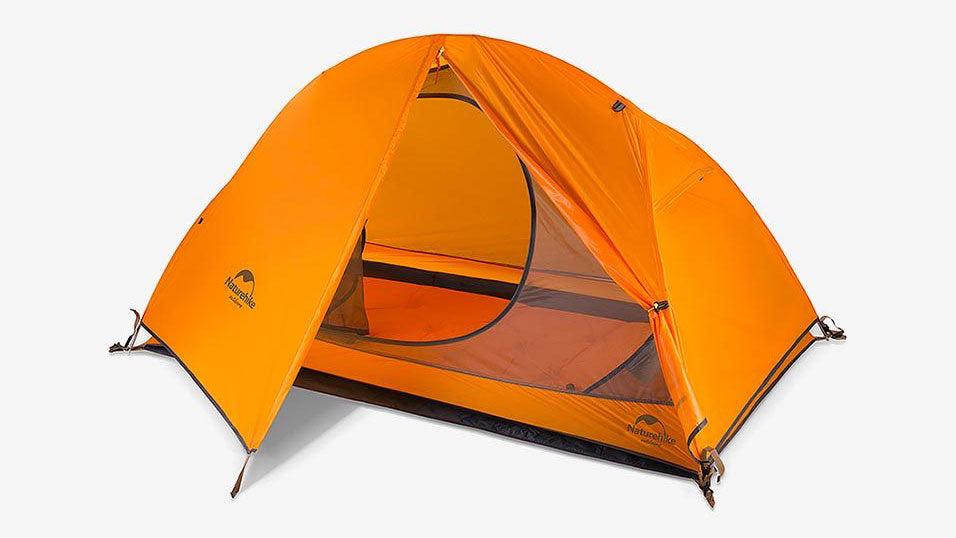
Overview
The Naturehike Spider is a lightweight 1-person, 3-season tent
that punches well above its price class on weather resistance, while making the trade-offs you’d expect at this budget.
Originally designed for cycling and backpacking, it works across very different terrains
— and it’s earned a loyal following among bikepackers and budget-conscious hikers who need a compact, freestanding double-wall without spending MSR money. A quick naming note:
the tent ships with a label stating “Spider” when ordered as a “Cloud Trek” — these are indeed the same tent
, just sold under different names across markets.
Key Specs
| Spec | Detail |
|---|---|
| Weight (manufacturer) | 1,400 g / 49.4 oz |
| Weight (with accessories) | ~1,618 g (incl. groundsheet) |
| Packed Size | 40 × 15 cm |
| Capacity | 1 person |
| Seasons | 3–4 |
| Freestanding | Yes |
| Double Wall | Yes |
| Doors / Vestibules | 1 / 1 |
| Interior Dimensions | 205 × 95 × 110 cm (L × W × H) |
| Rainfly | 20D nylon silicone, PU 4000mm |
| Inner Tent | B3 polyester mesh |
| Floor | 150D Oxford cloth |
| Poles | 7001 aluminum alloy |
| Model Number | NH18A095-D |

Would the Spider 1 earn its spot in your pack?
1400 g · 49.4 ozAdd the Naturehike Spider 1 to your Gear Closet and see exactly what it does to your base weight, then start packing for your next trip.
Free · No credit card · iOS, Android & web · Trusted by 3,000+ backpackers
Performance
Weather Resistance
The 4000mm-rated fly earns its keep. In real-world testing on Stage 5 of the Rim of Africa hike across the Langeberg Mountains, winds reached about 60 km/h with stronger gusts — and the tent held firm throughout the night. Reddit users echo this: the Spider 1 has survived some pretty intense storms and strong winds, with at least one owner having slept in it in winter at -5°C.
The design has a directional aerodynamic profile worth understanding. The design is “fin-like,” which is both a strength and a weakness — pitched correctly, the tent is very aerodynamic, but if it catches the wind side-on, it takes more of a hammering than a usual dome-shaped tent. Even so, the double-wishbone pole design provides good stability which, combined with a pegged-out flysheet and guy-lines, can stand up to strong wind. Site selection matters more here than with a symmetric dome. Always orient the narrow end into the prevailing wind.
Even on level ground, there’s some flysheet movement. In high winds, this can create noise or stress the material, but extending the peg points slightly with accessory cord helps to tighten the flysheet and improve aerodynamics.
Carry a couple of extra guylines — it’s a cheap fix that meaningfully improves storm performance.
Ventilation & Condensation
The tent has one air vent at the head end and a fully mesh inner, which provides ample ventilation — one reviewer reported no excessive condensation.
The all-mesh inner is a double-edged sword, though.
The full-mesh inner makes the tent less suitable for sub-zero conditions, as it offers little insulation, but for most three-season hikes, this is a fair trade-off for its low weight and breathability.
If you’re camping in genuinely cold, windless nights, you’ll feel it.
Interior Space & Livability
The inside is comfortably sized for one person, with enough floor space to keep gear inside while sleeping. The measured floor space is 204 × 93 cm, but because of the internal angles, the usable length is slightly less.
That’s where taller hikers run into trouble.
One owner who is 6 ft found it definitively too small, touching both ends without a mattress — suggesting 5’10” as the practical height ceiling.
Another reviewer who is 1.86 m (6’1”) reported “about 2–3 cm of clearance,” so your mileage literally depends on your inseam. At 110 cm peak height,
despite the sharp roof angles, there’s enough headroom to sit upright comfortably.
A small triangular storage pouch is located at the head end, and there’s a light hook in the roof
— small touches that show the designers thought about actual use.
A 75 L backpack fits comfortably under the vestibule, with a 105 L pack possible at a squeeze.
Setup
Pitching takes about 8 minutes. The inner clips to the poles and the flysheet clips to the inner — just ensure the poles are properly seated at the hubs, as the force is focused at those junction points.
This is an inner-first design, which means if you arrive in the rain, the inner gets wet before the fly goes on. That’s a meaningful practical annoyance. The freestanding setup does offset this somewhat —
the 2-Y pole system enables setup in roughly 5 minutes once you’ve practiced it.
Weight & Pack Size
Naturehike quotes 1,400 g, but be aware of a brand-wide quirk: Naturehike quotes all their weights before pegs and guys. With the included groundsheet and hardware, real-world carry weight is closer to 1,618 g. That’s not a featherweight by ultralight standards, but compared to an MSR Hubba, it’s roughly a quarter of the cost and only about 300 g heavier, performing well in challenging conditions. The packed size is where it genuinely shines: it fits into a bike’s handlebar bag — which is no small feat for a freestanding double-wall tent.
Durability
One owner used it for hiking across very different terrains over five years — from the rugged mountains of the UAE to camping at around 3,600 m on Mount Elgon — and reported it held up better than expected.
The silicone coating on the fly contributes here:
silicone coat filters out some UV, making the tent less prone to UV damage
than cheaper PU-only options. The 150D Oxford floor is relatively burly for a tent at this weight, though you’ll still want a footprint on rocky ground.
Pros & Cons
Pros
- Strong weather resistance for the price — 4000mm fly holds up in genuine storms
- Full-mesh inner keeps condensation manageable in three-season conditions
- Truly compact packed size (40 × 15 cm) — genuinely handlebar-bag compatible
- Freestanding, so usable on harder surfaces where staking is difficult
- Includes groundsheet out of the box — a real value-add
- Multi-year durability reported by long-term owners
- Under $100 at most retailers
Cons
- Inner-first pitching system: inner gets wet in a rainstorm setup
- Practical length limit around 178 cm (5’10”) — taller hikers will be cramped
- Flysheet is loose without careful guying; add extra guylines at purchase
- Side-wind exposure is a real vulnerability — orientation matters
- Manufacturer weight (1,400 g) excludes pegs and guys; real carry weight is higher
- Single door only — a limitation for a tent at this price
- Full mesh inner offers little insulation below freezing
Who Should Buy This
The Spider 1 is best suited to hikers and bikepackers under 178 cm who want a freestanding, double-wall shelter under $100 that can genuinely handle three-season weather. It’s a particularly strong pick for bikepacking, where the 40 cm packed length opens up handlebar or frame bag options that few freestanding tents can match. It also works well as an entry-level backpacking tent for someone who doesn’t want to compromise on waterproofing but can’t yet justify the asking price of an MSR Hubba or Big Agnes Copper Spur.
Verdict
The Spider 1 is hard to fault on a per-dollar basis: it’s a legitimately weatherproof, freestanding double-wall tent with a multi-year durability record and a bikepacking-friendly packed size — all for well under $100. The inner-first pitch is a genuine inconvenience in wet conditions, the length ceiling will exclude taller hikers, and the carry weight is meaningfully higher than the manufacturer’s headline figure. Take those trade-offs on board, and you’ve got one of the better value-for-money shelters at this price point. Rating: 7/10.