Naturehike Cloud Peak Review
Naturehike's Cloud Peak is a roomy, freestanding three-pole 2P tent that pitches fast and holds in wind, at about 2.3 kg. Its "4-season" label is generous.
Overview
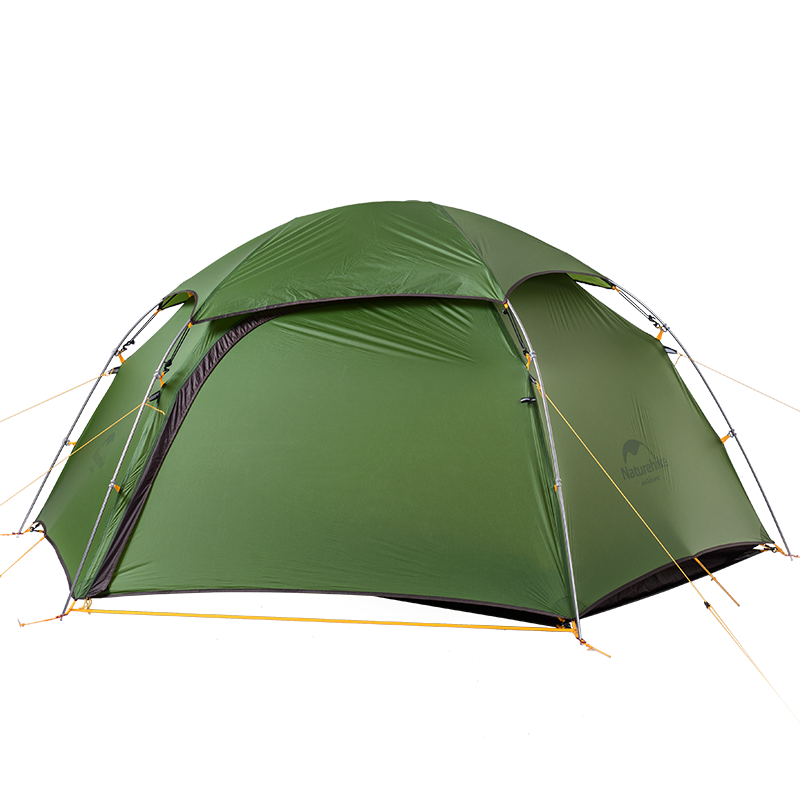
The Cloud Peak is Naturehike’s answer to the Hilleberg Allak: a hexagonal, freestanding, three-pole tent with two side doors and two vestibules. It is built for backpackers who want a livable two-person shelter at a budget price and will accept a weight penalty to get one. The trade-off is simple. It is more tent than the brand’s Cloud Up line, and about a kilogram heavier than a trekking-pole shelter of similar floor area.
Key Specs
| Spec | Detail |
|---|---|
| Weight | 2,260–2,300 g depending on version |
| Capacity | 2-person |
| Season rating | 4-season |
| Fly fabric | 20D silicone-coated ripstop nylon, PU 4000 mm+ |
| Floor fabric | 20D silicone-coated ripstop nylon, PU 4000 mm+ |
| Inner tent | Polyester mesh |
| Poles | 7001 aluminum alloy, three-pole cross structure |
| Doors | Two side doors, two vestibules |
| Expanded size | 274 × 210 × 105 cm |
| Packed size | Φ15 × 50 cm |
| Model | NH17K240-Y |
Versions compared
| Image | Version | Weight | vs. lightest |
|---|---|---|---|
| 2260 g 2P | 2260 g (79.7 oz) | lightest |
 | 2300 g 2P | 2300 g (81.1 oz) | +40 g |

Would the Cloud Peak earn its spot in your pack?
2260 g · 79.7 ozAdd the Naturehike Cloud Peak to your Gear Closet and see exactly what it does to your base weight, then start packing for your next trip.
Free · No credit card · iOS, Android & web · Trusted by 3,000+ backpackers
Performance
Setup. The Cloud Peak is properly freestanding. It pitches fly-first, so the inner stays dry when the tent goes up or comes down in rain. Owners say it stands without stakes in calm air, though the usual advice applies: peg it out anyway. The three-pole cross structure is the cost of that stability. Reddit users describe it as slower and fussier than a two-pole dome, a chore at the end of a long day, and that matches the tent’s sturdy feel once it is up. Plan on a few extra minutes at camp, more if pitching alone.
Space. This is the tent’s best argument. The hexagonal plan and 210 cm length give two adults real shoulder room, and the side doors mean nobody climbs over a partner to get out at night. Retailers describe the floor as wide enough for two sleeping pads side by side. Owners who have used both tents consistently rate it well ahead of the Cloud Up 2, which is narrower and has a single end door. Each side has its own vestibule, and reviewers single out the vestibules as big enough for gear and for cooking out of the weather.
Wind and weather. Owners rate the stability highly. One calls it rock solid in wind for the money. Another says the three independent poles avoid the weak spot of interconnected pole sets. A UK owner’s first night in torrential rain and strong wind left the tent standing, though a little spray came through and the footprint pooled water underneath. Cycloscope’s roundup picks the Cloud Peak as Naturehike’s best tent for winter expeditions, citing its snow-load capacity. A fair reading is that it handles shoulder-season cold, heavy rain and a snow squall well. It is not a Hilleberg-grade storm shelter, and with this much sail area it should be fully staked and guyed on exposed ground.
Ventilation. A vent at the top of the fly works with the mesh inner and the twin doors. That setup moves more air than a single-door tunnel tent. Some condensation on cold, still nights is normal for any double-wall tent in this fabric class.
Weight in the real world. The listed 2.26 kg excludes the footprint. Owners weighing a full kit with groundsheet report about 2.5–2.6 kg. That is heavy by thru-hiker standards. One owner who also has a Hilleberg Allak says the Cloud Peak is roughly a kilo lighter and packs smaller, which is why it gets the trip.
Durability. Owners of Naturehike’s Cloud-series tents generally describe them as sturdy for the price. The recurring caution is the zippers, which deserve gentle handling. Carry a pole repair sleeve, as with any budget tent.
Choosing a Version
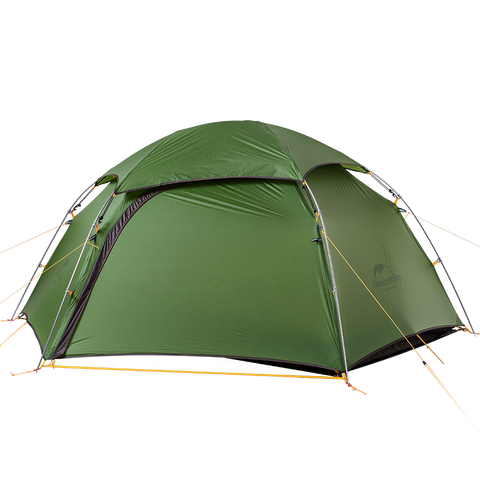
The two listings, 2,260 g and 2,300 g, share the same fabrics, aluminum poles, 274 × 210 × 105 cm footprint and Φ15 × 50 cm packed size. The difference is 40 g, about 1.4 oz, or under 2 percent of the total. That is less than most hikers shed by swapping a stuff sack. The practical advice is to buy whichever is in stock at the better price. Neither one makes the tent a lightweight option.
Pros & Cons
Pros
- Truly freestanding, and it pitches fly-first so the inner stays dry
- Roomy for two, with side doors and a vestibule on each side
- Owners report it is stable in wind, and the three independent poles resist snow load
- 4000 mm+ fly and floor handle sustained rain
- Packs to Φ15 × 50 cm, a reasonable size for the volume
Cons
- 2.26–2.3 kg before footprint and stakes, well above trekking-pole 2P shelters
- The three-pole setup is slower than a simple dome or tunnel
- “4-season” overstates it for exposed or alpine winter use
- Owners advise careful handling of the zippers
- Water can pool on the footprint in heavy rain
Who Should Buy This
This tent suits couples and pairs who want a comfortable freestanding shelter for shoulder-season trips, rainy-climate camping and the occasional cold night, and who care more about interior room and wind stability than base weight. It also works for bike tourers and car-access backpackers who need a tent that holds up. Gram-counters, thru-hikers aiming at a sub-3-lb shelter and anyone planning real mountaineering should look elsewhere.
Verdict
The Cloud Peak delivers what most budget 2P tents promise and miss: actual room for two, a stable pitch and sound weather protection. It costs weight and some setup time. Buy it as a sturdy shoulder-season shelter and it earns its place. Buy it for winter expeditions or a light pack and it will disappoint.