MSR Hubba Hubba 2 Review
Packstack is reader-supported. When you buy through links on our site, we may earn an affiliate commission. This does not affect the independence or objectivity of our reviews.
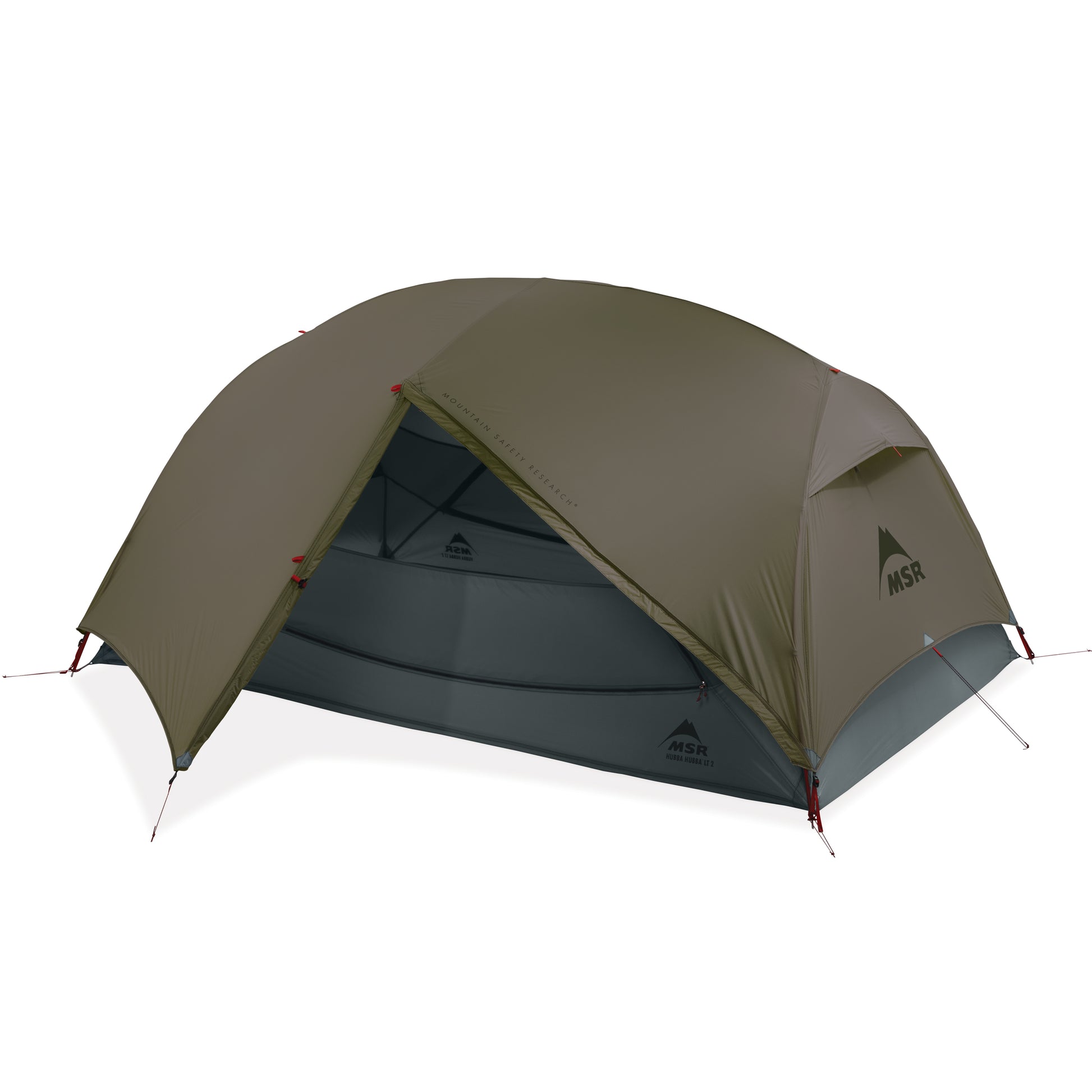
A thorough review of the MSR Hubba Hubba 2 backpacking tent — a freestanding, double-wall 3-season shelter balancing livability, weather protection, and sub-3-pound weight.
Overview
The MSR Hubba Hubba line has been a long-standing favorite among backpackers who want a balance of low weight, durability, and comfort.
The Hubba Hubba 2 is a freestanding, double-wall, 3-season two-person tent aimed squarely at backpackers who want real livability — think rectangular floor plan, dual doors, dual vestibules — without crossing over into burdensome territory.
It might not be the best option for the ultralight backpacker looking to shed every ounce, but it’s perfect for a pair that can split the weight.
Key Specs
| Spec | Value |
|---|---|
| Capacity | 2-person |
| Seasons | 3-season |
| Min Trail Weight | 1,304 g (2 lb 14 oz) |
| Packed Weight | 1,474 g (3 lb 4 oz) |
| Interior Peak Height | 40 in (1.01 m) |
| Floor Area | 29 sq ft (2.7 m²) |
| Floor Dimensions | 84 × 50 in |
| Vestibules | 2 × 8 sq ft |
| Doors | 2 |
| Rainfly Material | 20D ripstop nylon, DuraShield PU/silicone coating |
| Canopy Material | 20D ripstop nylon + 10D polyester micromesh |
| Floor Material | 20D ripstop nylon, DuraShield PU + DWR |
| Pole System | Easton Syclone composite, unified hub system |
| MSRP | ~$479.95 |
Would the Hubba Hubba 2 earn its spot in your pack?
1304 g · 46.0 ozAdd the MSR Hubba Hubba 2 to your gear closet and see exactly what it does to your base weight — then build your next packing list around it. Free, in about two minutes.
Free · No credit card · iOS & Android · Trusted by 3,000+ backpackers
Performance
Weight & Packability
At 1,304 g trail weight, the Hubba Hubba 2 lands in the middle of the lightweight category. Its listed packaged weight of 3 lb 4 oz puts it squarely alongside the Big Agnes Copper Spur HV UL2 and Nemo Dragonfly Osmo 2P (both 3 lb 2 oz). You can go lighter with the Big Agnes Tiger Wall UL2 (2 lb 8 oz), Fly Creek HV UL2 (2 lb 4 oz), or Nemo Hornet Osmo 2P (2 lb 8 oz), but those tents use thinner fabrics and compromise interior space at the foot end. That’s the real trade-off to understand upfront: the Hubba Hubba 2 trades a few ounces for genuine livability rather than a cramped, tapered cave. The tent splits neatly between two partners, bringing the per-person carry to around 650 g — reasonable by any standard.
Livability & Interior Space
This is where the Hubba Hubba earns its reputation. The symmetrical floor and dual-hubbed pole design are a big help. Whereas some lightweight models like the Hornet and Tiger Wall cut weight with slanted walls that taper at the feet, MSR kept the interior open and spacious with near-vertical walls and doors — leaving the option for two backpackers to sleep head to foot to maximize shoulder room. The newer iterations drastically open the interior space with a longer ridge pole and wider Y-shaped pole spread, making it one of the roomier two-person tents around, with a floor space of 32 square feet and a wide peak height of 40 inches.
Interior storage is a standout quality. There are two huge mesh pockets at both the head and foot, spanning the tent’s entire width and capable of holding an impressive amount of gear, complemented by two smaller overhead pockets.
The ceiling also features two triangular gear loft pockets, including a clothesline to hang damp laundry.
The two vestibules measure around 8 sq ft each — plenty for stashing boots and packs under the fly with room to spare.
That said, if you’re comparing against the Nemo Dagger Osmo’s cavernous 12.1 sq ft vestibules, you’ll notice the difference.
Setup
The symmetrical structure and pole system are so foolproof and intuitive that a solo backpacker can pitch this tent in only a couple of minutes.
The tent comes with a one-piece, many-segmented pole that has multiple hubs, forming an exoskeleton to support the inner tent and rainfly. The inner clips to the poles, and then the rainfly is draped over the top. Setup instructions are even sewn into the stuff sack, making them impossible to misplace.
One consistent gripe worth flagging: the Hubba Hubba pitches inside-first, so putting it up in the rain will result in a wet inner. This is not unique to the Hubba Hubba, but in a sustained downpour it’s annoying. Experienced users have developed a workaround — threading the poles through the fly first to create a freestanding roof, then clipping the inner from the inside — which largely solves the problem once you’ve practiced it a couple of times.
Weather Protection
With composite poles borrowed from their winter collection, a sturdy freestanding shape, and full-coverage rainfly, the Hubba Hubba is a solid performer in wet and windy conditions. The Easton Syclone poles are designed to flex and return to their original shape even in very strong gusts. In notoriously violent Patagonian winds, the tent held strong with no signs of letting up throughout the night.
Other quality weatherproofing measures include a raised bathtub floor to prevent leaking, as well as a waterproof DuraShield coating and taped seams on the fly to shed excess moisture.
The “gutter” feature on the vestibule doors keeps your entry dry during wet weather.
On the wind side, there’s a caveat worth noting: the tent has quite tall, steep-sided walls which can catch the full brunt of a wind, and it doesn’t have a low-profile shape. For campers who frequently go out in tumultuous weather this may be a deal-breaker, but for those only camping in fairer conditions it won’t be a problem.
Ventilation & Condensation
Ventilation is excellent for a tent of this class. Mesh panels on the tent body promote airflow, while roof vents help release warm, moist air.
Condensation can still form in humid or cold conditions, but it is generally well managed and does not drip onto occupants due to the double-wall design.
The double-wall construction does its job:
the pole structure preserves a gap between the inner and outer, so that condensation is not transferred to the inner compartment where it can make you wet, but instead remains on the underside of the rainfly.
Pros & Cons
Pros
- Genuine rectangular, non-tapered floor plan — accommodates modern wide sleeping pads
- One of the more livable floor plans in its weight class
- Fast, intuitive freestanding setup — manageable solo in minutes
- Dual doors and vestibules mean no climbing over your tentmate at 3 a.m.
-
Easton Syclone poles are engineered to flex and return to shape rather than permanently bend or snap.
-
Reinforced patches, pre-taped seams, and extra stitching at guy points add to rugged construction.
- Freestanding design works on virtually any surface — packed dirt, sand, rock platforms
Cons
- Inner-first pitch exposes the inside to rain during setup
- Not the lightest option; ultralight alternatives like the Tiger Wall UL2 save ~300 g at a similar price
-
The footprint must be purchased separately, which feels like a ding at this price point.
-
Vestibules are smaller than the Copper Spur’s (9 sq ft) and well short of the ultra-spacious Dagger (12.1 sq ft).
- Tall, vertical walls can catch wind — site orientation matters more than with lower-profile shelters
- Premium pricing (~$480) leaves little room for imperfection
Who Should Buy This
The Hubba Hubba 2 is built for partners who want a freestanding, feature-rich shelter they can trust in three-season backcountry conditions without destroying their base weight. It’s an especially natural fit for couples on moderate-to-long thru-hikes or weekend warriors who camp in mixed weather and want easy setup, real headroom, and the peace of mind that comes from a well-engineered double-wall tent. Constructed with resilient 20-denier nylon throughout, the fabric is highly resistant to punctures and tears, making it great for rugged environments — and it will handle thousands of miles without much maintenance. If your primary goal is gram-counting or solo hiking, there are lighter, cheaper shelters worth considering first. But for a two-person team willing to split the load, the Hubba Hubba 2 is hard to beat on livability per ounce.
Verdict
Among three-season backpacking tents, the Hubba Hubba 2 is not the lightest, not the cheapest, and not necessarily the very toughest in a full storm. But what it does offer is a good balance of those qualities — and more notable still is its excellent space-to-weight ratio, which is up there with the best in its class.
At 1,304 g trail weight, it earns its place in the pack. If you and a partner are looking for a single, reliable 3-season shelter that will hold up for years without demanding constant workarounds, this is still the benchmark against which competitors are measured. Rating: 8/10.