Mountain Laurel Designs DuoMid Review
The MLD DuoMid in .75 DCF pitches a two-person pyramid on one trekking pole for 439 g, trading a floor and a high price for weather security.
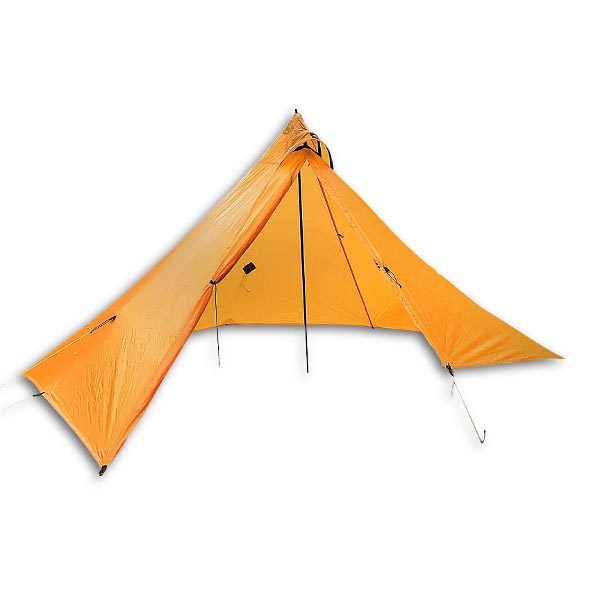
Overview
The DuoMid is Mountain Laurel Designs’ floorless, single-wall pyramid for one or two people, built from .75 DCF and held up by a single trekking pole. At 439 g it weighs less than most solo tents and sleeps two people with room left over for packs. The trade-off is the usual one for a mid: no floor, no bug netting unless it’s added, and a pitch that rewards practice.
Key Specs
| Spec | Detail |
|---|---|
| Type | Floorless single-wall pyramid |
| Fabric | .75 DCF (Dyneema Composite Fabric) |
| Weight | 439 g (15.5 oz) in DCF; the silnylon/SilPoly version is listed at up to 510 g |
| Length | 110 in / 280 cm |
| Width | 68 in / 172 cm |
| Peak height | 55 in / 140 cm |
| Floor area | 45+ sq ft / 4.1+ sq m |
| Capacity | 2 person |
| Pitch | One trekking pole, or a ridgeline from the peak loop |
| Seams | Taped (no seam sealing needed in DCF) |

Would the DuoMid earn its spot in your pack?
439 g · 15.5 ozAdd the Mountain Laurel Designs DuoMid to your Gear Closet and see exactly what it does to your base weight, then start packing for your next trip.
Free · No credit card · iOS, Android & web · Trusted by 3,000+ backpackers
Performance
Weight and space. The numbers are the pitch. Adventure Alan’s testers calculate about 46 sq ft of floor area per pound of shelter, a ratio few enclosed shelters match. Ben Kilbourne, who logged a long-term review of a .75 DCF DuoMid, put his at 16 oz with guylines, half a pound under his old silnylon version, which weighed 24 oz sealed and with long guylines. DCF doesn’t stretch when wet, so there’s no mid-night sag after a rainstorm. Kilbourne noted that DCF can still stretch, and his did during one violent desert windstorm in Utah.
Weather. The pyramid shape does most of the work. Section Hiker’s reviewer, who used the DuoMid through a 13-day TGO Challenge crossing of Scotland, describes a shelter that sheds wind and rain well. It pitches in a slightly six-sided shape when taut, which is why it needs six stakes for the base setup. Owners add more guylines in heavy wind and, in storms, lower the pitch toward the ground to cut spindrift and splashback. Kilbourne says the DuoMid handles just about any three-season conditions and some four-season ones. He could sleep through sideways sleet without worry.
It isn’t uncontested. One Section Hiker commenter argued the steep long sides catch wind more than a rounded mid would. Owners generally avoid the problem by pitching with the narrow end toward the weather.
Condensation. This is a single wall, so moisture is part of the deal. The peak vent helps. Section Hiker’s long-term reviewer kept it open and found condensation manageable even in heavy rain. In Scotland, most nights were pitched with 2–4 inches of gap under the walls to keep the interior dry, at the cost of some warmth. The steep walls keep wet fabric away from a sleeper’s head and quilt. Even so, expect some moisture on humid, still nights.
Livability. Two people fit, and it’s roomier than it sounds because of the straight walls. The shelter is long enough that Section Hiker’s reviewer calls it a palace for one. Veterans of the shelter often use it that way, with the sleep system at the rear and the front half left for gear and cooking out of the weather. Cooking inside is something owners do in wind, with the usual caution about stoves and fabric. Chris Townsend of The Great Outdoors judged the original size great for one and fine for two as long as neither is very tall. Taller pairs should look at the larger DuoMid XL, which is a different product.
Setup. One pole in the middle of the doorway is the simplest possible pitch. Owners report setup in two to three minutes once practiced, though Section Hiker stresses that getting the pole height right matters, so adjustable poles are recommended. Hunters have also used two poles strapped together. A peak loop allows a ridgeline pitch between trees, which clears the center pole entirely.
Bugs and ground. The floorless design means a separate inner, bivy or groundsheet. Kilbourne found a one-person Solomid XL inner (9.5–10.5 oz depending on floor material) the most comfortable of the options he tried, though adding inner weight narrows the gap with ordinary tents. Some owners go without the inner except during peak bug season.
Durability and availability. DCF requires care around abrasion and sharp rocks, and The Outdoor Gear Lab’s category testing lists Dyneema’s fragility and price among its drawbacks. The DuoMid is made in the U.S. and sold direct, and buyers have long reported waiting lists.
Pros & Cons
Pros
- 439 g for a shelter that sleeps two with gear
- Steep pyramid walls shed wind, rain and snow
- DCF doesn’t absorb water or sag when wet
- Taped seams; no seam sealing required
- Peak vent, plus a ridgeline option via the peak loop
- Modular: use with an inner, bivy, groundsheet or nothing
Cons
- Expensive, with DCF priced well above the silnylon version
- Floorless; bug protection means buying and carrying an inner
- Single wall, so condensation management falls to the user
- Needs six stakes and a careful pitch to perform in storms
- Long, steep sides draw some criticism in strong crosswinds
- DCF is vulnerable to abrasion and can stretch under extreme load
Who Should Buy This
The DuoMid suits thru-hikers and weight-focused backpackers who already carry adjustable trekking poles, are comfortable pitching a mid, and want one shelter for solo hiking and the occasional shared night. Couples under about six feet who accept a floorless layout will find it roomy. Hikers who want a floor and bug netting built in, or who don’t use poles, should consider a freestanding double-wall tent. Anyone on a tight budget should look at the silnylon version at roughly 70 g more.
Verdict
The DuoMid is the benchmark two-person mid for good reason: it’s very light, sturdy in weather and simple to pitch. The DCF version is a luxury, but one that pays off for hikers counting every gram. It’s recommended for experienced ultralighters, and not for first-time tent buyers.