Hilleberg Unna Review
A deep dive into Hilleberg's freestanding solo tent — bombproof in bad weather, but heavy and vestibule-less for what it costs.
Overview
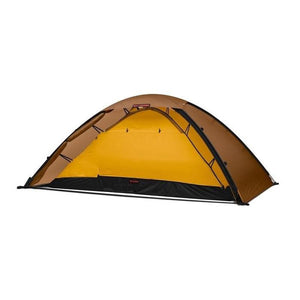
The Unna is Hilleberg’s simplest solo tent — a fully freestanding, two-pole dome built in the Red Label line, which sits in the middle of Hilleberg’s strength-to-weight spectrum (tougher than Yellow Label 3-season tents, lighter than Black Label expedition tents). It’s aimed at solo travelers — kayakers, bikepackers, alpinists, and long-distance backpackers — who want a tent that pitches anywhere from bare rock to deep snow and doesn’t care much what the forecast says. This isn’t an ultralight tent by 2026 standards, but it’s one of the lightest genuinely four-season, freestanding shelters you can buy.
Key Specs
| Spec | Value |
|---|---|
| Label | Red Label (all-season) |
| Capacity | 1 person |
| Trail weight | 2,000 g |
| Packed weight | 2,300 g |
| Packed size | 46 x 14 cm |
| Floor area | 2.5 m² |
| Inner dimensions | 230 x 110 cm |
| Head height | 100 cm |
| Poles | 2 x 9mm aluminum |
| Outer fabric | Kerlon 1200 |
| Inner fabric | 30D ripstop nylon, DWR |
| Floor fabric | 70D nylon, triple-coated PU |
| Vestibule | None (partial “virtual vestibule” via unclipped corner) |

Build your Gear Closet
View all of your gear in one place, create packing lists and hit the trail with confidence. Available on iOS, Android and the web.
Get StartedPerformance
Weather resistance. This is where the Unna earns its keep. It provides bomber protection from high wind and snow loading, and is equally or more comfortable than many two-person single wall tents, even though Hilleberg calls this a solo tent. The dome shape does a lot of the work here — the dome design holds its shape even without pegs, making it ideal for exposed sites. One reviewer who used the tent across a full range of Ontario seasons reported comfortable nights down to around -28°C with the right sleep system, and pointed out that the Unna is an exoskeletal design (poles on the outer) as all Hillies are, making it much easier to set up in wet snow or rain.
Pitching. Setup is genuinely fast for a double-wall tent, mostly because the inner and outer are pre-attached. The interior of the tent is never exposed when setting up as it is already attached to the outer fly with toggles, and it’s not clear why every other tent manufacturer hasn’t started doing this too. OutdoorGearLab clocked full setup, guylines and all, at about two minutes: two sleeves let you insert the poles quickly like all Hilleberg tunnel tents, and once tightened and guyed out the tent is rock solid in about 2 minutes tops — one of the fastest tents to pitch ever.
Livability. For a “solo” tent, the interior is unusually generous. Hilleberg claims a 1-person capacity, but two full-size sleeping pads will actually fit inside. The 230 cm inner length gives tall hikers real stretch-out room and space to store gear at the foot end without crowding your feet. The catch is the total lack of a real vestibule — a trade-off multiple owners flagged. As one CampSaver reviewer summed it up: no significant vestibule is the trade-off, and if you want a bomber tent with less inner space but a nice vestibule at a similar weight, look at the Soulo instead. Hilleberg’s workaround is to let you unclip a corner of the inner to create a makeshift gear pocket, and testers confirm it actually works: when using the tent alone, you can unhook several toggles in a corner to create vestibule space, which works well particularly if you want access to a wet pack.
Ventilation. Condensation management is solid by double-wall standards — most Hilleberg tents have best-in-class ventilation, and the Unna is no exception, though in truly still, humid conditions you’ll still get some morning dampness on the inner, as with any tent this size.
Weight, in context. At 2 kg trail weight this is genuinely light for what it is, but it’s still heavy next to purpose-built ultralight solo shelters. OutdoorGearLab was blunt about this: the Unna is very heavy for a solo tent, and when weight is the top priority their testers reached for lighter alternatives instead. The flip side is flexibility — pull the inner tent and you save real weight while gaining floor space, which is a trick few other freestanding dome tents offer. Removing the inner tent saves about 18 oz and creates a more spacious floorless tent.
Durability. This is a tent built to be used hard for a decade, not babied. Owners consistently describe it as packing small, relatively light, with a very roomy interior, and very, very strong — with the world-class quality you’d expect from any Hilleberg tent. One long-term Trailspace reviewer reported getting 6-7 years out of their Unna, though they noted abrasive, gritty environments can be tough on the zippers over time — worth keeping in mind if you’re planning a lot of desert or scree-field camping.
Pros & Cons
Pros
- Genuinely four-season capable in a freestanding package that pitches on rock, sand, or snow without stakes
- Fast to pitch — inner and outer go up together in about two minutes
- Roomy for a “1-person” tent; 230 cm length fits tall users plus gear
- Modular: remove the inner to save weight and gain a floorless shelter option
- Hilleberg build quality and Kerlon 1200 fabric durability are class-leading
Cons
- No real vestibule — wet gear storage is a workaround, not a feature
- Heavy relative to modern ultralight solo tents built for 3-season thru-hiking
- Premium price tag even by Hilleberg standards
- Single door limits airflow options in calm, humid conditions
- Zippers reportedly vulnerable to grit/dust in abrasive environments over years of use
Who Should Buy This
The Unna makes the most sense for solo travelers who camp in genuinely exposed or unpredictable conditions — above treeline, on rock ledges, sea kayaking trips, winter bikepacking, or shoulder-season mountaineering — where a stake-free, storm-worthy freestanding pitch matters more than shaving grams. If your trips are mostly established 3-season trails with reliable weather, you’re carrying more tent than you need; look at a lighter double-wall or trekking-pole shelter instead.
Verdict
The Unna does exactly what a Hilleberg is supposed to do: pitch fast, hold its shape in ugly weather, and outlast just about anything else in your gear closet. It’s not the tent to buy if grams are your only metric or if you need a proper vestibule for cooking and gear storage — but as a go-anywhere, all-season solo shelter for serious trips, it’s hard to beat. I’d put it at a 7.5/10: excellent at its actual job, just not the lightest or most versatile tool in the shed for casual three-season use.