Hilleberg Staika Review
A deep dive into Hilleberg's fully freestanding four-season dome tent, built for paddlers, ski tourers, and anyone who camps where staking out just isn't an option.
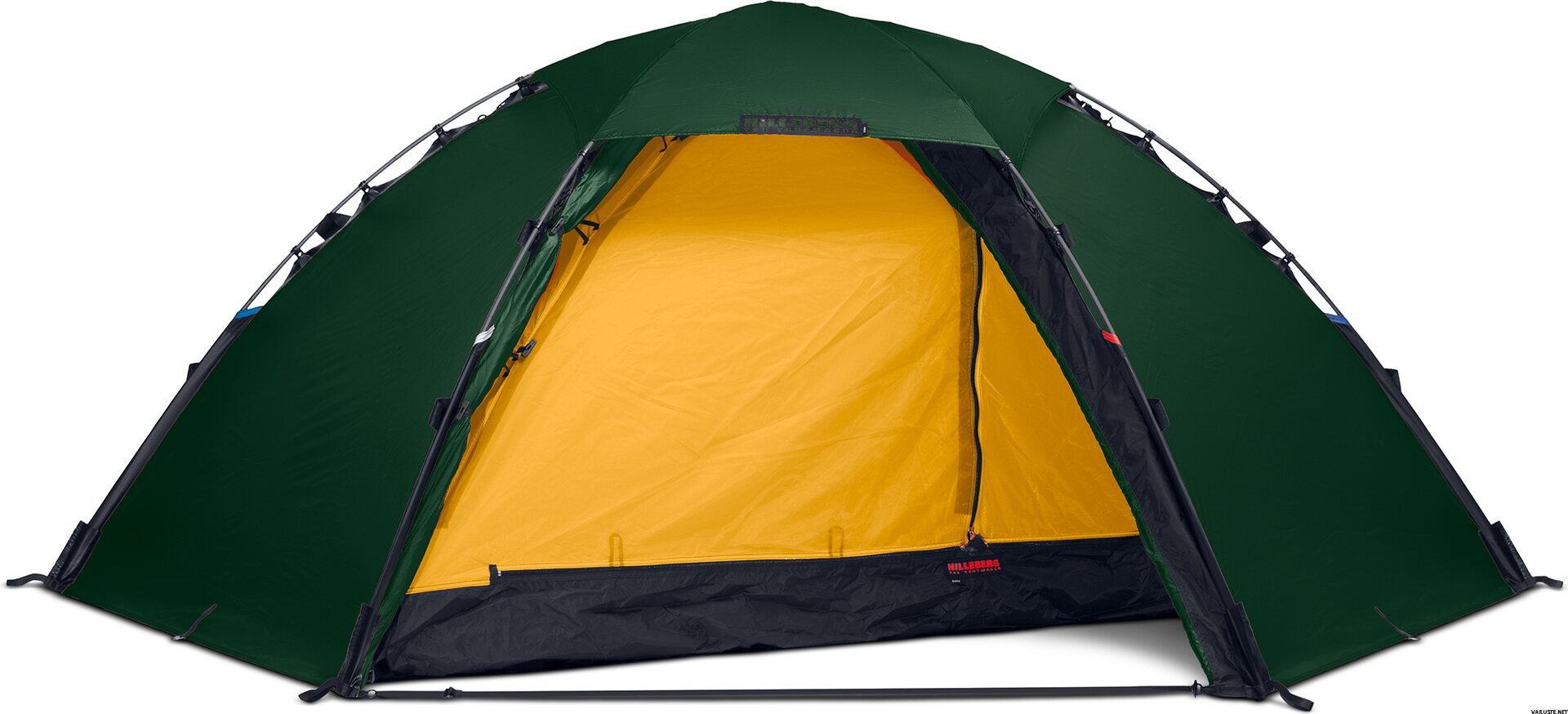
Overview
The Staika is Hilleberg’s original dome tent, first developed in 1989, and it’s still the brand’s answer for anyone who needs a fully freestanding, four-season shelter that doesn’t care what’s underneath it. The Staika was the first dome tent that Hilleberg developed, back in 1989, and it is fully free standing. It was designed with a specific problem in mind — pitching a tent on sand, rock slab, or snow where stakes just don’t work — and that origin story still defines who it’s for today.
Hilleberg originally designed the Staika for paddle tourers who wanted a highly stable, fully free standing tent for handling tricky pitching conditions. Since then, it has garnered a large, loyal following amongst mountaineers, polar travelers, and ski tourers who find it a supremely stable base camp tent in all conditions, along with bicycle tourers who love its simplicity.
If your trips involve exposed camps above treeline, winter touring, or put-ins where you can’t drive a stake, this is the tent built for that job. It’s not really aimed at the ounce-counting thru-hiker crowd — it’s a tool for people who prioritize bombproof shelter over pack weight.
Key Specs
| Spec | Detail |
|---|---|
| Capacity | 2 person |
| Season rating | 4-season (Black Label) |
| Packed weight | 4,000 g (8.8 lb) |
| Trail weight | 3,400 g (7.5 lb) |
| Outer fabric | Kerlon 1800 (silicone-coated ripstop) |
| Poles | 3 x 10 mm, 387 cm each |
| Pegs included | 16 Y-Pegs |
| Inner tent area | 3.2 m² |
| Vestibule area | 2 x 0.9 m² |
| Packed size | 50 x 23 cm |
| Freestanding | Yes, fully |

Would the Staika earn its spot in your pack?
3400 g · 119.9 ozAdd the Hilleberg The Tentmaker Staika to your Gear Closet and see exactly what it does to your base weight, then start packing for your next trip.
Free · No credit card · iOS, Android & web · Trusted by 3,000+ backpackers
Performance
Stability and weather resistance. The Staika’s whole reason for existing is stability without stakes, and that’s where it delivers. The three 10 mm poles cross at multiple points, which is what gives it its dome rigidity — the outer tent walls extend to the ground, mesh areas are backed with adjustable fabric panels, and the dome construction with multiple pole crossing points provides outstanding snow-load handling capability. One Trailspace reviewer who runs it in Colorado and Wyoming above treeline put it plainly: this is a great tent if you regularly experience heavy wind and/or storms, though if not it’s probably overkill, and it sets up extremely quickly while keeping the interior dry even if pitched in a storm. That “overkill if you don’t need it” caveat is worth taking seriously before you buy.
Livability. At 3.2 m² of inner tent space plus two 0.9 m² vestibules, this isn’t a cramped backpacking tent — it’s genuinely roomy for two. The two large, freestanding vestibules are a standout feature that one long-term user hadn’t seen matched in anything other than Hilleberg domes. The dual-door layout also solves a real problem in bad weather: venting runs right up through the top of the tent body and rainfly even in the rain, and the directionally opposed doors allow cross-flow circulation regardless of which way the wind is blowing.
Dry-pitch and floor design. One detail that keeps coming up in long-term reviews is how the fly meets the ground. A reviewer coming off years with an MSR Fury specifically called out that having the outer tent fly go fully to the ground is a very welcome feature the Fury (and most other tents) couldn’t manage, since even fully tightened there’s always 2-3 inches of exposed tent floor that lets water in if you touch it — the Staika will never have this issue. That’s a meaningful upgrade if you’ve ever had to sleep centered in your tent to avoid a wet sleeping bag during a storm.
Ventilation trade-off. It’s not all praise. More than one reviewer flagged condensation management as the tent’s weak point relative to its otherwise excellent weather sealing. One outlet noted it would benefit from more ventilation, but this is almost a trade-off for the level of protection it provides. That tracks — a tent this sealed against wind-driven rain and snow is inherently going to trap more moisture than a mesh-heavy three-season shelter. Users in dry climates report fewer issues; one Colorado owner noted ventilation is no problem for them, although that’s probably helped by very dry Colorado air. If you camp somewhere humid, expect to manage condensation more actively — crack the vents, wipe down the fly in the morning.
Weight and packed size. At 3,400 g trail weight (4,000 g packed with stakes and bag), this is heavy by ultralight standards but genuinely light for what it does. Weight, along with price, is the main reason this tent isn’t carried by more backpackers, though one long-term owner argued that carrying an 8-pound tent feels light given you’re getting a large two-door, two-vestibule, three-poled four-season self-standing dome with 36 cubic feet of living space. Packed size at 50 x 23 cm is reasonably compact for a 4-season double-wall dome, though it’ll still eat more pack volume than a typical 3-season shelter.
Build quality. This is the area where Hilleberg’s reputation gets earned. Multiple long-term owners describe it as the most well-built tent they’ve ever seen. The fabric itself has serious numbers behind it — Kerlon 1800 fabric carries an incredible 40 lb tear strength — and the floor gets similar praise: the 100 denier 3-coated floor almost feels rubbery and gives confidence it’ll keep out snow and rain.
Pros & Cons
Pros
- Fully freestanding — pitches on sand, rock, snow, or anywhere stakes won’t hold
- Exceptional storm and snow-load performance thanks to the crossing 3-pole dome design
- Fly goes fully to the ground, eliminating the gap-and-leak problem common in other tents
- Two full-size vestibules and dual doors with genuine cross-ventilation
- Build quality and fabric strength (Kerlon 1800) are best-in-class
- Quick to pitch once you’ve learned the system, even in bad weather
Cons
- Heavy for backpacking — 7.5-8.8 lb puts it well outside typical 3-season backpacking weights
- Ventilation is a known weak point in humid climates; condensation management takes effort
- Expensive, even by Hilleberg standards
- Genuinely overkill if you’re not regularly facing serious wind, snow, or storm conditions
- Packed size and weight make it a poor fit for anyone trying to keep a sub-20 lb base weight
Who Should Buy This
The Staika makes the most sense for paddlers, ski tourers, and mountaineers who need a tent that pitches reliably on surfaces where you can’t stake anything down — sand bars, granite slabs, packed snow. It’s also a strong pick for anyone who regularly camps above treeline in genuinely severe weather and wants a two-person shelter with real elbow room rather than a cramped solo-oriented mountaineering tent. If you’re a weight-conscious 3-season backpacker or thru-hiker, this isn’t your tent — the weight and price are hard to justify unless the extreme conditions and freestanding pitch are non-negotiable for your trips.
Verdict
The Staika does exactly what Hilleberg designed it to do: it’s an extremely stable, well-built, fully freestanding shelter for people who genuinely need to camp in serious wind, snow, or on unstakeable ground. It’s not a lightweight backpacking tent and it doesn’t pretend to be one — but for paddle touring, ski touring, and high-exposure basecamping, it’s hard to find a more trusted option. I’d rate it an 8.5/10: outstanding at its intended job, with weight and ventilation trade-offs that are the price of that capability.