Durston X-Mid Pro 2 Review
A deep dive into the Durston X-Mid Pro 2 — a 509g DCF trekking-pole shelter with patented offset geometry that punches well above its weight class in space, storm resistance, and ease of setup.
Overview
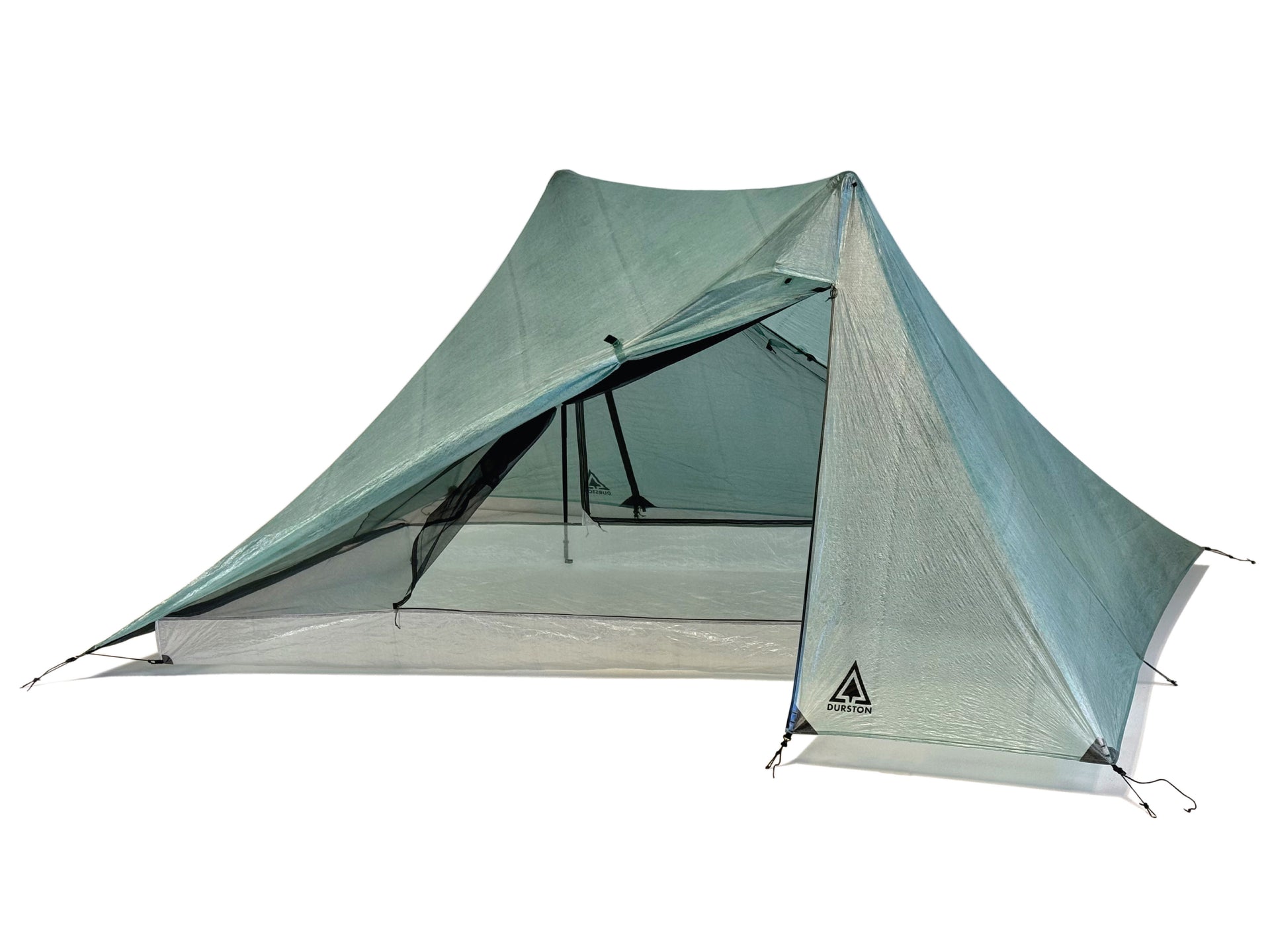
The Durston X-Mid Pro 2 is a two-person, trekking-pole-supported shelter built from Dyneema Composite Fabric (DCF) and anchored around Durston’s patented X-Mid geometry — an offset dual-pole design that squeezes genuinely impressive living space out of a sub-18 oz package. It’s aimed squarely at serious thru-hikers and ultralight backpackers who want DCF weight savings without the usual tradeoffs of crampedness or fragility. Think CDT, PCT, Te Araroa, or any long-distance route where every gram compounds over thousands of miles.
Key Specs
| Spec | Detail |
|---|---|
| Weight | 509 g / 17.9 oz (DCF floor) · 565 g / 19.9 oz (Silnylon floor) |
| Capacity | 2 person |
| Floor Dimensions | 90” L × 46” W |
| Peak Height (2P) | 6’4” (193 cm) |
| Peak Height (Solo) | 7’0” (213 cm) |
| Waterproofing | 8,000mm HH |
| Fly Fabric | 0.55 oz/yd² Dyneema Composite Fabric (DCF) |
| Wall Type | Hybrid single/double wall |
| Setup | 2 trekking poles + minimum 4 stakes |
| Doors / Vestibules | Dual / Dual |
| MSRP | ~$679–$739 (DCF floor; check durstongear.com for current pricing) |

Would the X-Mid Pro 2 earn its spot in your pack?
509 g · 18.0 ozAdd the Durston Gear X-Mid Pro 2 to your Gear Closet and see exactly what it does to your base weight, then start packing for your next trip.
Free · No credit card · iOS, Android & web · Trusted by 3,000+ backpackers
Performance
The Geometry Is the Story
You can’t review this tent without spending time on what makes it different. The entire X-Mid lineup uses Durston’s patented X-Mid geometry with twin-offset poles and a unique parallelogram internal/rectangle external shape that, according to Durston, provides best-in-class headspace, living room, and stormworthiness. In practice, what this means is that the poles are never in your doorways and never bisect your sleeping area — a problem that plagues most A-frame and mid-style trekking pole shelters. The ridgeline runs 60” long while competing tents are 45–50”, meaning the X-Mid Pro has 20–35% more headroom.
The floor layout threw a few reviewers off at first. Most people assume it’s supposed to be rectangular like every other ultralight backpacking tent — but the floor is actually an offset parallelogram. Once you understand why it exists, the penny drops: the floor is connected to the outer shell at each corner, creating a true bathtub-style structure once tensioned. The clever offset of the bathtub floor relative to the outer shell creates triangular vestibules on both sides without compromising internal living space — the result is exceptional space efficiency.
One nuance worth flagging for two-person use: the ridgeline is diagonal, so when two people share the tent, one person will have the highest area a bit above center while the other has it a bit below center. The asymmetry is real, and reviewers are split on how much it matters. For most height-matched partners sleeping side-by-side, it’s a non-issue. For taller hikers where every inch counts, it’s worth considering.
Weather and Storm Performance
This is where the X-Mid Pro 2 consistently earns respect. For a trekking pole tent, the X-Mid Pro 2 excels in harsh weather — it stood up impressively to strong winds and storms, maintaining stability even in challenging conditions. Over three years of testing in steady rain, light snow, and winds up to around 30 mph, the steep walls shed rain and snow well, with no zipper leaks, and the non-elastic Dyneema fabric maintains good tension in wet conditions.
The unique design creates no flat spots for snow to build up, and all of the angles created by the offset twin-pole design deflect wind remarkably well — it doesn’t matter which direction the wind is blowing.
The fly reaches close to the ground, which prevents splashback from rain — something competing shelters sacrifice by trimming the fly hem for weight savings.
Condensation
Here’s the honest part of the single-wall conversation. The X-Mid Pro is single-wall in some parts (ends, roof) but still double-wall in others (sides), making it a hybrid tent. The design is 100% bug-proof and brings substantial weight savings, but the downside is that you don’t have the ability to use the fly and inner separately, and there aren’t mesh inner walls in all areas to prevent you from touching the fly if condensation occurs.
Dual peak vents allow for condensation management and are designed to function in all but the most horrendous weather, such as sideways-driven rain or blowing spindrift.
In practice,
condensation isn’t an issue in mild conditions given the two ventilation ports, but with two people and temperatures approaching freezing, you’ll notice more buildup — keeping the vents open is key.
This isn’t unique to the X-Mid Pro, but it’s worth calibrating expectations if you’re coming from a full double-wall tent.
Setup
The X-Mid design utilizes a pair of trekking poles and a minimum of four stakes to pitch, with no mandatory guylines.
The tent is very quick to set up once you get the hang of it — stake out the four corners in a rectangle, insert the trekking poles, and retighten the guylines. The hardest part is ensuring the four corners are at right angles to each other, which is more difficult on uneven ground. With practice, you can set it up in under two minutes.
Note that you’ll want at least 6 stakes to open both vestibules fully —
the tent can technically be pitched with just 4, but 6 stakes makes the shelter fully functional with two spacious vestibules.
Durability and Construction
One of the most common failure points of DCF shelters is sewn seams — the seams on the X-Mid Pro 2 are entirely bonded with no sewing.
Durston uses hot-bonded construction to create seams that are stronger and better retain their strength in extreme temperatures, and a proprietary pre-shrinking process so the shape is more stable over time and won’t deform or create wavy zippers like other DCF tents.
The main long-term concern raised across user reports involves zippers. Around 1,200 miles of use, zipper issues commonly surface — either crimping them back down or replacing them is the usual fix, and Durston is reportedly planning to ship spare zipper crimps. In extreme conditions like the Utah desert and Grand Canyon, constant fine sand and dust eventually destroyed the zippers on one reviewer’s tent. Worth carrying a bit of zipper lubricant on an abrasive desert route.
On the floor: the thin silnylon or DCF material needs respect. Durston uses a 20-denier fabric for the floor, which is still lightweight and prone to punctures, so carrying a groundsheet in rocky terrain is worth considering.
Footprint
The rectangular shape is genuinely large, and this comes up consistently. It’s a pretty big footprint, so it may not be your best bet if you’re dealing with small campsites. The footprint is quite large, and its rectangular shape makes it more challenging to fit into natural spots compared to hexagonal designs. That said, Durston provides guides for alternative pitching methods that collapse the vestibules, offering a considerably reduced footprint when space constraints arise.
Pros & Cons
Pros
- At 509 g with the DCF floor, genuinely competitive weight for a fully-featured 2P shelter
- Exceptional space efficiency — 30 sq ft floor, 23 sq ft of vestibule, and a 60” diagonal ridgeline
- No mandatory guylines; fast, intuitive setup with only 4 stakes
- Full-coverage fly that extends close to the ground for rain and draft protection
- Hot-bonded seams; no-sag DCF fly maintains tension in wet weather
- Dual peak vents with magnetic toggles manage condensation well
- Dual large doors and vestibules; poles never block entry
- Fits occupants up to 6’4” (2P) or 7’0” (solo)
Cons
- Premium price: ~$679–$739 for DCF floor version, double the cost of the standard X-Mid 2
- Hybrid single-wall construction means more care needed to avoid touching fly during condensation
- Large rectangular footprint — harder to find a flat site than hexagonal or tapered alternatives
- Asymmetric headroom in 2P use: one occupant always gets slightly less
- Thin floor (silnylon or DCF) warrants a footprint in rocky or abrasive terrain
- Zippers can degrade on high-mileage thru-hikes; desert grit accelerates wear
- Requires trekking poles — non-starters for trekking-pole-free hikers
Who Should Buy This
The X-Mid Pro 2 is the right call for the thru-hiker or serious multi-week tripper who uses trekking poles anyway, cares about every gram, and doesn’t want to sacrifice comfort for weight savings. It’s well-suited for hikers and ultralight backpackers looking for the lightest and overall highest-performing two-person tent — while marginally lighter options exist, they generally involve significant compromises in durability and storm protection. Solo hikers who want a palatial single-occupancy setup at very low weight will also find this hard to beat. It’s overkill — financially and logistically — for occasional weekend trips. If you’re only doing the occasional weekend trip, don’t bother; but if you’re planning a thru-hike, it’s definitely worth considering, provided your budget is adequate.
Verdict
The X-Mid Pro 2 is the most thoughtfully engineered trekking-pole shelter in this weight class, and the DCF floor version at 509 g is a genuine achievement in the “light and livable” category. The condensation nuances and zipper longevity are real considerations on long trips, but neither is a dealbreaker if you’re prepared for them. At ~$679–$739, it’s an expensive tent — but for a thru-hiker who will live in it for months, it’s one of the best shelters money can buy right now. 9/10.