Big Agnes Copper Spur HV UL3 Review
Packstack is reader-supported. When you buy through links on our site, we may earn an affiliate commission. This does not affect the independence or objectivity of our reviews.
The Copper Spur HV UL3 delivers an exceptional space-to-weight ratio for a freestanding 3-person tent, though it's truly at its best sheltering two.
Overview
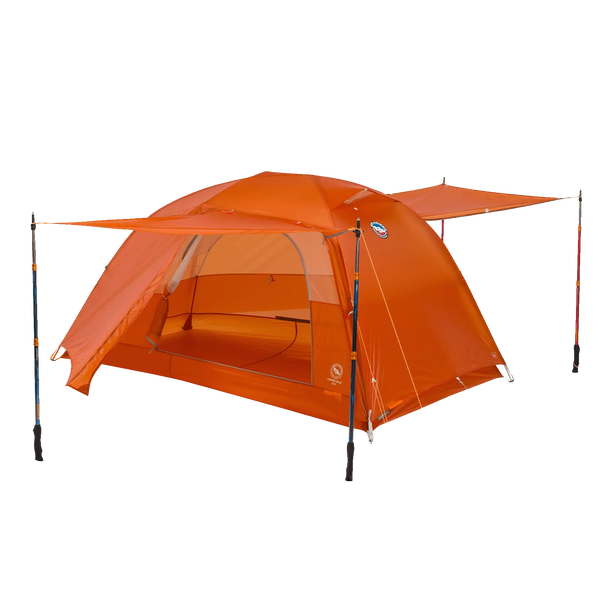
The Big Agnes Copper Spur HV UL3 is a three-season, freestanding double-wall tent built around one core idea: give you as much livable space as possible without making you pay for it in pack weight. The “HV” (High Volume) designation is the real story — pre-bent DAC poles push the walls nearly vertical, delivering a 43-inch peak height and a genuinely palatial interior in a package that trails at just 3 lb 9 oz. It’s technically a three-person tent, but most people who buy it are either a duo craving elbow room or a trio willing to split the weight and sleep cozy.
Key Specs
| Spec | Value |
|---|---|
| Trail Weight | 3 lb 9 oz (1620g) |
| Packed Weight | 3 lb 15 oz (1790g) |
| Floor Area | 41 sq ft (3.8 sq m) |
| Peak Height | 43 in |
| Packed Size | 21” × 6” |
| Vestibule Area | 9 sq ft × 2 |
| Doors | 2 |
| Capacity | 3-person |
| Seasons | 3 |
| Waterproof Rating | 1200mm |
| Poles | DAC Featherlite NFL/NSL |
Would the Copper Spur HV UL3 earn its spot in your pack?
1620 g · 57.1 ozAdd the Big Agnes Copper Spur HV UL3 to your gear closet and see exactly what it does to your base weight — then build your next packing list around it. Free, in about two minutes.
Free · No credit card · iOS & Android · Trusted by 3,000+ backpackers
Performance
Space and Livability
This is where the Copper Spur HV UL3 genuinely earns its reputation. The “HV” design uses a specialized pole hub and pre-bent pole sections to push the walls outward into a boxier shape — so the 43-inch peak height isn’t just a single point at the apex; it extends across a significant portion of the ceiling. In practical terms, that means you’re sitting up comfortably rather than hunching, and your sleeping bag isn’t pressed against the wall at the foot end.
The tent delivers an impressive 10.3 sq ft and 6.6 sq ft of headroom per pound
— a ratio that holds up against anything else in this class.
Packed, it comes down to 21 × 6 inches, which is smaller than some 2-person competitors.
Interior organization is thoughtfully done. The mesh ceiling pockets and foot “mezzanine” are genuinely handy for keeping track of small items in the midst of a gear explosion, and also for drying wet clothes overnight. The vestibule doors can also be staked out with trekking poles to create a shaded porch area for cooking or relaxing.
That said, the three-person capacity needs an honest asterisk. The floor is 68 inches wide at the head, but it narrows to 59 inches at the foot — and for context, a standard sleeping pad is 20 inches wide, so three of them take up every bit of wall-to-wall space at the foot. If you are going to sleep three, doing so head-to-toe gives more shoulder room to each camper. For a long trip, I’d honestly call this a premium two-person tent — a trio works for a weekend, but five days of close quarters is another story.
Setup
The tent goes from packed to pitched in under five minutes, and it’s entirely manageable solo.
Two primary poles cross in an X and connect at a hub at the apex, with each end fitting into a corner grommet; a cross pole runs the width to increase lateral sitting room. The color-coded fly clips and pole tips mean you always know how to orient everything.
Clips rather than sleeves make the process especially simple.
You can also pitch the fly first for rain protection while you finish staking out — a small feature that matters a lot on surprise afternoon storms.
Weather Resistance
Relative to its weight, weather resistance is above average. If you aren’t deliberately backpacking into large storms, the UL3’s protection is likely all you need.
The fly and floor carry a 1200mm waterproof PU coating with fully taped seams, and it handles rain well.
Because the fabric is lightweight nylon, it can sag slightly when wet or cold, so re-tensioning the guylines before bed is worth adding to your camp routine.
Wind is where I’d pump the brakes. This tent comes with guylines pre-attached to the fly — which is genuinely helpful because you’re far more likely to use them — but there are only four, one per pole. Since the tent is fairly tall, wind can put a lot of pressure on the sides, and more support would be welcome. In a serious blow, you’ll want to supplement with extra cordage tied to the additional low-loop tie-outs at the head and foot. The tent can handle a dusting of light snow, but heavy snow loads can collapse the roof, and the mesh body allows spindrift to enter in blizzard conditions — this is a three-season tent, and you should treat it like one.
Durability
To achieve its weight, Big Agnes uses proprietary 15D and 20D nylon fabrics. These fabrics are thin — thin enough to feel delicate — and you cannot pitch this tent on sharp rocks or sticks without a footprint.
That said, the double ripstop weave increases tear strength significantly compared to older models, and the fabric is surprisingly resilient to tension and abrasion if treated with respect.
One reviewer used their Copper Spur HV UL3 for 3,000+ miles of bikepacking without major issues, which suggests the tent holds up well under sustained use when you’re thoughtful about campsite selection.
The one maintenance issue that crops up with age is shock cord deterioration in the poles — but it’s an easy fix; a $20 spool of replacement cord from Amazon does the job.
The stuff sack also has a reputation for being fragile; swapping it for something sturdier early on isn’t a bad idea.
Pros & Cons
Pros
- Exceptional space-to-weight ratio — lighter than many 2-person tents at the same packed size
- 43-inch peak height with near-vertical HV walls; genuinely comfortable headroom throughout
- Freestanding design pitches anywhere — hard ground, sand, even indoors for airing out
- Two large doors and dual 9 sq ft vestibules with awning functionality
- Color-coded, clip-based setup is fast and foolproof, even solo
- Interior organization (overhead pockets, foot mezzanine bin) punches above class
- Split three ways, trail weight averages just over 1.25 lbs per person
Cons
- Truly tight for three adults on longer trips; best called a roomy two-person
- Only four guylines (one per pole) — inadequate for genuinely high winds
- Thin 15D/20D fabric requires care; a footprint is effectively mandatory, adding cost and weight
- Nylon fly sags and needs re-tensioning when wet
- Expensive — around $600 at retail
- Not suitable for heavy snow loads or winter use
Who Should Buy This
The Copper Spur HV UL3 is the right call for a two-person team who wants a freestanding shelter with real headroom and enough floor space that gear doesn’t end up in your face — and who’s willing to spend money to keep the weight down. It also works well for a weight-conscious trio on weekend trips where you’re genuinely splitting the load. Where it isn’t the right call: alpine objectives with serious wind exposure, true winter conditions, or budget-minded buyers who balk at $600 for a tent that still needs a separately purchased footprint to protect its floor.
Verdict
The Copper Spur HV UL3 has held its position as a benchmark in the freestanding ultralight category for good reason — the space-to-weight ratio is hard to argue with, and the livability details (doors, headroom, pockets, fast setup) are all well-executed. The thin fabric and modest guyline count are real trade-offs, not marketing asterisks, and the “three-person” label should be read as “roomy two-person with occasional guests.” If you’re a duo doing three-season trail travel and want a shelter that feels like an upgrade at every camp, this tent earns its price tag. 8.5/10.