Thermacell Backpacker Mosquito Repeller Review
The Thermacell Backpacker Mosquito Repeller creates a DEET-free 15-foot protection zone by screwing onto your existing stove canister — effective at camp in calm conditions, but wind is its kryptonite.
Overview
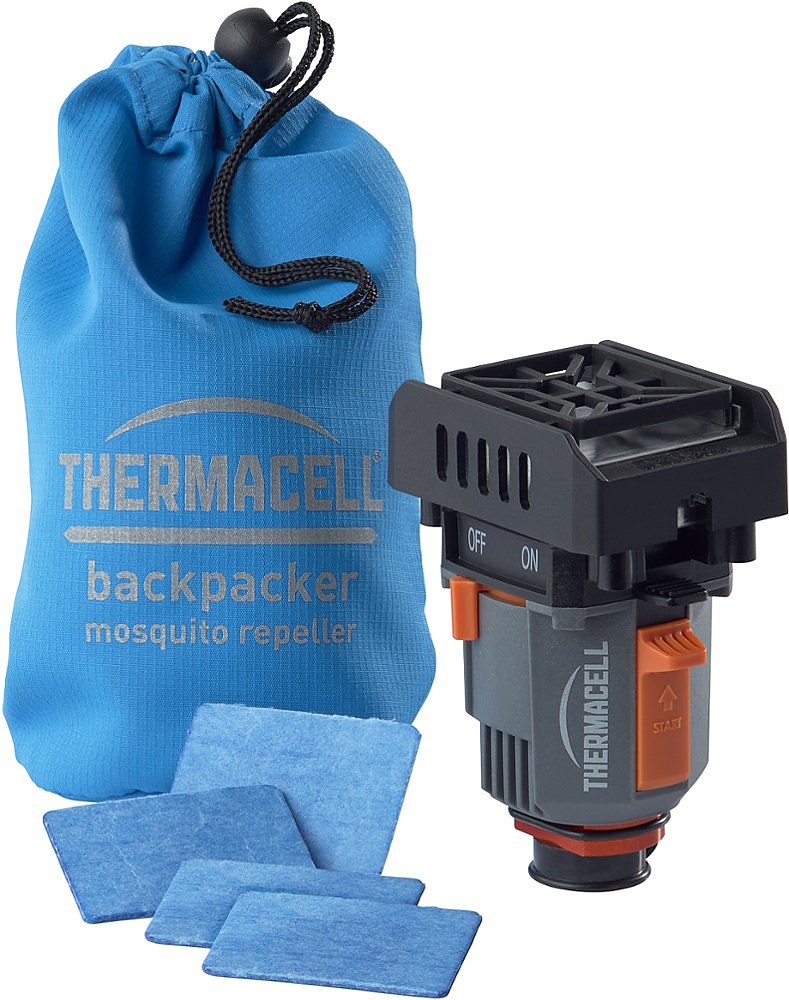
The Thermacell Backpacker Mosquito Repeller is a camp-use mosquito repeller that screws directly onto any EN417-compatible isobutane/propane canister — the same fuel you’re already hauling for your stove. A fuel source heats a repellent mat, causing it to emit allethrin, a synthetic version of pyrethrum found in some chrysanthemums. It doesn’t kill bugs; it repels them. The result is a claimed 15-foot protection zone with no DEET, no odor, and no open flame. Previous Thermacell products were too heavy and bulky for backpacking — this model was specifically designed to address that.
Key Specs
| Spec | Value |
|---|---|
| Weight | 114 g (4 oz) |
| Packed Size | 97 mm H × 50 mm W × 67 mm L |
| Protection Zone | 15 ft diameter (225 sq ft) |
| Max Elevation | 7,000 ft |
| Mat Duration | 4 hrs per mat |
| Included Repellent | 16 hrs (4 mats) |
| Fuel Runtime (4 oz canister) | 90 hrs |
| Fuel Runtime (16 oz canister) | 360 hrs |
| Fuel Type | Isobutane/propane mix (EN417) |
| Active Ingredient | Allethrin (DEET-free) |
| Includes | 4 repellent mats, water-resistant travel bag |

Would the Backpacker Mosquito Repeller earn its spot in your pack?
114 g · 4.0 ozAdd the Thermacell Backpacker Mosquito Repeller to your Gear Closet and see exactly what it does to your base weight, then start packing for your next trip.
Free · No credit card · iOS, Android & web · Trusted by 3,000+ backpackers
Performance
The core question — does it actually work? In calm to light-wind conditions, the answer is a solid yes. In swarming conditions, users report that about 10–15 minutes after turning on the device, mosquitoes left the area entirely — enough to make it a permanent trip fixture. One tester described how, roughly five minutes after setup, the group realized the bugs were gone — sitting almost in a circle around the device as mosquitoes hit what felt like an invisible wall, then turned and went elsewhere. That’s a pretty compelling field report.
Startup behavior trips people up. Some negative reviews appear to stem from users not realizing the unit is actually on — there’s no dramatic flame or noise, just a small orange glow in the viewing port, similar to checking a pilot light. Once running, it can take up to 15 minutes to fully establish the mosquito-free zone — so don’t judge it by the first three minutes.
The mat system is straightforward. Mats start blue and turn white as the allethrin depletes; Thermacell claims roughly 4 hours per mat, and user experience generally bears that out. The blue dye can fade early due to heat, humidity, wind, or altitude, but Thermacell says the repellent stays active for the full duration regardless — leave it in for the full 4 hours even if it looks white.
Fuel efficiency is genuinely impressive. The device burns so little gas that near-empty cooking canisters that can no longer support a stove will still power the Backpacker for hours — a useful way to squeeze value from dregs you’d otherwise pack out. The claimed 90 hours on a 4 oz canister seems credible given how low the BTU draw is.
Wind is the real adversary. This is where the honest picture gets complicated. Even a light breeze can dilute the allethrin plume — the repellent blows away while the mosquitoes don’t. Thermacell’s own guidance acknowledges this: place the unit upwind of your location in breezy weather, and note that the device may be less effective on very windy days — though they add that mosquitoes aren’t typically active in high wind anyway. In sheltered campsites on calm evenings, this thing earns its place. On a breezy ridgeline, don’t expect miracles.
Elevation ceiling matters. The Backpacker is rated to 7,000 ft. Users camping above that elevation report it simply won’t work — one user found out at 9,000 ft the hard way. Thermacell’s rechargeable repellers carry no altitude limitations and are worth considering for Sierra Nevada or Colorado high country trips.
What about other bugs? The official EPA-reviewed claim covers mosquitoes only. Thermacell has submitted performance data showing effectiveness against black flies and no-see-ums, but those claims are still under EPA review. Anecdotally, some users report it works well for biting flies too, but I’d treat that as a bonus rather than a guarantee.
Reliability is mostly good, with occasional exceptions. Quality is decent overall, but it’s worth testing the unit at home before a trip — there are isolated reports of units that won’t stay lit requiring returns. Allethrin has low toxicity for humans and birds, but can be toxic to fish and cats — something to keep in mind near water or with feline camp companions.
Pros & Cons
Pros
- Piggybacks on your existing stove fuel — no separate proprietary canister required
- Genuinely effective at repelling mosquitoes in calm conditions
- Fuel-efficient: 90 hours on a 4 oz canister; works well on near-empty dregs
- DEET-free, scent-free, no open flame, no noise
- Compact enough to fit in a palm; fits easily in a pack lid pocket
- Mat color indicator (blue → white) gives a clear “replace me” signal
- Built-in piezo igniter — no matches needed
- Included water-resistant travel bag keeps it tidy in your pack
Cons
- Wind significantly degrades effectiveness — a genuine limitation, not a minor caveat
- Hard 7,000 ft elevation ceiling; not viable for high alpine camping
- Takes up to 15 minutes to establish protection — start it before you need it
- Mats are a recurring consumable cost (roughly $7–9 per 3-pack)
- Mosquito-specific by EPA claim; biting fly performance is anecdotal
- Can’t be used in rain; must be fully dry before next use
- Fuel canisters can’t fly in checked or carry-on luggage
Who Should Buy This
This repeller earns its 114 g in the kit of any backpacker heading into genuinely gnarly mosquito country — think late-season Boundary Waters, early-summer Sierra campsites below 7,000 ft, or the swampy lowlands of the Appalachians. If the choice between getting eaten alive or coating yourself in DEET on a hot evening feels like picking between two bad options, this device is a meaningful third path. It’s best suited to calm, sheltered camping environments. If your trips regularly push above 7,000 ft or feature exposed, breezy campsites, look at Thermacell’s rechargeable Radius or E90 instead — they carry no altitude restriction.
Verdict
The Thermacell Backpacker Mosquito Repeller does what it promises under the conditions it was designed for: calm evenings at camp, below 7,000 ft, when the bugs are worst. Where wind isn’t a factor, it works really well — not a perfect force field, but enough to make things entirely tolerable and cut through the worst swarming. The fuel-sharing trick with your stove canister is genuinely clever and keeps the system weight negligible. Just go in with eyes open about the wind and elevation limitations — treat those as hard constraints, not edge cases, and this earns a firm 7.5/10.