SOL Emergency Bivvy with Rescue Whistle Review
A thorough review of the SOL Emergency Bivvy with Rescue Whistle — a 113g ultralight survival shelter for day hikers and backpackers who want real emergency protection without the bulk.
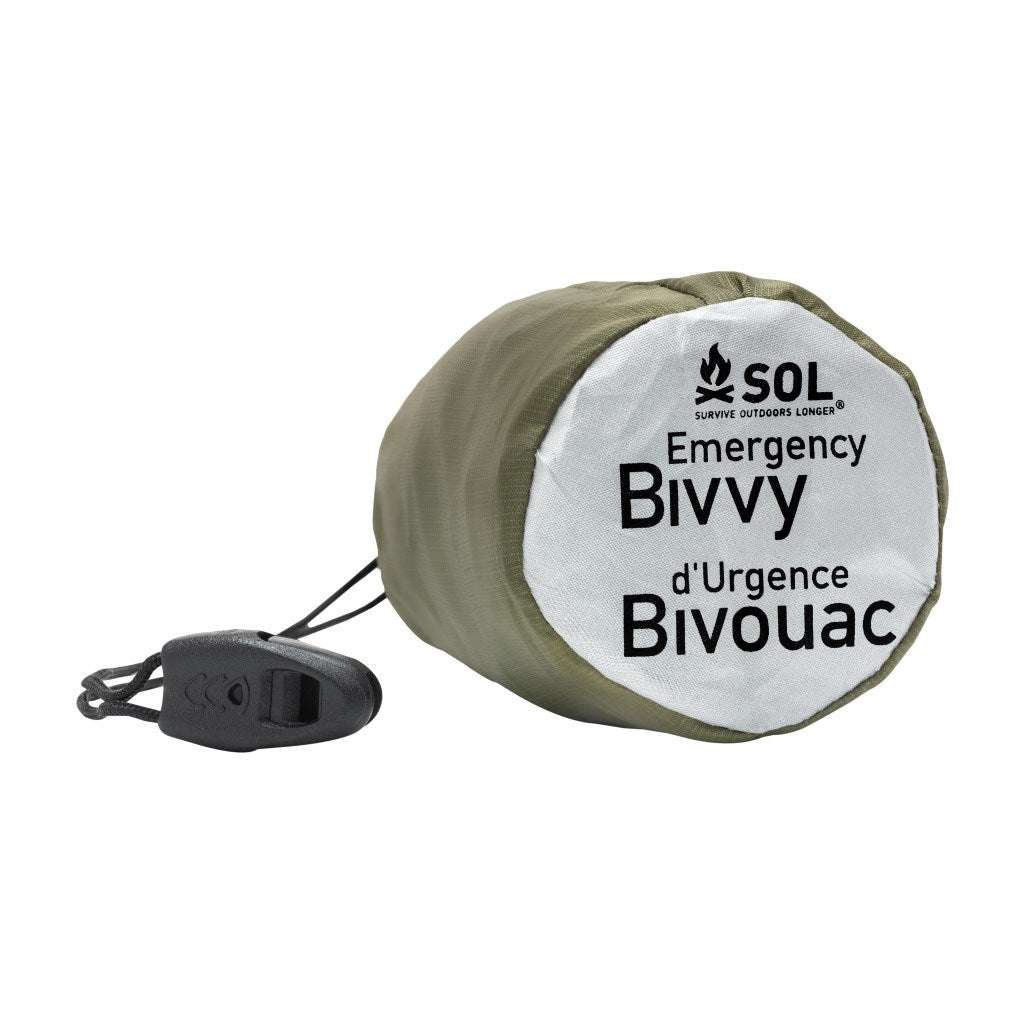
Overview
The SOL Emergency Bivvy with Rescue Whistle is a purpose-built, one-person emergency shelter designed to keep you alive — not comfortable — on an unplanned night out. At 113 g and packed down to roughly the size of a baseball, it’s the kind of piece you toss in the lid pocket of your daypack and hope you never think about again. The target audience is day hikers, trail runners, and backpackers who want a credible last-resort safety net without meaningfully adding to their base weight.
Key Specs
| Spec | Detail |
|---|---|
| Weight | 113 g (4 oz) |
| Deployed Dimensions | 36 × 84 in |
| Packed Size | 3.25 × 3.25 × 3.54 in |
| Material | Tear-resistant aluminum-coated polyethylene |
| Heat Reflectivity | 90% |
| Waterproof / Windproof | Yes — sealed seams |
| Breathable | No |
| Closure | Drawstring (no zipper) |
| Included Extras | Rescue whistle, tinder cord drawstring |
| Colors | Hunter orange, green |
| MSRP | ~$24.49 |

Would the Emergency Bivvy with Rescue Whistle earn its spot in your pack?
113 g · 4.0 ozAdd the SOL (Survive Outdoors Longer) Emergency Bivvy with Rescue Whistle to your Gear Closet and see exactly what it does to your base weight, then start packing for your next trip.
Free · No credit card · iOS, Android & web · Trusted by 3,000+ backpackers
Performance
Thermal Protection
The core claim here is that the aluminum-coated polyethylene shell reflects 90% of your radiated body heat back to you. In real-world tests and field accounts, that claim holds up — at least in the short term. One reviewer who was caught by a sudden weather change 10 miles from a trailhead at altitude reported that body heat made the interior warm up quickly. A GearJunkie field test in high-50°F temperatures found it adequate for an overnight in lightweight clothing with no sleeping bag. The key caveat is ground insulation: you should always insulate yourself from the surface you’re resting on to make this product more effective. The bivvy does nothing for conductive heat loss to the ground — pack a pad.
Condensation: The Honest Problem
Here’s the thing nobody in the marketing copy mentions: this bivvy is non-breathable, so condensation will develop inside. In mild temperatures this is a manageable nuisance. Push into cold weather and it becomes genuinely serious. The bag has zero breathability, and the inside can become covered in condensation droplets that wet your clothes, making you feel colder and potentially more dangerous — you may not be able to leave the bag because your clothes are wet. One Trailspace reviewer pushed it to -13°C and reported so much condensation inside that the bivvy had to be abandoned. This isn’t unique to the SOL — condensation is a universal problem with bivvys; even breathable Gore-Tex models have to be dried out every day at below-freezing temperatures. The takeaway: this bivvy is a genuine life-saver for short unplanned nights above freezing. In sustained sub-freezing emergencies, manage condensation actively — open the drawstring periodically to ventilate, or keep moving until rescued.
Durability vs. Traditional Space Blankets
One of the legitimate differentiators here is material toughness. SOL’s bivvies are 30–50% thicker than metalized polyester competitors like Space® brand, and are puncture-resistant — tears don’t propagate, meaning a nick doesn’t become a disaster. The polyethylene material is plastic-like and somewhat stretchy — it won’t tear and shred like an old-school Mylar product. Unlike traditional Mylar bivvies, it’s quieter, stretchy, and rips can be repaired with tape. In practice, this means the bivvy can be packed and unpacked without treating it like a museum artifact — and it’s genuinely reusable across multiple outings if handled with reasonable care.
The Bundled Kit
Included with the brightly colored, highly visible orange bivvy is a tinder paracord drawstring for fire starting and a survival whistle to signal your location to rescuers.
The tinder cord is woven into the drawstring itself — a clever bit of integration that means it’s always there when you need it. The whistle is a simple pea-less design; it’s not going to replace a dedicated signaling whistle, but in a pinch it does the job of getting attention.
The hunter orange exterior provides increased visibility, helping rescuers spot you in emergency situations.
The color-coding also solves a dumb-but-real problem:
the orange exterior reminds you which side is reflective, whereas all-silver traditional space blankets can be turned inside out in stressful situations, making them useless.
No Zipper
The one ergonomic gripe worth flagging: there is an opening on one end, but no zipper. You slide in head-first and cinch the drawstring. Getting in and out in the dark, cold, and stressed is more fumble-prone than a zippered option. It’s a legitimate trade-off for the weight and price point, but worth knowing before you need it.
Pros & Cons
Pros
- Genuinely ultralight at 113 g — negligible pack weight for the protection offered
- Significantly more durable and quieter than cheap mylar space blankets
- Sealed seams provide real waterproof and windproof protection
- Rescue whistle and tinder cord add functional emergency value
- High-visibility orange exterior aids search and rescue
- Reusable and repackable — not a one-time-use throwaway
- Affordable (~$25) for a legitimate safety item
- 90% heat reflectivity beats most competitors in its category
Cons
- Zero breathability guarantees condensation buildup, especially in sustained cold
- No zipper — drawstring-only entry is awkward in high-stress situations
- No temperature rating provided (and no ground insulation built in)
- Condensation risk makes it unsuitable as a routine sleeping bag overbag
- Thin material relative to purpose-built mountaineering bivvies
- Strictly a rescue/emergency tool, not a comfort or multi-use sleep system
Who Should Buy This
This bivvy belongs in the kit of virtually every day hiker, trail runner, and weekend backpacker who isn’t already carrying a full shelter system. It’s a piece meant to be carried a lot and used rarely — perfect for warming hypothermia victims or hiding from the elements in a survival situation. It’s particularly well-suited for day hikes where you’re not carrying a shelter, and as added insurance on longer overnight trips in case things don’t go as planned. If you’re planning sustained cold-weather mountaineering or multi-night above-treeline travel, consider stepping up to SOL’s breathable Escape Bivvy (8.5 oz, ~$86) which trades some heat reflectivity (70% vs. 90%) for meaningfully better moisture management.
Verdict
For a sub-$25, 113 g emergency tool, the SOL Emergency Bivvy with Rescue Whistle is hard to argue with. It’s meaningfully better than cheap mylar alternatives in durability and real-world usability, and the rescue whistle and tinder cord add genuine survival value without adding grams. The condensation limitation is real and should be clearly understood — this is a get-you-through-one-bad-night tool above freezing, not a cold-weather sleep system. Every daypack should have one.
Rating: 8/10