Ozark Trail Emergency Reflective Survival Tent Review
A sub-$5, 151 g reflective emergency tube shelter that pitches with a 14-foot cord. It's a fine glovebox backup but a heavy, one-use fallback for ultralight kits.
Overview
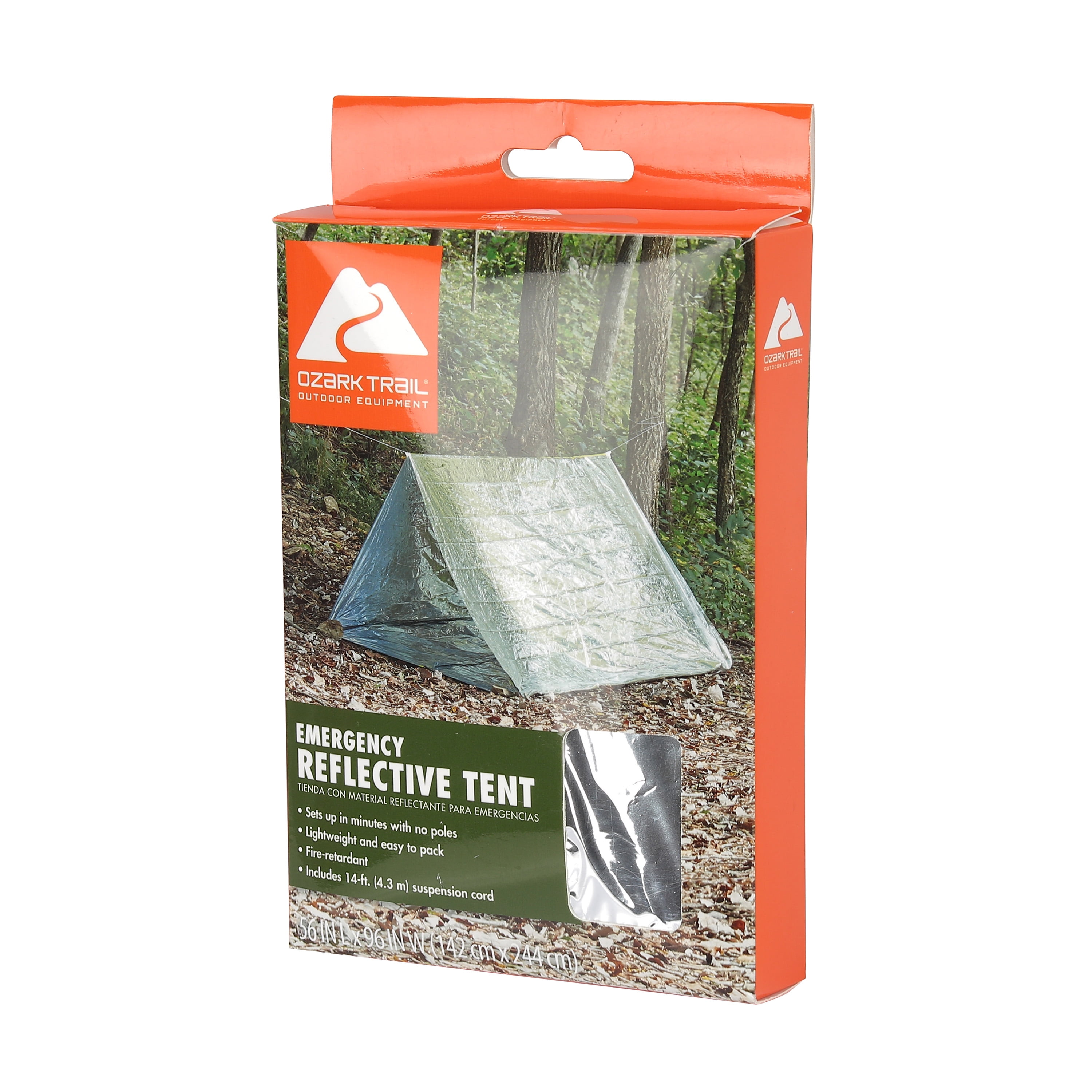
Ozark Trail’s Emergency Reflective Survival Tent is a silver, fire-retardant polyester sheet that turns into a one-person tube shelter once a 14-foot cord is strung through it. It is built for the car kit, the first-aid bag and the “something went wrong” pocket of a day pack, not for planned nights out. The trade-off is simple: it costs less than a sandwich, but at 151 g it is no featherweight, and it is a shelter of last resort rather than a piece of a sleep system.
Key Specs
| Spec | Detail |
|---|---|
| Weight | 151 g (5.3 oz) |
| Listed dimensions | 96 x 56 x 96 in |
| Material | Fire-retardant reflective polyester |
| Setup | Pole-free; ridgeline pitch with included cord |
| Included | 14-ft suspension cord |
| Color | Silver |
| Capacity | One person |
| Price | Under $5 at Walmart |

Would the Emergency Reflective Survival Tent earn its spot in your pack?
151 g · 5.3 ozAdd the Ozark Trail Emergency Reflective Survival Tent to your Gear Closet and see exactly what it does to your base weight, then start packing for your next trip.
Free · No credit card · iOS, Android & web · Trusted by 3,000+ backpackers
Performance
Setup. The design is as basic as shelters get. The cord threads through the body and ties off between two trees, a trekking-pole pair or any other anchor points, and the sides are weighted down with rocks or gear. Buyers on Walmart’s listing, which carries a 4.4 average across 62 ratings, say it goes up in minutes. The one recurring complaint is that the instructions don’t spell out the steps, which matters for a product whose whole purpose is to be used by someone cold, tired and in a hurry. Practicing the pitch once in the backyard solves that problem.
Space and warmth. One owner reports fitting a single-person sleeping bag inside with room to spare and suggests two people could squeeze in with the roof pulled low. That second claim is optimistic: the shelter is sized for a solo user, and sharing makes the already limited headroom disappear. The reflective polyester cuts wind and sheds rain, and it holds in radiant heat better than a bare tarp. Like every mylar-style tube tent, though, it does not breathe. Anyone who has spent a night in one knows the result is condensation on the inside walls, plus a crinkly, noisy shell in any breeze. That is acceptable for a survival night and miserable for anything longer.
Visibility. The foil-bright finish doubles as a signaling device. Reviewers point out that it flashes in sunlight and is easy to spot from a distance, which is a real advantage in a search-and-rescue scenario. One owner also likes that the shiny exterior makes it hard to see in from outside.
Durability. Nothing about a sub-$5 polyester sheet suggests multi-season abuse. It is a reusable item on paper, but sharp rocks, stakes and wind-snapped corners are all hazards, and the thin material will not take a hard pitch twice. Treat it as an emergency item that stays in its package until needed and gets replaced after use.
Versatility. Owners have found plenty of secondary uses: a ground sheet, a makeshift poncho, a fire reflector, a moisture barrier under a sleeping pad, and a warming wrap. Those tricks are real but not unique. Every foil sheet does most of them.
Weight. This is where ultralight hikers will wince. At 151 g, it weighs about the same as a number of dedicated two-person mylar tube tents, such as one 240 x 150 x 90 cm competitor listed at 175 g, and far more than a basic foil blanket. Ozark Trail’s own 52 x 82.5 in emergency blanket is listed at 1.5 oz. Hikers who already carry a tarp or a bivy get little from the added grams.
Pros & Cons
Pros
- Costs under $5, cheap enough to stash in every vehicle and pack
- Pole-free setup using the included 14-ft cord
- Silver finish reflects heat and serves as a signaling aid
- Fire-retardant material
- Large enough for one person in a sleeping bag
- Compact when packed and easy to forget in a kit until it’s needed
Cons
- 151 g is heavy for what is effectively a disposable shelter
- Non-breathable material condenses heavily on the inside
- Setup instructions are thin
- Not rated for sustained weather, wind or repeated use
- Sized for one; a second occupant is a squeeze
- Cannot substitute for a real tent, tarp or bivy
Who Should Buy This
Car campers, hunters, day hikers and anyone building a vehicle or home emergency kit will find this an easy buy: it is cheap, it works as advertised for one night, and several can be tossed in the trunk or glovebox without a second thought. It also suits beginners who want a visible, wind-blocking shelter on short hikes.
Thru-hikers and weight-conscious backpackers should look elsewhere. Anyone counting grams already carries a tarp, bivy or tent, and a 151 g backup shelter adds little to a kit that already has rain protection. Those who want an emergency layer for a base-weight-focused kit are better served by a foil blanket or bivy at a fraction of the weight.
Verdict
The Ozark Trail Emergency Reflective Survival Tent does one job at a price that makes it an easy yes for a car or home kit. It is too heavy and too fragile to earn a place in an ultralight pack, where a lighter emergency bivy or space blanket does the same work.