Salomon XA Review
Salomon's XA pairs a running-vest fit with a roll-top body in 25 L and 35 L sizes, trading back ventilation for a nearly bounce-free carry.
Overview
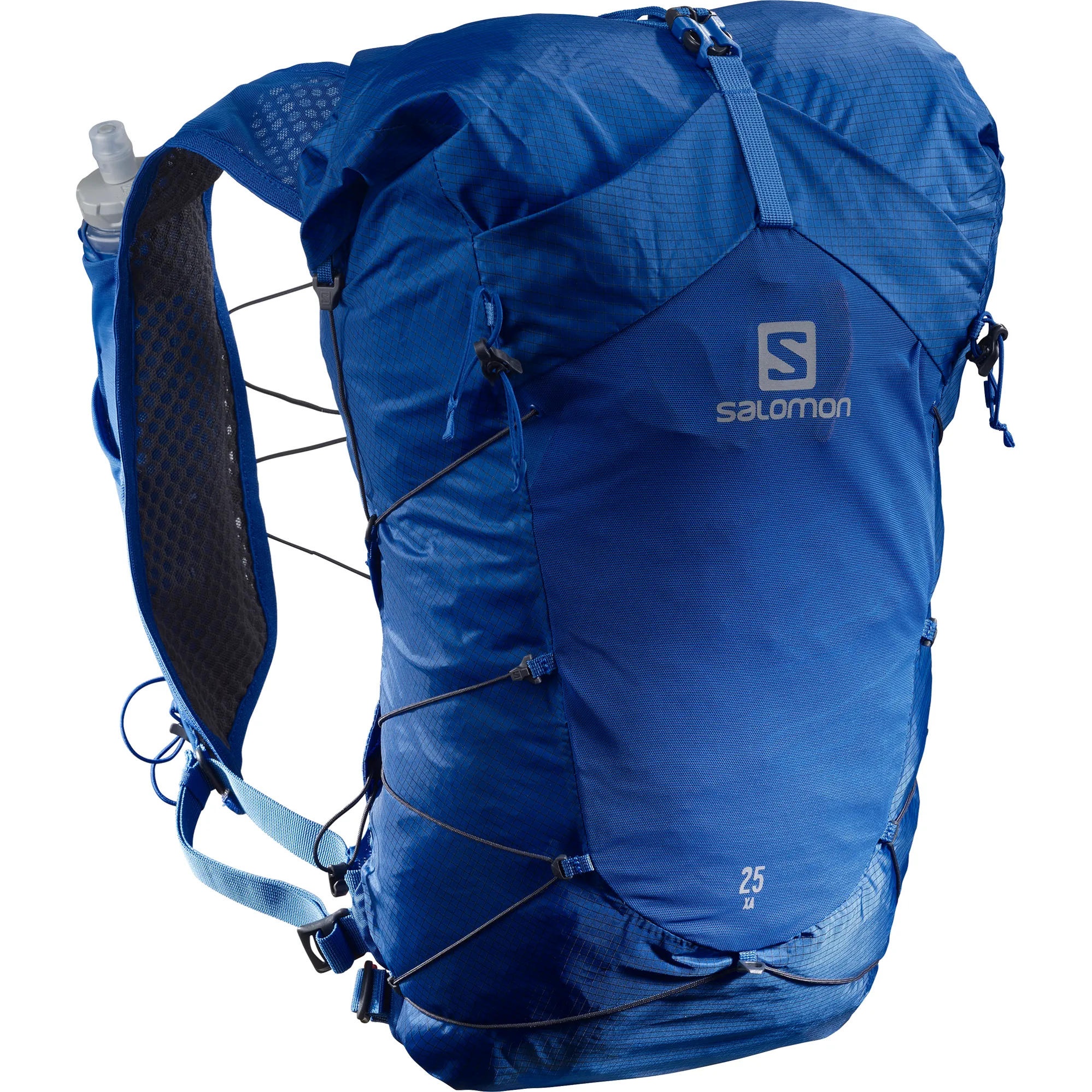
The Salomon XA is a roll-top daypack built on running-vest architecture: wide mesh straps, twin chest straps and a stack of stretch pockets up front, wrapped around a weather-resistant main compartment. It comes in 25 L and 35 L, and it is aimed at fast hikers, scramblers and fastpackers who want a pack that stays put at a jog. The trade-off is a body-hugging fit that runs warm and a rear pocket you can’t reach on the move.
Key Specs
| Spec | Value |
|---|---|
| Weight | 443–603 g depending on size |
| Volume | 25 L or 35 L |
| Closure | Roll-top |
| Frame | Frameless, EVA foam back pad |
| Back panel | 3D AirMesh over EVA foam |
| Shoulder straps | Wide, thermo-molded 3D AirMesh |
| Hydration | Reservoir-compatible; two front flask pockets |
| Weather protection | Taped, weather-resistant fabrics; roll-top closure |
| Body fabric | 82% polyamide, 18% polyethylene |
| Sizing | S/M and M/L |
Versions compared
| Image | Version | Weight | vs. lightest |
|---|---|---|---|
| 25 L | 443 g (15.6 oz) | lightest |
 | 35 L | 603 g (21.3 oz) | +160 g |

Would the XA earn its spot in your pack?
443 g · 15.6 ozAdd the Salomon XA to your Gear Closet and see exactly what it does to your base weight, then start packing for your next trip.
Free · No credit card · iOS, Android & web · Trusted by 3,000+ backpackers
Performance
Fit and carry
The XA’s reputation rests on how it carries. Instead of a stiff, bulky suspension, it uses running-vest technology: cross-chest bungees and multiple attachment points between the straps and the pack body, which pull the load tight against the upper torso. Salomon’s SensiFit hybrid construction combines the wide straps and twin chest straps for three attachment points. The stretchy Quick Link sternum strap can be adjusted on the fly and leaves room to breathe when the pace picks up.
Testers have loaded the 25 L with a full winter running kit, including multiple layers, microspikes and a few liters of water, and finished a long day with no shoulder soreness. That is a strong result for a frameless pack.
Stability at speed
Compression cords run along the sides of the pack and can be tugged while it’s worn. Loaded to the brim or half empty, a couple of pulls stop the load from shifting. Owners using the 35 L as a fastpacking pack on multi-day runs describe it as riding tight and close. A photographer who carried a camera body, two lenses, a drone and a 1.5 L bladder up a technical peak reported little bounce.
Weather protection
The roll-top and taped fabrics do real work. In spray tests, the main compartment stayed dry, and the lack of seams under the pack helps. The wide opening makes it easy to pack, and many owners skip a pack liner or rain cover.
Access and organization
Pockets on the shoulder straps and the two front flask pockets, carried over from Salomon’s vest line, keep snacks, phone and water reachable without stopping. The weak point is the single rear stuff pocket. It can’t be reached while the pack is on, so a shell or extra layer means stopping or planning ahead. Outdoor Gear Lab testers and Japan’s Outdoor Gearzine both flagged the number of drawcords as a complication, and OGL noted a learning curve before everything is dialed in.
Ventilation
The close fit has a cost. Testers found the XA slightly less breathable than packs with suspended-mesh back panels, and the wide straps and loaded front pockets trap heat across the chest. Outdoor Gearzine’s reviewer found the back less breathable than the mesh construction suggested. On a hot climb at a fast pace, a sweaty back is a given.
Sizing
Only two sizes are offered. Smaller users, particularly petite women, report that the S/M doesn’t adjust small enough. The pack can then sit too low on the back, and the front flask pockets press on the ribs. Buyers of the 35 L have also asked whether the S/M runs large, so trying one on first is worth the effort.
Choosing a Version
The two sizes share the same vest-style harness, pockets and roll-top. What changes is capacity, the belt and the rear closure.
25 L (443 g). This is the version for day hikes, scrambles, long trail runs and fast single-day missions. The official weight includes two 500 ml soft flasks. It carries layers, food and water for a full day, and its removable hip belt lets users pare it down when the load is light. It is also the only version with a thorough record of weather and fit testing.
35 L (603 g). At 160 g more, the 35 L adds room for overnight kit. It has a soft belt with a zipped pocket that helps spread the load, and a carbon quick-lace system on the back for compressing or expanding the pack. It also has an internal pocket in the roll-top and an external rear pouch. A hiker on a two-day traverse of New Hampshire’s Presidential Range fit everything needed with space to spare, while staying at a hut instead of carrying a full sleep system. Another buyer on his second one used it for two- to five-day runs. Trekking poles can be carried on loops, though one owner found stowing them under the arm worked better than strapping them to the back.
For day trips, the 25 L is the better pick, because the 35 L’s extra volume adds weight and encourages overpacking. The 35 L only makes sense for fastpacking or overnights where the kit is minimal and the weight stays low.
Pros & Cons
Pros
- Stable, nearly bounce-free carry that works at a run
- 443 g for the 25 L, with real weather protection
- Roll-top with taped fabrics keeps contents dry without a cover
- Strap and front flask pockets put essentials within reach on the move
- Side compression cords tighten the load quickly
- The 35 L adds a belt with a zipped pocket and enough volume for light overnights
Cons
- Rear pocket can’t be reached while wearing the pack
- Limited ventilation against the back and chest
- Two sizes only, and smaller frames may struggle to get a good fit
- Many cords and a learning curve to set it up
- Priced above most conventional daypacks
Who Should Buy This
The XA is for trail runners, fast hikers and fastpackers who want vest-like stability with more capacity than a running vest offers. It also works for mountain day hikes where bad weather is a concern and quick access to food and water matters more than a ventilated back panel. The 25 L covers most days. The 35 L fits fastpackers moving light over a night or two.
Anyone who sweats heavily and wants airflow should choose a suspended-mesh pack. Those who need a lot of rear storage that’s accessible while walking, commuters and travelers will find cheaper and simpler options elsewhere.
Verdict
The XA is one of the most coherent takes on the vest-style daypack: snug, stable, weatherproof and light for its volume. The compromises on ventilation, rear access and sizing are real, but they come from design choices that make it good at its job. Fast movers should take the 25 L for day trips, or the 35 L for light overnights.