REI Co-op Flash Air 50 Review
REI's first true ultralight pack pairs a sub-two-pound weight with plush padding and a real frame, but durability and a 25-lb load limit hold it back at $299.
Overview
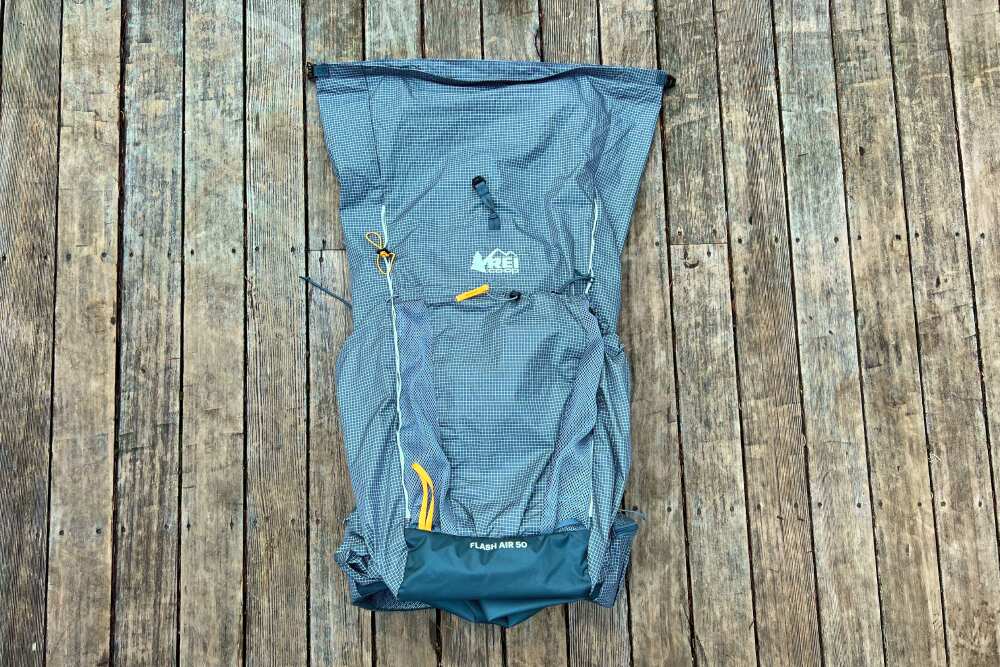
The Flash Air 50 is REI’s attempt to shrink a conventional comfort pack down to cottage-brand weight: a 50-liter roll-top with a spring steel frame, thick foam padding and a body of UHMWPE ripstop nylon, at 794 to 851 g depending on size. It suits hikers coming out of a 3-to-4-pound pack who want to drop weight without giving up a cushioned carry. The trade-off is a 25-pound recommended load, middling durability and a $299 price that sits above packs with better track records.
Key Specs
| Spec | Detail |
|---|---|
| Weight | 794–851 g depending on size |
| Volume | 50 L |
| Recommended max load | 25 lbs |
| Frame | Spring steel |
| Closure | Roll-top |
| Fabric | UHMWPE ripstop nylon (87% nylon / 13% polyethylene), reinforced 210D nylon bottom |
| Water resistance | PFAS-free DWR |
| Suspension | 3D contoured hipbelt, ventilated back panel, load lifters |
| Price | $299 |
Versions compared
| Image | Version | Weight | vs. lightest |
|---|---|---|---|
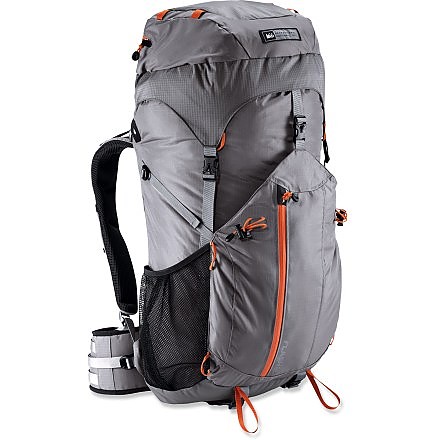 | Women's / XS | 794 g (28.0 oz) | lightest |
| Medium | 851 g (30.0 oz) | +57 g |

Would the Flash Air 50 Pack earn its spot in your pack?
851 g · 30.0 ozAdd the REI Co-op Flash Air 50 Pack to your Gear Closet and see exactly what it does to your base weight, then start packing for your next trip.
Free · No credit card · iOS, Android & web · Trusted by 3,000+ backpackers
Performance
Comfort. This is where the Flash Air earns its keep. Testers at Better Trail called the carry plush, crediting thick padding in the back panel, shoulder straps and hipbelt. CleverHiker’s reviewers described the suspension as a stiff internal frame, a supportive hipbelt and a heavily padded back panel with airflow channels, and noted that most of the comfort comes from the foam rather than the frame. Outdoor Gear Lab’s testers said it delivers much of the comfort of a pack that weighs several pounds more. Ventilation is a mixed bag: the channels help, but one reviewer found the back panel breathes less well than the design suggests.
Weight and load. At 1 lb 14 oz in the medium, the pack undercuts nearly every full-suspension pack of this volume from the big outdoor brands. The 25-pound recommendation is the sticking point. Better Trail flagged it as low for an internal-frame pack this size. CleverHiker’s testers felt it could carry more comfortably, but the recommendation is the manufacturer’s, and the spring steel frame is not a rigid load-hauling stay. Weekend hikers and hikers with a sub-15-pound base weight sit comfortably inside it. A winter kit or a week of food in a bear canister pushes past it.
Storage and organization. The pocket layout leans conventional, and that is mostly a strength. It has two zippered hipbelt pockets, two angled side bottle pockets, two exterior side pockets and a front stash pocket. A top Y-strap holds bulky items such as a bear canister, and daisy chains and loops handle ice axes or poles. CleverHiker’s reviewers liked the roomy side pockets, two of which are easy to reach for on-the-go hydration, and found the front pocket handy for rain gear but a little small. Reviewers also report trade-offs: with the main compartment stuffed full, it eats into the exterior pocket volume from inside, and the pockets get hard to reach when the pack is tightly loaded. The hipbelt pockets lack structured undersides, so they hold less than they look like they should, and they are not removable. The hydration tube ports at the top can let rain in.
Durability. The UHMWPE blend gets better marks than plain nylon of the same weight. Better Trail’s tester judged it tougher than ordinary nylon of similar weight, and the thicker bottom panel has held up well. Still, the same reviewers rate durability as middling overall. Outdoor Gear Lab’s testers describe the fabric as durable. CleverHiker flagged the top and side straps as weak points. One Better Trail tester had an elastic drawcord for the side and rear pockets come undone on the first trip and could not re-thread it, a bad look at this price.
Weather. The PFAS-free DWR beads off light precipitation, and CleverHiker’s reviewers say it performs well early on but wears off with time. The pack is not a waterproof design, so rain days call for a pack liner or a dry bag. The foam padding can also absorb water.
Choosing a Version
The Flash Air comes in two versions here, and the 57 g difference between them (794 g versus 851 g) is the least of the choice. What matters is fit. The pack has no adjustable torso length, a limitation Outdoor Gear Lab lists among its cons, so the frame, shoulder straps and hipbelt are fixed at whichever size is chosen. Size is a bigger decision than on a pack with a sliding yoke.
- Women’s / XS (794 g): The lighter option, built for smaller frames and women’s proportions, with a pre-curved hipbelt and shoulder straps shaped accordingly. Hikers with shorter torsos or narrower hips should start here.
- Medium (851 g): The standard choice for average-torso hikers, and the version most reviewers carried. The extra weight is mostly more fabric and padding for the larger frame.
Try on a loaded pack at an REI store before committing. A mismatched torso length turns a plush suspension into a pressure-point problem.
Pros & Cons
Pros
- Under 900 g with a real frame, load lifters and thick padding
- Comfort that rivals much heavier packs
- Large, well-placed pockets, including easy-reach side bottle pockets
- UHMWPE fabric and reinforced base outlast plain nylon of similar weight
- Y-strap and roll-top handle bulky loads such as bear canisters
- PFAS-free DWR coating
Cons
- 25-lb recommended load is low for a 50 L frame pack
- Fixed torso length and limited sizing
- Straps, drawcords and pocket stitching have drawn durability complaints
- Hipbelt pockets are not removable and are less roomy than they look
- Not waterproof, and the foam soaks up water
- $299 is steep, and cottage-brand packs at similar weights often carry more
Who Should Buy This
The Flash Air fits the hiker in transition: someone with a 12-to-20-pound base weight and a sore-shoulder history with frameless packs, who wants a store-bought pack that can be fitted and returned. It works for weekend trips and three-to-five-day outings in mild conditions. Thru-hikers carrying heavy food loads, winter backpackers and anyone who wants a pack that survives years of abuse should look at sturdier, higher-capacity options from cottage makers. Hikers already comfortable in frameless packs will find little reason to switch.
Verdict
The Flash Air 50 is the most comfortable sub-two-pound pack a mainstream retailer sells, and for a hiker lightening up in stages it is a sensible step. The 25-lb ceiling, the fixed fit and some construction flaws keep it from being the best value at $299. Buy it for comfort at low weight, and not for long-haul toughness.