Osprey Rook 65 Review
The Osprey Rook 65 is a budget-friendly, durably built 65L backpacking pack with solid ventilation — a capable starter pack with real trade-offs in comfort and features.
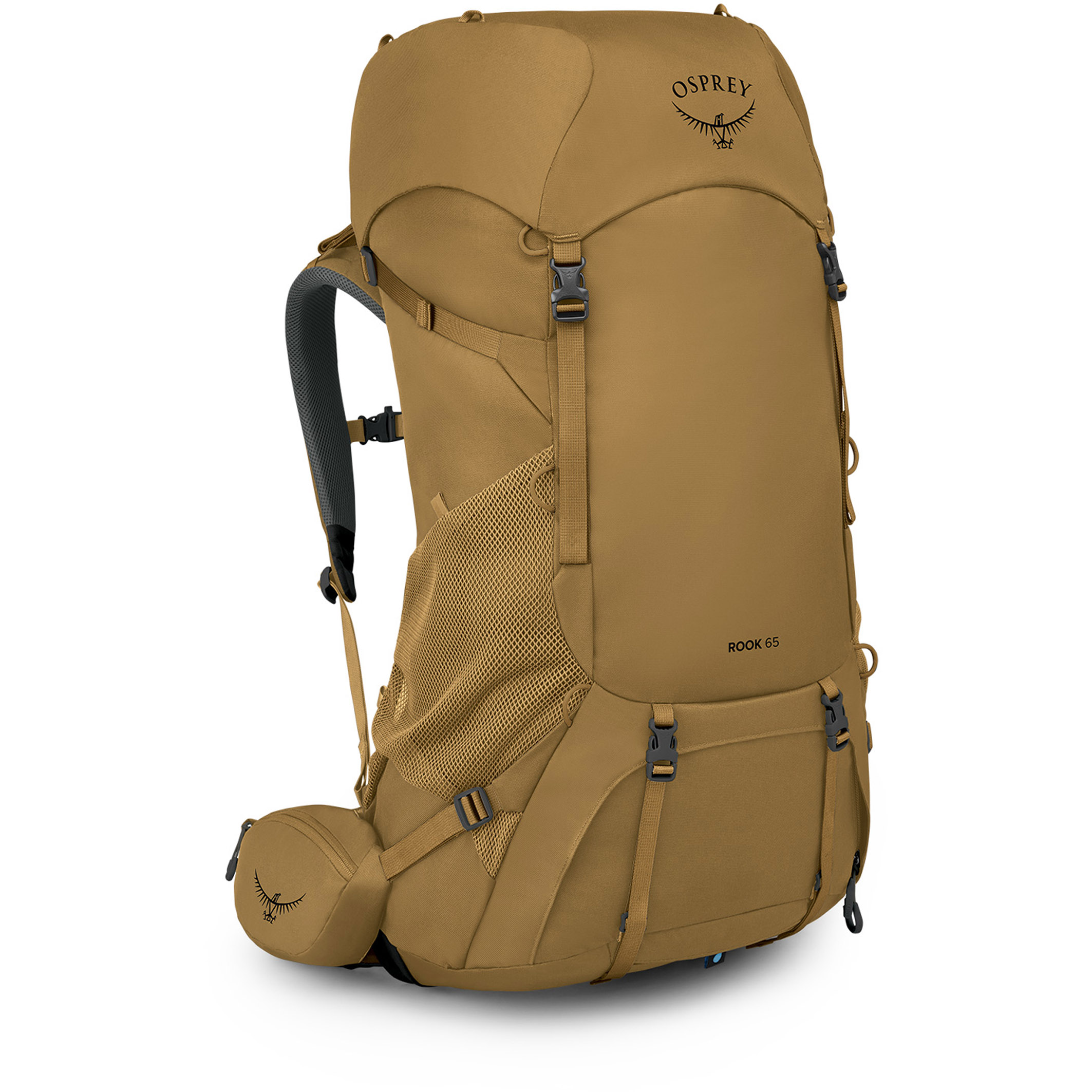
Overview
The Osprey Rook 65 is Osprey’s entry-level 65-liter backpacking pack, aimed squarely at beginners and budget-conscious hikers who want a recognizable brand without the premium price tag. At around $165, it’s one of Osprey’s most affordable multi-day offerings, coming in roughly $100 cheaper than much of the competition. For a thru-hiker or seasoned gram-counter, this pack will feel like a compromise — but as a first serious pack or a loaner for a guest, it’s harder to dismiss.
Key Specs
| Spec | Value |
|---|---|
| Weight | 1,588 g (3 lb 8 oz) |
| Volume | 65 L |
| Fabric | 600D / 1000D Polyester |
| Frame | LightWire peripheral |
| Back Panel | AirSpeed tensioned mesh |
| Torso Fit Range | 17–22 in (one size) |
| Hydration | 3L reservoir sleeve |
| Rain Cover | Integrated, removable |
| Certification | bluesign® |

Would the Rook 65 earn its spot in your pack?
1588 g · 56.0 ozAdd the Osprey Rook 65 to your Gear Closet and see exactly what it does to your base weight, then start packing for your next trip.
Free · No credit card · iOS, Android & web · Trusted by 3,000+ backpackers
Performance
Suspension & Fit
The tensioned mesh back panel adjusts to fit a wide range of torso lengths while providing ventilation to reduce sweating, and the LightWire frame transfers loads to the hipbelt, taking the pressure off the shoulders for a stable, comfortable carry.
On paper, that sounds like the Atmos experience at a fraction of the cost. In practice, there’s a meaningful gap.
The raised mesh AirSpeed back panel creates a pocket between the pack and your back for air to flow, though it’s a trimmed-down version of Osprey’s Anti-Gravity system found on the more expensive Atmos — which also extends around the inside of the hipbelt — and the difference in performance is noticeable.
That said,
when you first put the pack on, the trampoline mesh panel is instantly comfortable and really sets this rucksack apart from many others at this price point.
The pack only comes in one size, but you can adjust the torso length from 18 to 22 inches, and dialing in that torso length is very easy — in less than 15 seconds you can adjust the length to fit your body.
That’s a genuine strength for a budget pack. The flip side:
some users report that the hip belts don’t touch their hips unless the shoulder straps are raised far above where they should be.
Fit is always personal, but it’s worth noting that the Rook’s single-size approach means it won’t suit every body.
The padding on the shoulder straps and hipbelt is fairly thin and feels cheap compared to pricier packs.
Under a moderate load of 25–35 lbs, most users won’t notice —
the carrying system works well enough that you can hardly notice the load on your back.
Push it toward 45 lbs and the thin padding becomes a real conversation.
Not many trampoline-style harnesses can handle large loads of 45 pounds or more, and trampoline suspensions position the load further away from your back, increasing leverage and reducing balance, which makes for a less comfortable overall carrying experience as the weight increases.
Organization
The Rook has side stretch-mesh water bottle pockets, a zippered pocket for small items on the lid, and zippered hip belt pockets, plus a zippered pocket that holds the included waterproof rain cover.
That’s functional but minimal.
The most notable omission is a front shove-it pocket — the large pocket on the outside of the pack — which is a feature many backpackers really value for quickly stuffing or accessing gear on the go.
Most packs at this price range now include some form of front storage, so this is a genuine gap, not just a premium-tier ask.
A zippered sleeping bag compartment with a floating divider keeps the lower contents of the bag in place
, which is a useful organizational touch.
The zippered hip belt pockets, while useful, are on the smaller side — a few users mentioned difficulty fitting a phone or camera.
Durability
This is where the Rook earns genuine respect. The Rook is impressively durable for a sub-4-pound budget pack — with a burly 600-denier polyester body and 1,000-denier bottom, it’s one of the thickest backpacking packs in its class. After being tossed around the desert haphazardly, there’s barely a scratch on any part of the pack — it’s reminiscent of the super-thick canvas packs of old. Fabric durability is genuinely not a concern here, which is a meaningful differentiator at this price.
Rain Cover
The integrated rain cover makes the pack more usable in wet conditions and adds to its overall value — many backpacking packs don’t come with a rain cover at all and still cost more than the Rook.
It stows neatly in its own pocket at the bottom of the pack and deploys quickly. For trips where weather is unpredictable, this is a legitimate perk.
Warranty
Osprey will repair any damage or defect for any reason free of charge — if they’re unable to perform a functional repair, they’ll replace it.
That lifetime warranty covers the Rook the same as it covers the Atmos, and that has real value when you’re buying a pack to last a decade.
Pros & Cons
Pros
- Exceptional fabric durability for the price (600D body, 1000D base)
- AirSpeed tensioned mesh back panel provides genuine ventilation
- Integrated rain cover included — rare at this price
- Fast, tool-free torso adjustment spanning 17–22 inches
- Osprey’s All Mighty Guarantee covers repairs and replacements for life
- bluesign® certified fabrics
Cons
- No front stuff-it/shove-it pocket — a real organizational miss
- Shoulder strap and hip belt padding is noticeably thinner than premium packs
- Only one size; fit can be hit or miss depending on body type
- Hip belt pockets are small — a phone likely won’t fit
- 1,588 g is heavy for an ultralight-oriented audience; the Osprey Exos 58 shaves nearly 400 g
- Trampoline suspension struggles with loads above ~40 lbs
- Front torso adjustment hook can disengage if the pack is crammed into a car boot carelessly
Who Should Buy This
The Rook 65 is a solid match for first-time backpackers, casual weekend warriors, or anyone working with a tight gear budget who wants a trustworthy brand behind their pack. Its durability and adjustability make it a good choice for sharing among friends, as an affordable pack for diverse users, or for growing teens. It’s also worth considering as a loaner pack or a camp-to-camp workhorse for trips where you’re carrying organized group gear. Due to its rigid padding and stiff components, it’s not the most comfortable pack for extended weeks-long trips — if you’re planning a multi-month thru-hike or regularly carrying 40+ lbs, the Rook will start to wear on you. Spend the extra money on the Gregory Paragon 58 or Osprey Atmos AG 65 for that use case.
Verdict
The Osprey Rook 65 does exactly what it sets out to do: deliver a durable, ventilated, brand-backed 65L pack at a price that won’t require financing. The fabric toughness is genuinely impressive, the integrated rain cover is a bonus most competitors skip, and the AirSpeed panel keeps you from becoming a swamp creature on warm-weather climbs. What holds it back is the absence of a front pocket, thin harness padding that shows under heavy loads, and a weight that will make ultralight hikers wince. For a gram-counter or serious thru-hiker, there are better options — but as an entry point into real backpacking gear, the Rook makes a reasonable case for itself.