Osprey Levity 45 Review
An in-depth review of the discontinued Osprey Levity 45 — a sub-900g ultralight pack with a full AirSpeed suspension that punches well above its weight class in comfort.
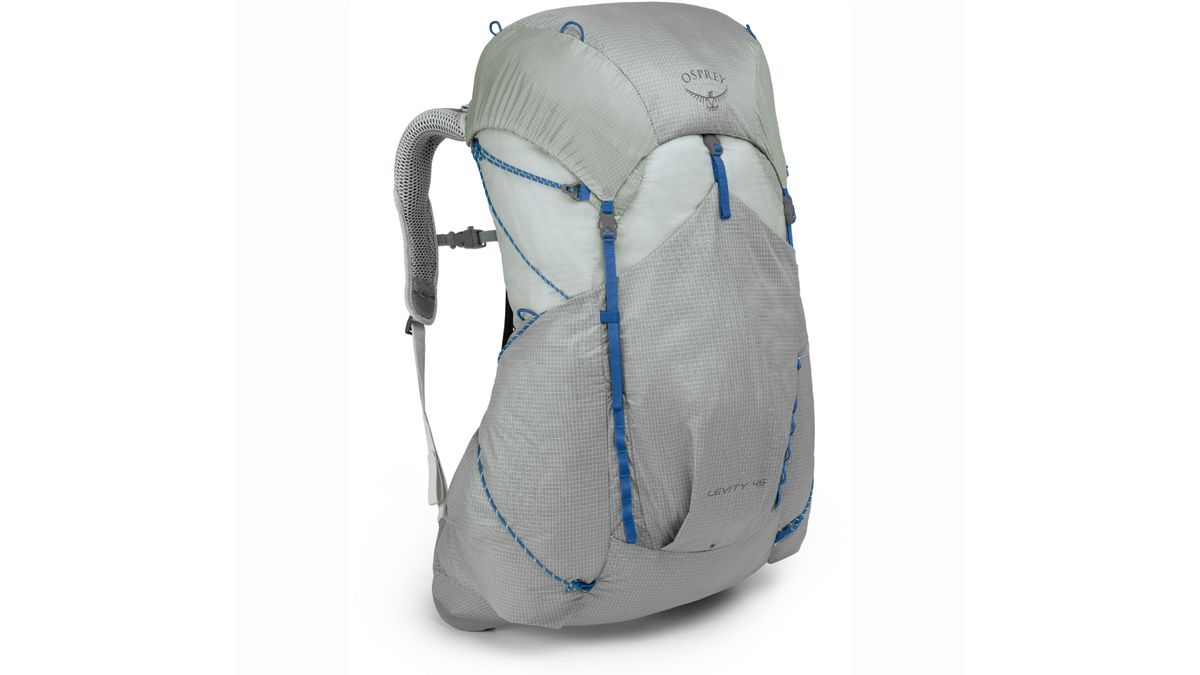
Overview
The Osprey Levity 45 was Osprey’s first serious swing at the ultralight backpacking market — a ventilated, internally framed pack weighing under 900g that competed directly with cottage-industry alternatives at mainstream retail prices. What made it notable was being one of the first ultralight backpacks from an established brand sold at large retailers, bringing sub-900g performance to hikers who’d never considered a frameless cuben-fiber sack from a small online company. It’s now discontinued, but used and old-stock units still surface regularly, and it remains worth understanding on its own merits.
Key Specs
| Spec | Detail |
|---|---|
| Weight | 844g / 1 lb 13.8 oz (size M) |
| Volume | 42L (S) · 45L (M) · 48L (L) |
| Load Range | 5–20 lbs |
| Frame | 3.5mm Lightwire internal aluminum frame |
| Back Panel | 3D-tensioned AirSpeed mesh |
| Main Fabric | 30D Cordura Silnylon Ripstop |
| High-Wear Fabric | 210D NanoFly nylon |
| Pockets | Zippered lid pocket, bellows front pocket, 2 open side pockets |
| Extras | Hydration sleeve, daisy chains, gear loops, sternum strap with whistle |
| Original MSRP | $250 USD |
| Status | Discontinued |

Would the Levity 45 earn its spot in your pack?
844 g · 29.8 ozAdd the Osprey Levity 45 to your Gear Closet and see exactly what it does to your base weight, then start packing for your next trip.
Free · No credit card · iOS, Android & web · Trusted by 3,000+ backpackers
Performance
Suspension and Fit
This is where the Levity earns its reputation. Most ultralight packs sit directly on the back, but the Levity holds itself away from your body with an air gap running the full length of the back system, structured by a narrow-gauge aluminum wire frame wrapped around the edge of the pack onto which a full mesh back panel is stretched in tension. The result is Osprey’s well-regarded AirSpeed trampoline back — the same system found on the Exos — and at this weight class it’s genuinely unusual. With a modest overnight load, the fit, balance, and carrying comfort are superb, while for a pack this light the ventilation is exceptional.
The sweet spot is loads between 10–20 lbs. When loaded fully with backpacking gear, food, and water, the Levity rides like a cloud for lightweight loads up to 20 lbs; in the 20–30 lb range it still carries well, but the thinner-than-normal shoulder straps and hip belt make themselves known as the miles pile up. That’s a reasonable trade-off for the weight saved. Push it past 25–30 lbs and the suspension starts to struggle — it’s important to understand the limits of the Levity; there arguably isn’t enough support and structure for loads beyond about 10–12 kg, and it’s not designed to withstand years of hard abuse.
Fit also depends on your waist size. The hip fins can be too short for waists above about 38 inches, making effective load transfer difficult; Osprey acknowledged the issue but didn’t change the production version — hikers with a 36-inch waist or less generally find the pack very comfortable.
Packability and Organization
Loading the Levity is a little challenging at first because it’s narrower at the top than at the bottom, which makes it feel slightly smaller than the stated 45 liters — you have to pack strategically from the bottom up to fully use the space.
Think of it as a Tetris game rather than a stuff-it-in situation. Once you get your system dialed, most users find it plenty capacious.
Full-weight loads of around 30 lbs with ten days of food have been swallowed by the pack.
Externally you get one zippered pocket in the lid and three more open but fairly deep pockets on the back and sides.
The front pocket has a bellows design with a top clip for stashing rain layers, and the side pockets can be accessed from two directions — handy for soft-sided flasks on the move.
The conspicuous absence is hip belt pockets, which is a genuine miss for anyone who carries a phone, snacks, or a phone in their waist pockets. Third-party clip-on options exist, but it’s still an annoyance.
The small drawstring compression mechanism on both sides makes it easy to slim down for lighter, smaller loads
— reportedly effective enough for day trips or shoulder-season use where the main bag isn’t stuffed.
Durability
The main body uses translucent 30D Cordura ripstop silnylon, while high-wear areas on the bottom and sides use a more robust 210D NanoFly nylon.
These materials are much lighter and thus more delicate than most packs — some tents are made of comparable fabrics, which can give you an idea of what the pack feels like.
That said, real-world reports are cautiously positive:
one tester put the pack through a demanding Grand Canyon trip with class 3–4 scrambling and found it came out virtually unscathed with only minor scratches on the front pocket — a reasonable testament to the durability of the materials.
Treat it like the ultralight gear it is and it holds up. Take it bushwhacking or scrambling on technical terrain and you’re taking a risk.
Bear Canister Compatibility
Worth noting for JMT and Sierra trips: the Levity 45 will not horizontally hold a bear canister like the Garcia or BV500 — you’d need the 60L version if a canister is required.
Pros & Cons
Pros
- Sub-900g with a full ventilated suspension — genuinely rare at this weight
- AirSpeed mesh back is among the best in class for breathability
- Surprisingly capable at loads up to 20 lbs; manageable up to ~25 lbs
- Osprey fit and finish — build quality is noticeably above cottage-industry norms
- Side drawcord compression works well and doubles the pack’s versatility
- 210D NanoFly reinforcement in high-wear zones adds meaningful durability where it counts
- Three size options with torso sizing to match
Cons
- No hip belt pockets — a real omission at $250
- Minimal hip belt padding; hikers with waists above 36 inches may struggle to transfer load
- Narrow top opening makes packing slower and more deliberate
- 30D silnylon main body is more susceptible to abrasion than most competitors
- Compression straps feel fairly delicate and seem like they could break over time
- Discontinued — no warranty support from Osprey on new purchases going forward
Who Should Buy This
This pack is built for the ultralight backpacker who wants the carrying comfort of a real suspension system without paying the weight penalty. If your base weight is already under 10–12 lbs and you’re looking for a pack that won’t roast your back on warm-weather trips, the Levity 45 is a compelling find on the used market. If you’re tempted to go lighter but not willing to sacrifice the carrying comfort of an internal framed pack, there’s probably no better option than the Osprey Levity 45. It’s less well-suited for anyone frequently hauling over 20 lbs, needing hip belt pockets, or taking the pack into rough off-trail terrain.
Verdict
The Levity 45 was Osprey proving it could play in the ultralight space without completely abandoning the comfort principles that built its reputation. At roughly 12 oz lighter than a comparably sized Exos, Osprey had to make sacrifices — and those sacrifices (minimal hip padding, no hip pockets, delicate fabrics) are real, but they’re the right trade-offs for a disciplined lightweight kit. If you find one in good condition for a fair price, it’s worth picking up — just keep loads lean and treat the silnylon shell with some respect. Rating: 8/10.