Osprey Kyte Review
Osprey's women's-specific Kyte, in 36 L and 48 L, trades roughly a pound of extra weight for a plush fit, deep organization and a lifetime repair guarantee.
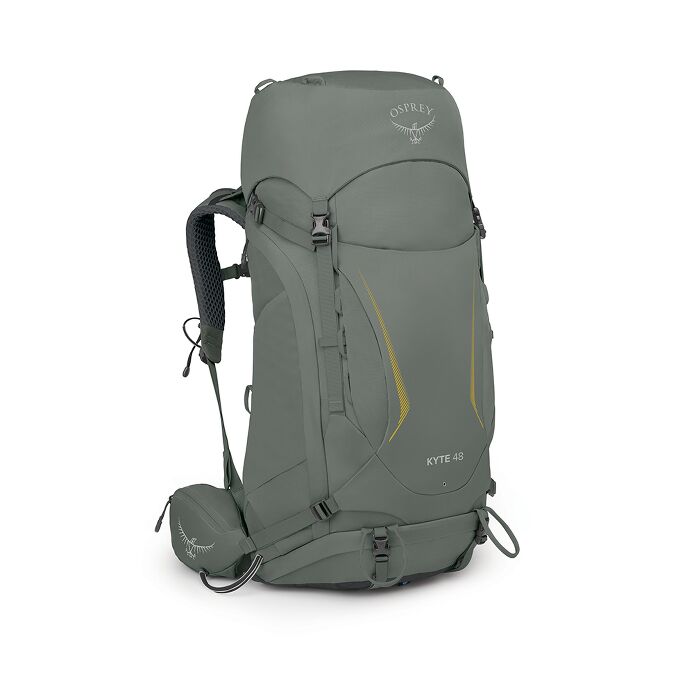
Overview
The Kyte is Osprey’s women’s-specific rucksack for weekend backpacking and heavy-duty day hikes, and it is the counterpart to the men’s Kestrel. It comes in two capacities, 36 L and 48 L, and both are built around fit, durability and pocket count rather than gram-shaving. Hikers with a conventional kit get a comfortable, well-organized pack. Ultralight loadouts get a pack that weighs more than they need.
Key Specs
| Spec | Detail |
|---|---|
| Volume | 36 L or 48 L |
| Weight | 1,465–1,844 g depending on version |
| Recommended load range | 20–35 lb |
| Dimensions, 36 L (WS/M) | 27.6 h x 13 w x 11.8 d in |
| Dimensions, 48 L (S/M) | 26 h x 14 w x 11 d in |
| Dimensions, 48 L (M/L) | 28 h x 14 w x 11 d in |
| Back panel | AirScape ridged foam with adjustable torso length |
| Frame | Peripheral frame with Atilon framesheet |
| Rain cover | Integrated, removable |
| Fit | Women’s-specific harness and hip belt |
Versions compared
| Image | Version | Weight | vs. lightest |
|---|---|---|---|
 | 36 L Women's / M/L | 1465 g (51.7 oz) | lightest |
| 48 L | 1844 g (65.0 oz) | +379 g |

Would the Kyte earn its spot in your pack?
1844 g · 65.0 ozAdd the Osprey Kyte to your Gear Closet and see exactly what it does to your base weight, then start packing for your next trip.
Free · No credit card · iOS, Android & web · Trusted by 3,000+ backpackers
Performance
Carry. The AirScape back panel is a foam-ridged design with adjustable torso length, and it rides close to the spine. That is a different proposition from the trampoline-mesh suspension on Osprey’s Exos and Eja. The mesh holds the load away from the back and moves more air. The Kyte gives up some of that ventilation and gets stability on uneven ground in return. The peripheral frame and Atilon framesheet carry weight to the hips, which is why the pack stays composed near the top of its 20–35 lb range instead of sagging into the hip belt. The 48 L is the version that makes use of that ceiling. Outdoor reviewers who tested the men’s Kestrel on the same platform singled out the perforated back-panel pads for keeping sweat down. They also found it a more breathable carry than a foam panel would suggest.
Fit. This is the reason to buy the Kyte over its men’s sibling. The shoulder straps are shaped to avoid pinching at the chest and underarms. The hip belt flares to wrap a curvier hip, and the torso length adjusts within each size. A dedicated Kyte review found that it fits a wide range of torso lengths despite only two size options. Owners of the 36 L describe the hip belt as soft and wide, and one trekker who switched from the Tempest 40 found it noticeably more comfortable. Hikers who have fought unisex packs that dig into the shoulders or ride up off the hips are the people this pack was built for.
Organization. Both versions share a feature list that is dense for the weight class. They have a top lid with an external zip pocket, a zippered sleeping bag compartment with a floating divider, a front shove-it pocket, stretch mesh side pockets and zippered hip belt pockets. They also have an external reservoir sleeve, Stow-on-the-Go trekking pole attachments, ice tool loops and an integrated rain cover. Side zip access to the main compartment means a rain jacket at the bottom doesn’t require unpacking the pack from the top. The hip belt pockets swallow a phone, snacks and a lighter. Ultralight packs often leave them off. Reviewers of the Kestrel platform did flag that the side bottle pockets are awkward to reach while the pack is on.
Weight. At 1,465 g, the 36 L is 3.23 lb. The 48 L runs about 4.1–4.25 lb depending on size. Neither is light by thru-hiker standards. Comparisons with the framed Osprey Eja 48 put the Eja about a pound lighter, with fewer features. That pound shows up on every climb for anyone whose base weight is already low. It also buys fabric that tolerates brush, granite and airline baggage handling.
Durability. Osprey builds the Kyte from bluesign-approved fabrics, with a DWR treatment made without PFAS. The All Mighty Guarantee covers repair of damage or defects free of charge. If a repair isn’t possible, Osprey replaces the pack. For a pack that gets dragged through a few seasons of trips, that matters more than a spec sheet.
Choosing a Version
36 L (Women’s M/L, 1,465 g). This is the one for overnighters, hut-to-hut trips, the Camino and gear-heavy day hikes. Owners on Camino forums report it holding everything for multi-week walks when the kit is lean. An outdoor reviewer testing it judged the volume too small for trips beyond about three days. It is 400 g lighter than the 48 L, and its smaller footprint keeps the top lid from nudging the back of the head. Carry-on travelers like it for the same reason. Hikers with a bulky sleeping bag and a bear canister will not fit them in here.
48 L (1,844 g). This is the weekend-to-long-weekend pack. The extra 12 L takes a winter-weight bag, a roomier shelter or a few days of food. It is also the version that justifies the framesheet and the 35 lb ceiling. The 48 L comes in two sizes, S/M at 26 in tall and M/L at 28 in. The same torso adjustment applies. Choose it if the gear list regularly overflows 36 L, and choose the 36 L if the 48 L would travel half empty.
Pros & Cons
Pros
- Women’s-specific harness and flared hip belt, not a resized unisex design
- Stable, close-to-body carry that handles loads up to 35 lb
- Deep organization, including hip belt pockets, side zip access and a sleeping bag compartment
- Integrated rain cover and trekking pole attachments
- PFAS-free DWR, bluesign-approved fabrics and a lifetime repair guarantee
- Two capacities that cover day hikes through long weekends
Cons
- Roughly a pound heavier than framed ultralight options like the Eja 48
- Foam back panel breathes less than trampoline-mesh designs
- Side pockets are awkward to reach while wearing the pack
- The 36 L runs out of space on trips longer than three days
Who Should Buy This
The Kyte suits women doing weekend and short multi-day trips with a conventional kit. It also suits new backpackers who want a forgiving, supportive pack while they refine their gear list, and anyone who has given up on unisex packs. Choose the 36 L for lean overnights, treks and travel. Choose the 48 L if the load regularly runs 25–35 lb. Thru-hikers and sub-10-lb base weight hikers should look at the Eja or a cottage-brand frameless pack.
Verdict
The Kyte is a durable, comfortable, well-organized pack that fits women better than most unisex alternatives, and its weight is the only real trade-off. The 48 L is the better all-round pick for weekend backpacking, and the 36 L is the choice for light overnights and treks. Ultralight hikers should pass.