Osprey Kestrel 48 Review
A feature-rich, rugged mid-weight pack for weekend backpackers and heavy-duty day hikers who want Osprey quality without the premium price tag.
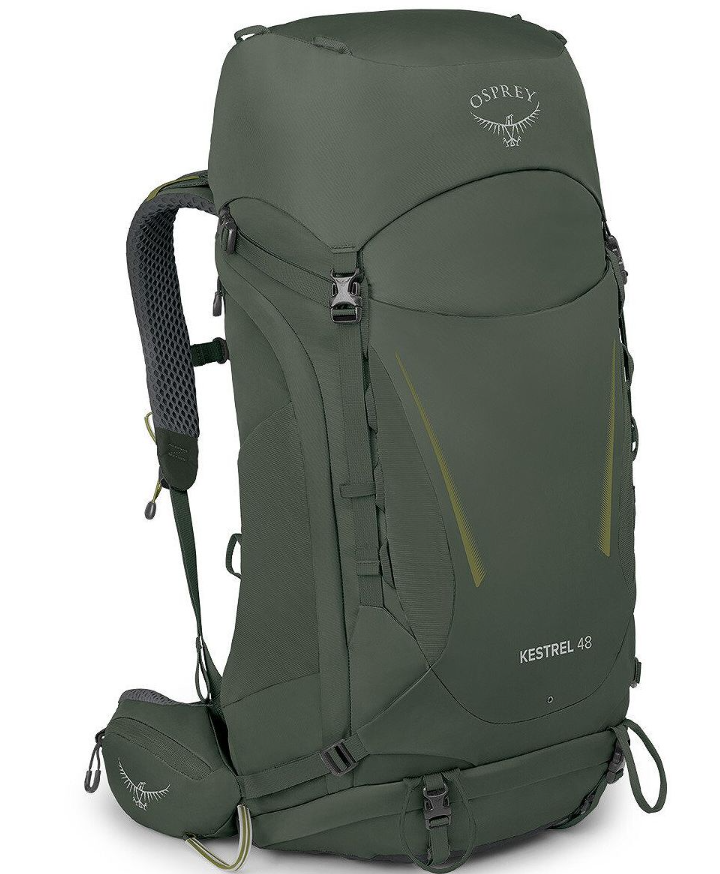
Overview
The Osprey Kestrel 48 is a mid-weight, full-featured rucksack aimed at weekend backpackers and hard-use day hikers who need a capable, durable pack without spending flagship money. It sits squarely in the conventional (not ultralight) category — at 2,090 g (4 lbs 10 oz), this is not the pack you reach for when base weight is the obsession. What it offers instead is a thoughtfully organized, well-built load hauler with a wide torso fit range, solid suspension, and an included rain cover — at a price that undercuts much of the Osprey lineup.
Key Specs
| Spec | Detail |
|---|---|
| Weight | 2,090 g (4 lbs 10 oz) |
| Volume (S/M) | 46 L |
| Volume (L/XL) | 48 L |
| Dimensions (S/M) | 74h × 40w × 30d cm |
| Dimensions (L/XL) | 79h × 40w × 30d cm |
| Torso Fit (S/M) | 16″–20″ |
| Torso Fit (L/XL) | 19″–23″ |
| Frame | 3.5 mm LightWire peripheral + Atilon framesheet |
| Back Panel | AirScape™ injection-molded framesheet, ridged mesh foam |
| Main Fabric | 420D recycled nylon (body) / 500D recycled HT nylon (bottom) |
| DWR | PFAS-free, bluesign®-approved |
| Rain Cover | Included, stores in bottom zippered pocket |
| MSRP | ~$200 USD |

Build your Gear Closet
View all of your gear in one place, create packing lists and hit the trail with confidence. Available on iOS, Android and the web.
Get StartedPerformance
Suspension & Fit
The Kestrel runs on a combination of a 3.5 mm LightWire peripheral frame and Osprey’s Atilon framesheet, which together are designed to transfer the load from the harness to the hipbelt across the full back panel. In practice, most users find the load transfer decent for moderate weights. At 25–35 lbs, the pack rides well and the hipbelt does real work. Push closer to 40 lbs and some users — myself included — start to notice the shoulder straps working harder than you’d like; at about 4 miles in with 32 lbs, the straps were digging into muscle noticeably.
The adjustable torso length is a genuine feature. With the S/M covering 16″–20″ and the L/XL covering 19″–23″, the Kestrel handles a wider range of body types than many competitors at this price. That said, the hipbelt is fixed and non-removable, which limits customization compared to higher-end packs like the Atmos AG.
Ventilation
The AirScape back panel — mesh-covered ridged foam with an injection-molded framesheet — is supposed to keep the pack suspended slightly off the back for airflow. In most conditions, it delivers noticeably better ventilation than a flat-panel pack. However, there’s a known issue worth flagging: some users have reported the panel gradually deforming from concave to convex under repeated heavy loads, which defeats the purpose and turns it into a sweaty contact patch. This appears to affect a subset of units rather than all of them, but it’s worth checking periodically if you’re running heavy loads regularly.
Organization
This is where the Kestrel earns genuine goodwill. The feature list is long for the price:
- A right-side zipper opens directly into the main compartment — useful for grabbing gear mid-hike without unpacking from the top
- The left-side zipper accesses a full-length pocket ideal for a rain jacket or extra layers
- A floating divider creates a dedicated sleeping bag compartment at the bottom, and you can collapse it to run the pack as one large space
- Dual zippered hipbelt pockets are sized for a phone, a handful of snacks, or a headlamp — easily the most useful real-estate on the pack
- Stow-on-the-Go trekking pole attachment lets you stash poles without taking the pack off
The main organizational complaint, echoed across multiple reviewers and forum posts, is the side water bottle pockets. When the pack is loaded, the mesh compresses too tightly against the main body to easily get a Nalgene in or out — often requiring you to stop and use both hands, or recruit a hiking partner. If you run a hydration bladder instead of bottles, this is a non-issue. If you’re a bottle-and-go drinker, plan around it.
Durability
The 420D recycled nylon body and 500D high-tenacity nylon bottom are legitimately robust. Multiple long-term users report their packs holding up through 2,200-mile thru-hikes, multi-season trail work with the National Park Service, and five-plus years of hard use with zippers and clips still intact. The one material concern flagged by a few users is the stretch mesh on the side pockets, which can fray with heavy off-trail brush exposure over time.
Pros & Cons
Pros
- Feature-rich for the price: dedicated sleeping bag compartment, included rain cover, Stow-on-the-Go pole attachment, dual ice tool loops
- Adjustable torso length accommodates a wide range of body sizes
- Dual zippered hipbelt pockets are generously sized and actually useful
- Full-length side access zipper on both sides for quick organization
- Durable fabric construction holds up to hard use over multiple seasons
- Solid load transfer at moderate weights (25–35 lbs)
Cons
- At 2,090 g, it’s heavy relative to category alternatives (the Osprey Exos 48 comes in around 975 g)
- Side water bottle pockets are nearly inaccessible when the pack is loaded
- AirScape panel can deform under sustained heavy loads, reducing ventilation
- Fixed lid and hipbelt limit customization
- Shoulder strap padding starts to feel inadequate with loads above ~35 lbs
- 48L is tight for 4+ days with conventional gear
Who Should Buy This
The Kestrel 48 is a strong match for weekend backpackers carrying conventional (non-ultralight) kit, trail workers, and approach-style hikers who need gear attachment options and heavy-duty durability. It’s also a good fit for someone who has already trimmed their kit down to ultralight weights but still wants a structured, feature-laden pack rather than a frameless sack. If your base weight is above 15 lbs or you’re new to backpacking and buying your first serious pack, the Kestrel makes a lot of sense at ~$200. If you’re chasing sub-20 lb total weight on thru-hikes, the Exos 48 or a competitor like the Hyperlite Mountain Gear 3400 Southwest will serve you better — you’d be carrying over 2 kg of pack before a single piece of gear goes in.
Verdict
The Osprey Kestrel 48 does what it sets out to do: deliver a durable, well-organized, comfortable-enough pack at a price accessible to hikers who aren’t ready to go minimalist. The organization is genuinely good, the adjustable torso fit is a real advantage, and the construction quality is hard to argue with at this price point. The weight is the honest sticking point — it’s simply not competitive with packs designed for efficiency. For the right user, it earns a 7/10; for anyone serious about base weight, that number drops fast.