Osprey Exos Review
Osprey's Exos pairs a trampoline mesh back panel and adjustable torso with a sub-1.3 kg carry, but it trades ounces for comfort and ventilation.
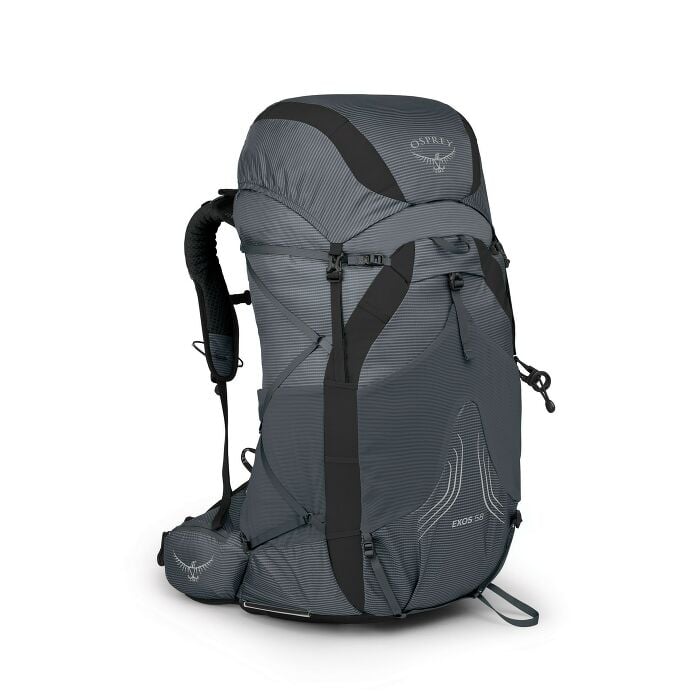
Overview
The Exos is Osprey’s answer to a question thru-hikers keep asking: how much pack do I actually need? Built around a suspended AirSpeed mesh back panel, a lightweight aluminum perimeter frame and an adjustable torso, it offers real load support and ventilation at roughly 2.5 to 2.8 pounds. It isn’t a true ultralight pack, and the headline trade-off is plain: more comfort and organization than a frameless sack, but more weight than the cottage-industry packs it competes with.
Key Specs
| Spec | Value |
|---|---|
| Weight | 1,166–1,276 g depending on version |
| Volumes | 38 L, 48 L, 58 L (the 58 runs 55 L Small, 58 L Medium, 61 L Large) |
| Max recommended load | 35 lb (58 and 48); lower on the 38 |
| Frame | Aluminum perimeter frame |
| Back panel | AirSpeed suspended mesh (“trampoline”) |
| Torso adjustment | About 4 in, ladder-style |
| Materials | Recycled high-tenacity nylon ripstop (100D body, 400D reinforcement); bluesign approved; PFC/PFAS-free DWR |
| Lid | Removable floating lid with two zippered pockets; FlapJacket underneath |
| Price | About $285 |
| Women’s equivalent | Osprey Eja |
Versions compared
| Image | Version | Weight | vs. lightest |
|---|---|---|---|
 | 48 | 1166 g (41.1 oz) | lightest |
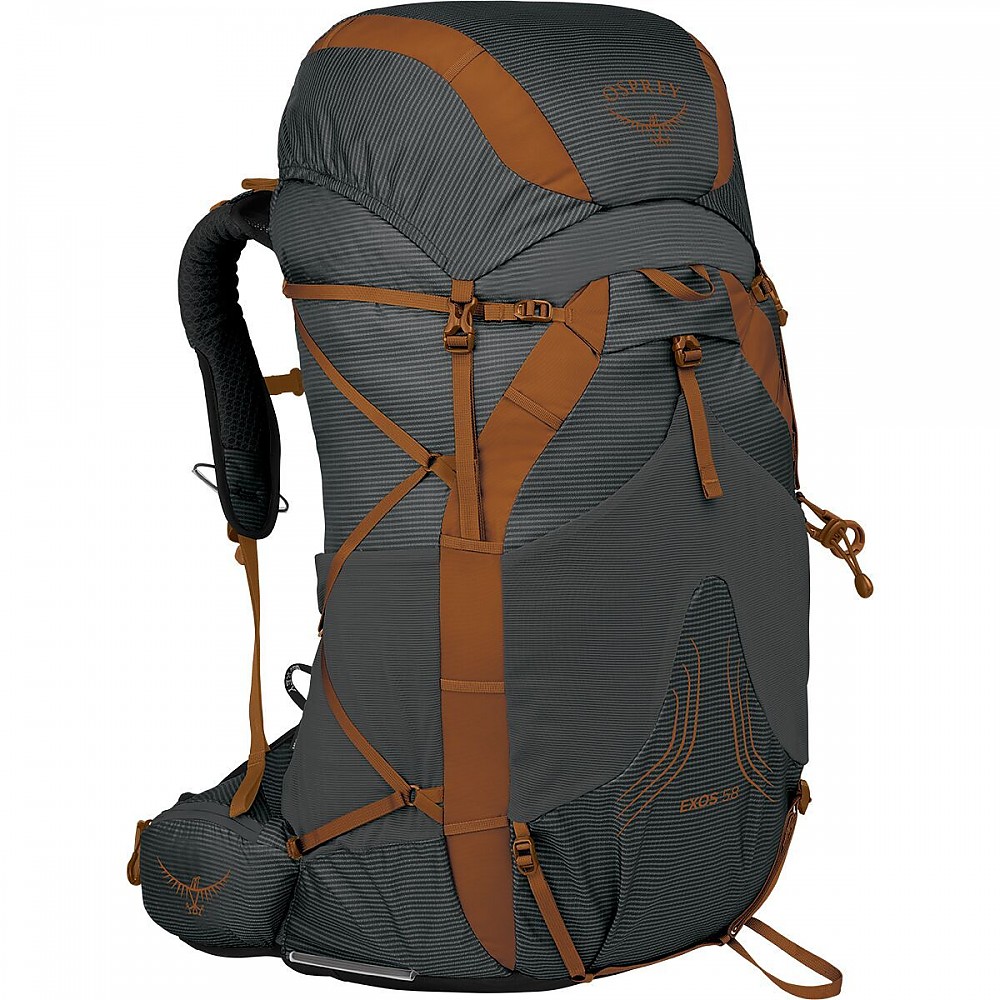 | 58 2009 | 1185 g (41.8 oz) | +19 g |
 | 38 | 1190 g (42.0 oz) | +24 g |
 | 48 S/M | 1255 g (44.3 oz) | +89 g |
| 58 Small/Medium | 1276 g (45.0 oz) | +110 g |

Build your Gear Closet
View all of your gear in one place, create packing lists and hit the trail with confidence. Available on iOS, Android and the web.
Get StartedPerformance
Comfort and suspension
The AirSpeed panel is the reason the Exos has stayed on trails for years. Across most of the back, only mesh touches the wearer, so air moves freely on a sweaty climb. Paired with a padded hipbelt and the stiffness of the perimeter frame, it carries 30 pounds without drama. Reviewers at CleverHiker and Switchback Travel both single out the mix of ventilation and carrying comfort as the pack’s strength.
The same design has a cost. Trampoline suspension holds the load away from the spine, which pushes the center of gravity back and makes the pack feel heavier than the scale says. Under about 30 pounds, the effect is minor. Past 35, shoulders start to complain, and testers who have tried it report that the pack loses its composure rather than failing outright. A few hikers also report the frame pressing into the top of the glutes over consecutive days, a pain that builds with mileage. Trying the pack on loaded, before committing, is worth the trouble.
Fit and adjustability
The torso ladder raises and lowers the shoulder straps through five positions, covering roughly 4 inches, and it can be adjusted on the trail without unpacking. That matters because the Exos comes in only two size ranges, Small/Medium and Large/XL. The system covers a wide spread of builds, and Greenbelly’s testers rated adjustability among the pack’s strongest traits.
Organization
Unlike most ultralight packs, the Exos uses a floating top lid rather than a roll-top. The lid has two zippered pockets and lets extra gear ride on top of the main compartment. Removing it exposes a permanently attached FlapJacket that covers the drawstring opening, and dropping the lid along with the compression and sleeping-bag straps takes about 5 oz off the carry weight. On the 58, a BV500 bear canister fits horizontally inside, which is a real advantage for canister-required routes. One tester fit a two-person tent, a 15-degree bag and a pad in the base with room left for three days of food and layers.
Stretch mesh pockets on the sides and back are easy to reach on the move, and the large back pocket swallows a puffy on cold mornings. The hipbelt pockets are the weak spot: they are small, awkward to zip while wearing the pack, and better for snacks and lip balm than a modern phone.
Durability
A 100D body with 400D reinforcement puts the Exos in the middle of the durability range. It should last a thru-hike with reasonable care, but it won’t shrug off abuse the way a heavier hauler does. Fabric edges around the frame take abrasion, and long-distance hikers report the mesh wearing through somewhere between 1,500 and 2,000 miles. Osprey’s lifetime guarantee covers the gap; at least one hiker who wore out the mesh after 2,000 miles received a replacement pack rather than a repair.
Choosing a Version
The listed weights span only 110 g, from 1,166 g to 1,276 g, so volume and load rating matter more than ounces.
- 48 (1,166 g) and 48 S/M (1,255 g): The sweet spot for most thru-hikers. Reviewers at Switchback Travel call the 48 a versatile size for overnighters through long trails, and Greenbelly’s testers consider it sufficient for hikers with a compact quilt and tent. The 48 is the best choice for anyone carrying 30 pounds or less. The 90 g gap between the two listings reflects different size and measurement conditions; the shape and feature set are the same.
- 58 2009 (1,185 g) and 58 Small/Medium (1,276 g): The extra volume suits bulky gear, long food carries and bear canisters. Halfway Anywhere’s reviewer noted the 58 is only about 2 oz heavier than the 48, which makes the larger bag an inexpensive hedge. Hikers who regularly pack under 25 pounds will have empty space they’ll have to compress.
- 38 (1,190 g): The 38 suits fast overnights and weekend loads. Its load rating is lower than the bigger bags’, in the 25 to 30 pound range in published figures, and it weighs about the same as the 48. Unless a 38-liter capacity is a hard requirement, the 48 gives up almost nothing in weight and gains a lot of room.
Pros & Cons
Pros
- AirSpeed suspended mesh gives genuine back ventilation under multi-day loads
- Roughly 4 in of torso adjustment fits a wide range of builds from two size ranges
- Removable lid and straps trim about 5 oz when going lighter
- The 58 swallows a BV500 bear canister horizontally
- Stretch mesh pockets are reachable while walking
- Recycled, bluesign-approved fabrics with PFC/PFAS-free DWR
- Osprey’s lifetime guarantee backs the known mesh wear points
Cons
- Heavier than frameless and cottage-brand alternatives, many of which come in under two pounds
- Trampoline design shifts the load rearward, and comfort drops past about 35 lb
- Hipbelt pockets are small and hard to zip while wearing the pack
- Frame can rub the top of the glutes on multi-day trips for some wearers
- Mesh and frame-edge fabric are the first parts to wear on long thru-hikes
- 100D fabric is a middle-weight compromise, not bombproof
Who Should Buy This
The Exos fits the three-season hiker who carries 20 to 35 pounds and wants a proper hipbelt, a ventilated back and a pack that adjusts to a changing torso or a changing gear list. It’s a natural upgrade for anyone leaving a 4-pound hauler behind. The 48 suits most thru-hikers, the 58 suits those who carry a bear canister or long food stretches, and the 38 suits short trips. Hikers with sub-12-pound base weights, or anyone chasing the lowest possible carry, will find lighter packs from smaller makers that do the job with less fabric and fewer straps.
Verdict
The Exos remains one of the most well-rounded framed packs in the low-to-mid weight range: cool, adjustable, well organized and backed by a real warranty. It won’t satisfy gram-counters, and it gets uncomfortable above 35 pounds. For hikers who value ventilation and support over the last few ounces, it earns a 7.5 out of 10, and the 48 is the version to buy.