Osprey Atmos AG 50 Review
Packstack is reader-supported. When you buy through links on our site, we may earn an affiliate commission. This does not affect the independence or objectivity of our reviews.
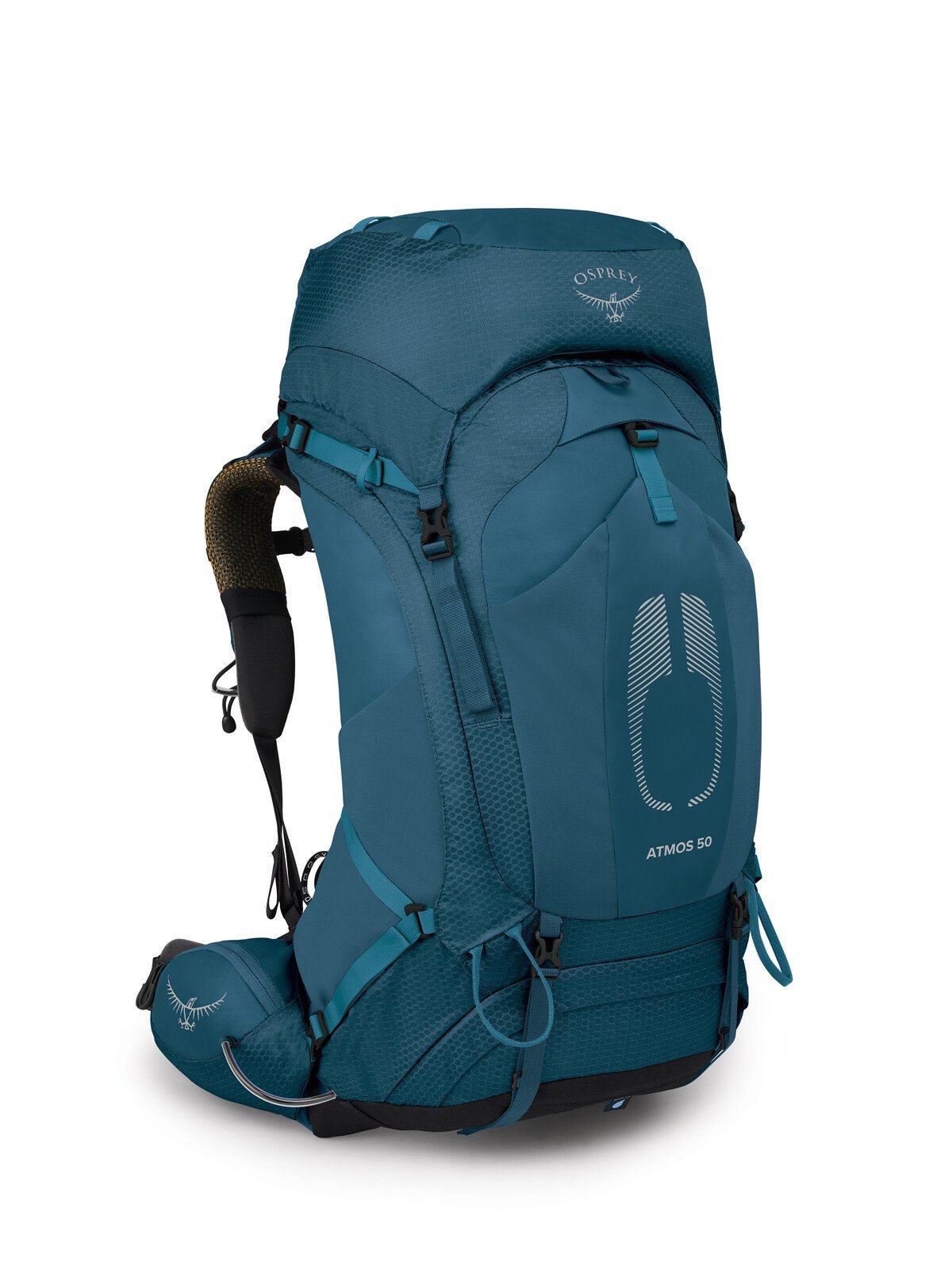
The Osprey Atmos AG 50 is a comfort-first, 50L backpacking pack with an Anti-Gravity suspension system that excels at carrying 25–35 lb loads for 3-season multi-day trips.
Overview
The Osprey Atmos AG 50 is a feature-rich, 50-liter internal-frame pack built around Osprey’s award-winning AntiGravity (AG) suspension system. It’s aimed squarely at 3-season backpackers who carry 25–35 lbs and prioritize all-day carrying comfort over base weight. If you’re counting grams, this isn’t your pack — but if you want the most comfortable ride for a moderate load, the Atmos AG is one of the strongest arguments in the category.
Key Specs
| Spec | Detail |
|---|---|
| Weight | 1,960 g / 4 lbs 5 oz (L/XL) |
| Volume | 50 L (S/M: ~47 L / L/XL: ~53 L) |
| Sizes | S/M, L/XL |
| Load Range | 25–35 lbs (11.3–15.9 kg) |
| Torso Fit | S/M: 17”–20.5” / L/XL: 19.5”–23” |
| Dimensions (L/XL) | 33.9H × 15W × 12.2D in |
| Materials | 100% recycled fabrics, bluesign® approved |
| Rain Cover | Included (PFAS-free DWR, stows in bottom pocket) |
| Frame | 4mm powder-coated full peripheral LightWire frame |
| Warranty | Osprey All Mighty Guarantee (lifetime) |
Would the Atmos AG 50 earn its spot in your pack?
1960 g · 69.1 ozAdd the Osprey Atmos AG 50 to your gear closet and see exactly what it does to your base weight — then build your next packing list around it. Free, in about two minutes.
Free · No credit card · iOS & Android · Trusted by 3,000+ backpackers
Performance
The AG Suspension: It Actually Works
The centerpiece here is the AntiGravity suspension — a ventilated back panel suspended from a loop frame, where the rear mesh flows from the back panel into the hip belt so it behaves like one integrated unit instead of two separate components moving independently. In practice, the pack hovers a good four inches away from your back, and you rarely feel its presence at all. The result is that load transfer to your hips is efficient enough to keep shoulders fresh even on long climbs, the mesh backpanel provides excellent ventilation, and on a July trip with temperatures reaching 85°F, your back stays noticeably drier than with conventional packs.
The hip belt deserves its own mention. It isn’t rigidly attached to the pack body — it connects through a pivot system that allows independent movement. When you step up on a rock, the belt rotates with your leg; when you twist to adjust your trekking poles, the belt follows. Traditional packs fight this motion. The Atmos AG works with it.
Fit and Adjustability
The pack wraps around your upper torso, positioning itself on your hips for maximum load transfer and comfort, and it’s adjustable so you can dial in torso length and hip belt for a custom fit.
One gripe worth flagging:
Osprey hasn’t printed torso length indicators on the torso length adjustment, so there’s no way of knowing, other than by feel, if you’ve repositioned the shoulder harness to match your torso length.
It’s a small oversight on an otherwise well-engineered system. If you’re buying online, try to get into a store and have the hipbelt heat-molded — reviewers report it makes a significant difference in eliminating hip slip on longer days.
Organization
The Atmos AG is a top-loading, alpine-style backpack with a floating top lid, main compartment, rear shovel pocket, and two side water bottle pockets. The hip belt has two zippered pockets large enough for snacks and frequently accessed items, and the top lid holds two zippered pockets.
Large curved side-zip panels provide access into the main compartment from both sides,
which I find genuinely useful mid-day without having to excavate from the top.
A zippered sleeping bag compartment with a removable divider and removable sleeping pad straps round out the bottom.
The hip belt pockets are a recurring debate. Some users find them small; in practice, a phone, a few bars, and a lighter fit fine on one side — just don’t expect them to swallow a full-frame GPS and a rain jacket simultaneously.
Durability and Weather Protection
The main body uses 100D × 630D nylon, while high-wear areas get 420HD nylon packcloth — a combination that balances durability with weight savings. After a full season of use including bushwhacks through overgrown trails, the pack shows minimal wear.
The AG mesh is the one area I’d handle with some care;
while it hasn’t torn on extended use, some users do report mesh tears after aggressive use, so it’s worth being mindful of sharp branches and rocks near camp.
Osprey includes an integrated rain cover that stows in a dedicated pocket at the bottom of the pack — it’s decent quality, not an afterthought.
The raincover has been relocated from the lid to that dedicated bottom pocket on recent models, making it significantly faster to deploy without removing the pack when a sudden storm hits.
Winter Limitations
Worth flagging for anyone considering shoulder-season or winter use: snow melts against the mesh and makes your back extremely wet, and with snow sitting against your core all day, heat loss can sneak up on you. This makes the AG system a poor choice if you’re primarily targeting winter conditions. Three-season use is where this pack genuinely shines.
Warranty
Osprey will repair any damage or defect for any reason free of charge — whether it was purchased in 1974 or yesterday. If they’re unable to perform a functional repair, they’ll replace it.
For a pack in this price range, that matters.
Pros & Cons
Pros
- Best-in-class carrying comfort for 25–35 lb loads
- AG suspension provides exceptional ventilation and body-conforming fit
- Fit-on-the-Fly hipbelt with pivot system adapts dynamically to movement
- Solid 3-season feature set: side zip access, sleeping bag compartment, Stow-on-the-Go pole attachment, ice axe loops
- Integrated rain cover included (PFAS-free, stows at bottom)
- Built from 100% recycled, bluesign® approved fabrics
- Osprey’s lifetime All Mighty Guarantee
Cons
- At 1,960 g (4 lbs 5 oz) empty, it’s heavy — roughly 2–3× a comparable ultralight pack
- AG mesh can collect snow in cold/winter conditions; not ideal for serious winter use
- No torso length markers on the adjustment system — sizing is done by feel
- Limited external lash points compared to competitors like the Gregory Baltoro
- Hip belt pockets run small for large hands or big phones
- Hip belt is not removable for alpine or ultralight use cases
Who Should Buy This
The Atmos AG 50 is the right pack for a 3-season backpacker who regularly carries 25–35 lbs — think standard camping kit, not cuben-fiber minimalism — and wants to stop thinking about their back after the first mile. It’s especially well suited for hikers who’ve struggled to find a comfortable fit in the past, given how much the AG system and Fit-on-the-Fly hipbelt can accommodate different body shapes. If your base weight is under 10 lbs and you’re pushing for speed or going gram-conscious, look at the Osprey Exos 48 or Gossamer Gear Mariposa 60 instead.
Verdict
The Osprey Atmos AG 50 does exactly what it promises: it makes a 30-pound pack feel lighter than it has any right to. The weight penalty — nearly 2 kg empty — is real and intentional, trading base weight for a suspension system that genuinely delivers on comfort over long days and steep terrain. For a comfort-focused, 3-season backpacker who hasn’t yet found their perfect fit, it remains one of the most defensible buys in the category. 8/10.