Osprey Atmos AG Review
Osprey's Atmos AG trades 4 to 4.6 lb of pack weight for a tensioned-mesh suspension that carries 30–40 lb comfortably and breathes better than most rivals.

Overview
The Osprey Atmos AG is the pack that made tensioned mesh back panels a fixture of the backpacking aisle. It remains a default recommendation for hikers who care more about how a load feels at mile 15 than what it weighs at the trailhead. It is offered in 50 L and 65 L versions, all built around the AntiGravity suspension, which carries the mesh from the back panel into the hipbelt. The trade-off is plain: roughly 4 to 4.6 lb of pack in exchange for ventilation and a carry that thru-hikers and weekend hikers alike describe as unusually kind to the back.
Key Specs
| Spec | Detail |
|---|---|
| Weight | 1,845–2,098 g depending on version |
| Volume | 50 L (S/M) / 53 L (L/XL) in the 50; 65 L (S/M) / 68 L (L/XL) in the 65 |
| Max recommended load | 40 lb (18 kg); Osprey lists an ideal range of 25–35 lb for the 50 |
| Frame | Lightwire internal perimeter frame |
| Suspension | AntiGravity 3D-suspended mesh across back panel and hipbelt |
| Fit system | Fit-on-the-Fly harness and hipbelt |
| Sizes | S/M, L/XL |
| Fabrics | 100% recycled main, accent and bottom fabrics (210D nylon body, 500D nylon base) |
| Rain cover | Included, integrated |
Versions compared
| Image | Version | Weight | vs. lightest |
|---|---|---|---|
 | 65 L | 1845 g (65.1 oz) | lightest |
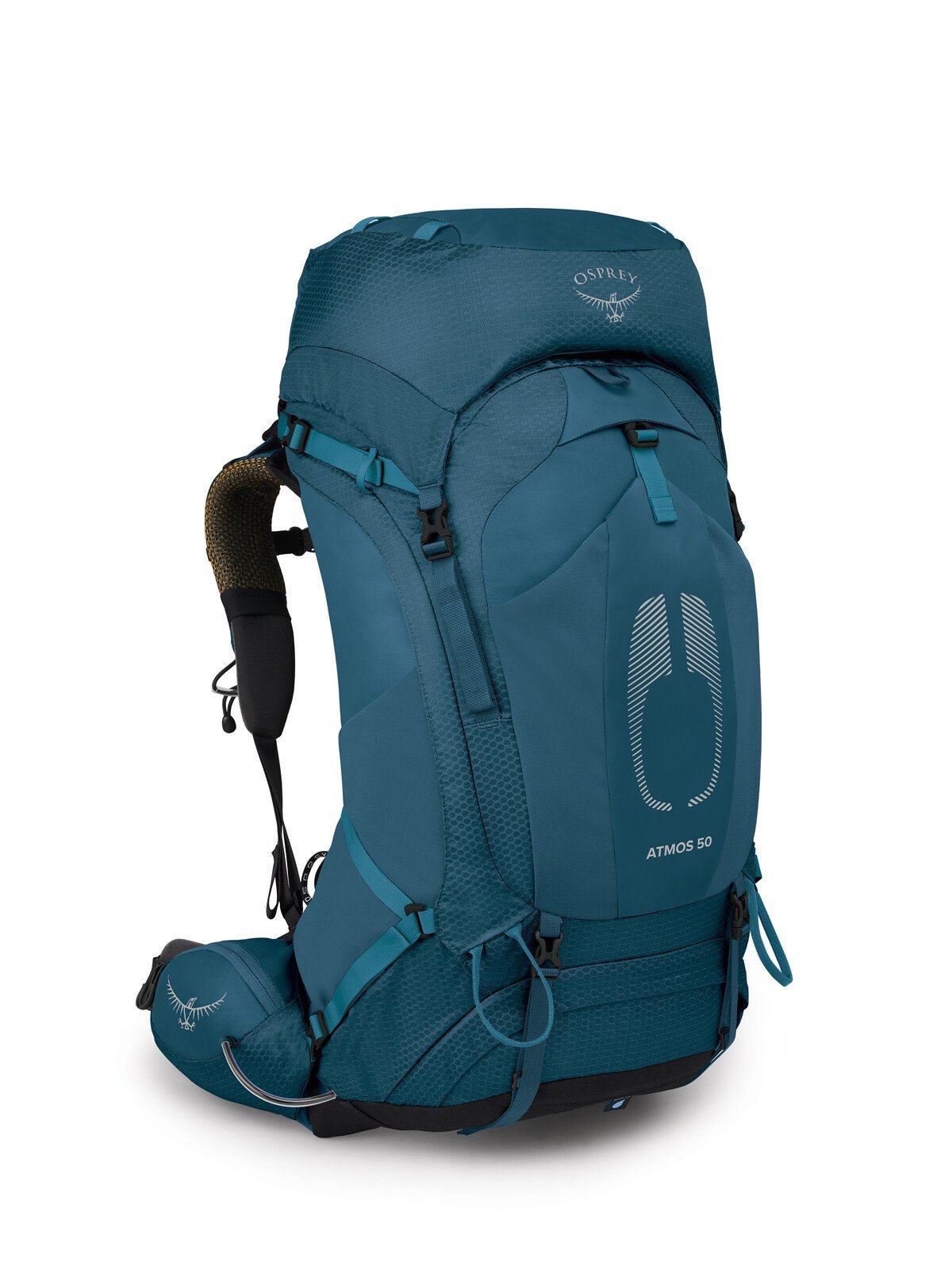 | 50 | 1960 g (69.1 oz) | +115 g |
| 65 Men's | 2098 g (74.0 oz) | +253 g |

Build your Gear Closet
View all of your gear in one place, create packing lists and hit the trail with confidence. Available on iOS, Android and the web.
Get StartedPerformance
Suspension and load carry
This is the reason the Atmos has lasted. The mesh runs uninterrupted from the shoulder yoke to the hipbelt, stretched over the perimeter frame, so the load rides off the back instead of against it. Pressure spreads across the whole panel and the hips rather than pinching at a few points. SectionHiker’s reviewer, carrying about 30 lb in the 50, wondered whether a four-pound pack with this suspension might be more comfortable than a 1.5-pound ultralight pack with a basic harness. That is the Atmos pitch in one sentence.
The hipbelt is the differentiator. Because the mesh wraps into it, the belt tends to fold inward and hug the hips instead of perching on them. Owners carrying 25 to 35 lb report that the snug fit holds up over long days.
There is a ceiling. Past 40 lb, the belt is not stiff enough for the load, and hikers who regularly push 45 lb or more are better served by something with a firmer, more traditional belt, such as Osprey’s own Aether. Earlier generations had a stiff hipbelt that could roll inward and create pressure points; the current shaping and added foam address that.
Ventilation
Air moves freely between the mesh and the pack body, which removes the damp patch that foam-panel packs leave across the back. Hikers with chronically sweaty backs, or anyone climbing sustained grades in warm weather, get the most from this. The flip side is that the pack body sits farther from the spine, pushing the center of gravity back a little. On scrambly, off-trail terrain, the pack can feel less planted than a close-fitting frame pack.
Fit and adjustability
Fit-on-the-Fly gives about four inches of vertical adjustment in the harness and up to six inches in the hipbelt. Torso length can be changed with the pack on, though the short straps make that fiddly, and most owners set it once and leave it. On a long thru-hike, where waist measurements change over the months, retuning the belt without tools is a quiet benefit. Shop staff and testers report that the pack fits a wide range of body shapes, which is why it so often lands on the shortlist of people who have struggled with other packs.
Organization
The Atmos is a top-loader with a removable floating lid, a fabric-reinforced shove-it pocket on the front, tall dual-access side pockets and zippered hipbelt pockets sized for snacks and sunscreen. Curved zips on both side panels open into the main compartment. The 65 adds a lower zip into a sleeping bag compartment with a removable divider, and an internal sleeve takes a hydration reservoir of up to 3 L. Trekking poles stow on the go. The number of entry points is handy, but it encourages packing by pocket instead of by weight, and the hipbelt pockets have drawn size complaints on earlier models.
Durability and rain protection
The body fabric is recycled 210D nylon with 500D on the base, a combination that holds up to seasons of regular use without being bombproof. A PFAS-free DWR handles splashes and light rain while the fabric is clean, but it is no substitute for the included rain cover in a downpour. The cover stows in a zippered pocket at the bottom of the pack. Osprey’s All Mighty Guarantee, essentially a lifetime warranty, adds value to a pack that lists around $370 in the 65 size.
Choosing a Version
Three versions are on offer, and the weight spread is narrower than the capacity spread suggests. The 65 L comes in at 1,845 g, the 50 at 1,960 g and the 65 Men’s at 2,098 g. The 65 L is about 253 g (roughly 9 oz) lighter than the 65 Men’s and 115 g lighter than the 50, which makes it the pick for anyone who wants the 65-liter volume without paying the full weight penalty. The 50 sits only 138 g (under 5 oz) below the 65 Men’s, so weight is a poor reason to choose the smaller pack.
Load rating is the better guide. Osprey places the 50’s ideal range at 25 to 35 lb, and the family tops out at 40 lb. The 50 suits shorter trips and compact, modern gear lists. The 65 versions are for hikers carrying bulkier kit or a bear canister, or food for five to seven days, and they see the 30 to 40 lb loads the suspension handles best. The 65 Men’s is the standard men’s-cut version of that pack; the women’s equivalent in Osprey’s line is the Aura.
Every version comes in S/M and L/XL. The 50 measures 50 L in the S/M and 53 L in the L/XL, while the 65 grows from 65 L to 68 L. On the 65, back length covers roughly 43 to 50.5 cm in the S/M and 48 to 58.5 cm in the L/XL. Torso length should decide the size, not height. Hikers with a 19- or 20-inch torso land between sizes on the 50 and should try both.
Pros & Cons
Pros
- Mesh back panel and hipbelt combine for a stable carry and ventilation that few packs match
- Comfortable and well balanced at 25–40 lb
- Fit-on-the-Fly adjusts torso length and hipbelt range without tools
- Generous organization, including side-zip access and a sleeping bag compartment on the 65
- Included rain cover, recycled fabrics and a lifetime guarantee
Cons
- At 1,845–2,098 g, it weighs roughly double many ultralight frame packs
- Hipbelt loses support above 40 lb
- The mesh standoff pushes weight away from the back, which can feel less nimble on technical terrain
- Many pockets and zips add complexity and encourage overpacking
- Premium pricing, with the 65 listing around $370
Who Should Buy This
The Atmos AG suits the comfort-first backpacker on weekend to week-long trips with a conventional kit: full shelter, a warm bag, a stove and a few days of food. It also suits anyone who has struggled to find a pack that fits, and warm-climate hikers who dread a sweat-soaked back. Choose the 50 for lighter, shorter outings and a 65 for longer carries. Ultralight hikers with base weights under 15 lb will find it overbuilt, and those regularly hauling more than 40 lb should look at a stiffer-belted pack.
Verdict
The Atmos AG earns its reputation: at 25 to 40 lb, few packs carry as comfortably or breathe as well. Its weight and price are real costs, but for hikers who value a pain-free day over a lower scale number, it is a safe and sound choice. For most multi-day trips, a 65 is the better buy, and the lighter 65 L at 1,845 g is the one to take if the scale matters at all.