Osprey Aether Review
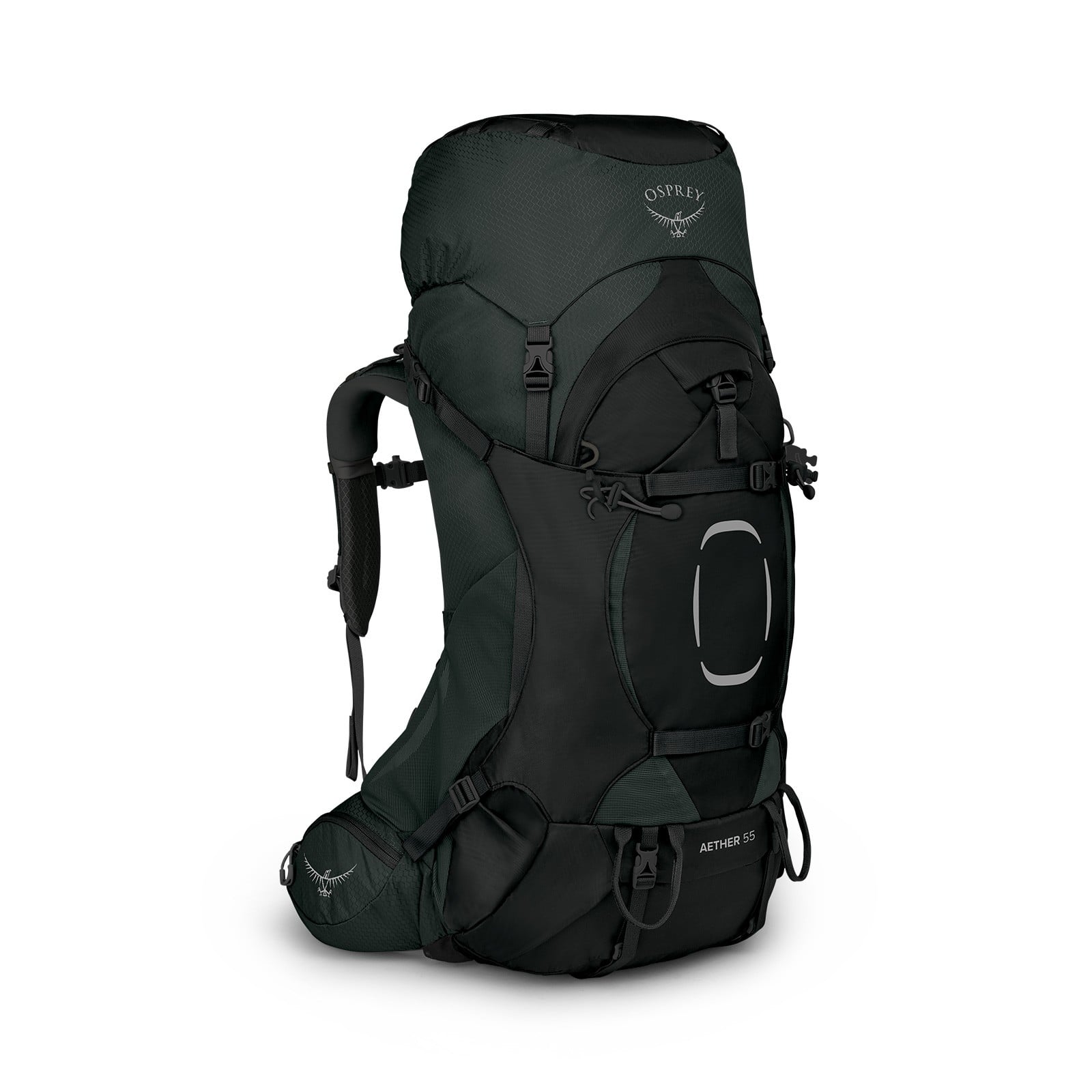
Osprey's Aether is a stiff, adjustable, heavy-load frame pack in five versions from 55 to 85 L. It's comfortable to 60 lbs and weighs nearly 5 lbs empty.
Overview
The Osprey Aether is a traditional load hauler for backpackers who carry 30 to 60 lbs and want the pack to disappear under that weight. It pairs a stiff aluminum perimeter frame with a fully adjustable harness and a lot of organization, and it earned a 2021 Backpacker Editors’ Choice Gold Award. The trade-off is plain: at roughly 4 lb 13 oz to 5 lb 6 oz empty, depending on version, it’s built for people with a heavy kit, not a light one.
Key Specs
| Spec | Value |
|---|---|
| Weight | 2,190–2,435 g depending on version |
| Volume | 55, 65, 70 or 85 L (plus a 70 L Anti-Gravity build) |
| Load range | 30–60 lbs (14–27 kg) |
| Frame | LightWire aluminum alloy peripheral frame with injection-molded AirScape back panel |
| Fabric | bluesign®-approved 420HD nylon packcloth, PFC-free DWR |
| Sizes | S/M (torso 17–20.5 in), L/XL (torso 19.5–23 in) |
| Hipbelt fit | 28–55 in (71–140 cm) |
| Adjustments | Fit-on-the-Fly torso, shoulder strap and hipbelt |
| Rain cover | Included |
Versions compared
| Image | Version | Weight | vs. lightest |
|---|---|---|---|
| 55 | 2190 g (77.3 oz) | lightest |
 | 70 | 2200 g (77.6 oz) | +10 g |
 | 65 | 2231 g (78.7 oz) | +41 g |
 | 70 AG | 2363 g (83.4 oz) | +173 g |
 | 85 L Men's | 2435 g (85.9 oz) | +245 g |

Build your Gear Closet
View all of your gear in one place, create packing lists and hit the trail with confidence. Available on iOS, Android and the web.
Get StartedPerformance
Suspension and load carry
Carrying weight is what the Aether does best. The LightWire frame, a rigid framesheet and a die-cut foam AirScape back panel give the pack a stiff skeleton. Reviewers consistently describe a stable, close-to-the-body carry that handles loads well beyond what most 2-lb packs can manage. The chunky hipbelt moves weight onto the hips effectively, and the pack stays comfortable up to its 60-lb recommended limit. An owner of the 85 L version reports barely noticing a 40-lb load and staying comfortable when the pack was stuffed to about 60.
Stiffness is the price. The back panel feels straight and unyielding, and it can seem overbuilt with lighter loads. Testers also note limited mobility, so scrambling, boulder hopping and Class IV terrain call for a more flexible suspension. Some owners find the hipbelt runs a touch small near the top of the weight range.
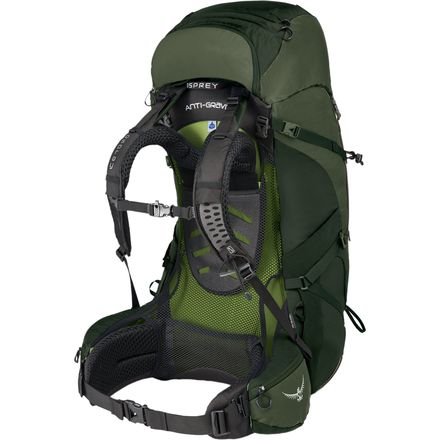
The current back panel drops the Anti-Gravity suspension of the previous generation and resembles the Aether Pro’s streamlined design. Switchback Travel’s testers rated ventilation a step down from the old model and from the Atmos AG, though large foam cutouts and a layer of mesh keep breathability decent.
Fit and adjustability
Fit-on-the-Fly is the headline feature. Torso length, shoulder straps and hipbelt all adjust with the pack on, so the fit can be corrected mid-climb instead of at the trailhead. Two webbing straps and buckles beside the lumbar pad set the torso length, and the shoulder yoke slides up or down the back panel.
Owners frequently rank it among the most comfortable packs they’ve worn. Hikers at the short end of the range should try one first: a Backcountry reviewer with a 17-inch torso ran the S/M nearly at its longest setting.
Organization and access
A U-shaped front zipper opens the main compartment like a suitcase, so a sleeping bag or buried layer can be reached without unpacking from the top. The pack also loads from the top under a floating lid and has a sleeping bag compartment at the base. Water bottle pockets open from the top and the side, so a bottle can be pulled and returned with the pack still on.
The hipbelt pockets are deep enough for a water bottle or tent poles, though the curved zippers can snag. The sleeping bag compartment zipper runs stiff when the bag is stuffed full. Two sets of loops and bungee cinches on the front hold an ice axe or trekking poles. The standard builds lack the Stow-on-the-Go pole attachment found on other Osprey packs, and the detachable DayLid is reserved for the Aether Plus line.
Weather resistance and durability
The 420HD nylon feels bombproof and should survive years of abuse. The included rain cover is a real plus, but it relies on an elastic drawstring with nothing to anchor it, and owners report it blowing off in high wind. Osprey’s Aura AG 65 solves this with hipbelt pass-through slots on its cover, and the omission stands out on a pack at this price.
Weight
The Aether’s weight divides opinion. At 2,190 g, the 55 is around 500 g heavier than the Gregory Paragon 50. A hiker with a sub-10 lb base weight gains nothing by hanging it on a nearly 5-lb pack, and a sub-12 lb kit is better served by a lighter 55 L option.
Choosing a Version
Capacity is the main variable among the 55, 65, 70 and 85 L. They share the same load rating, S/M and L/XL sizing, Fit-on-the-Fly harness and AirScape back panel. The 70 AG is a different suspension altogether.
- 55 (2,190 g): The most compact and the lightest by a hair. It suits weekend and 3- to 5-day trips and hikers who want a slimmer profile. Switchback Travel notes it keeps the 65’s key features, including the included rain cover and the ice axe and trekking pole loops. It costs less than the 65.
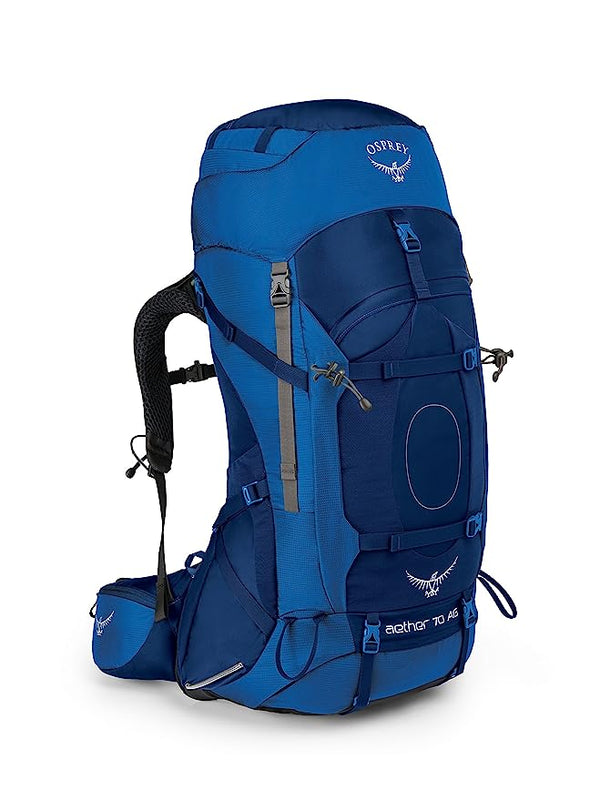
- 70 (2,200 g): Only 10 g heavier than the 55, and lighter than the 65 on paper. It’s the sensible pick for long food carries and bulky insulation, where the extra volume gets used.
- 65 (2,231 g): At 41 g heavier than the 55, it adds 10 L for roughly an extra ounce and a half. It suits week-long trips and winter gear. Anyone buying a pack for heavy loads gains little from the smaller version, since the weight gap is so small.
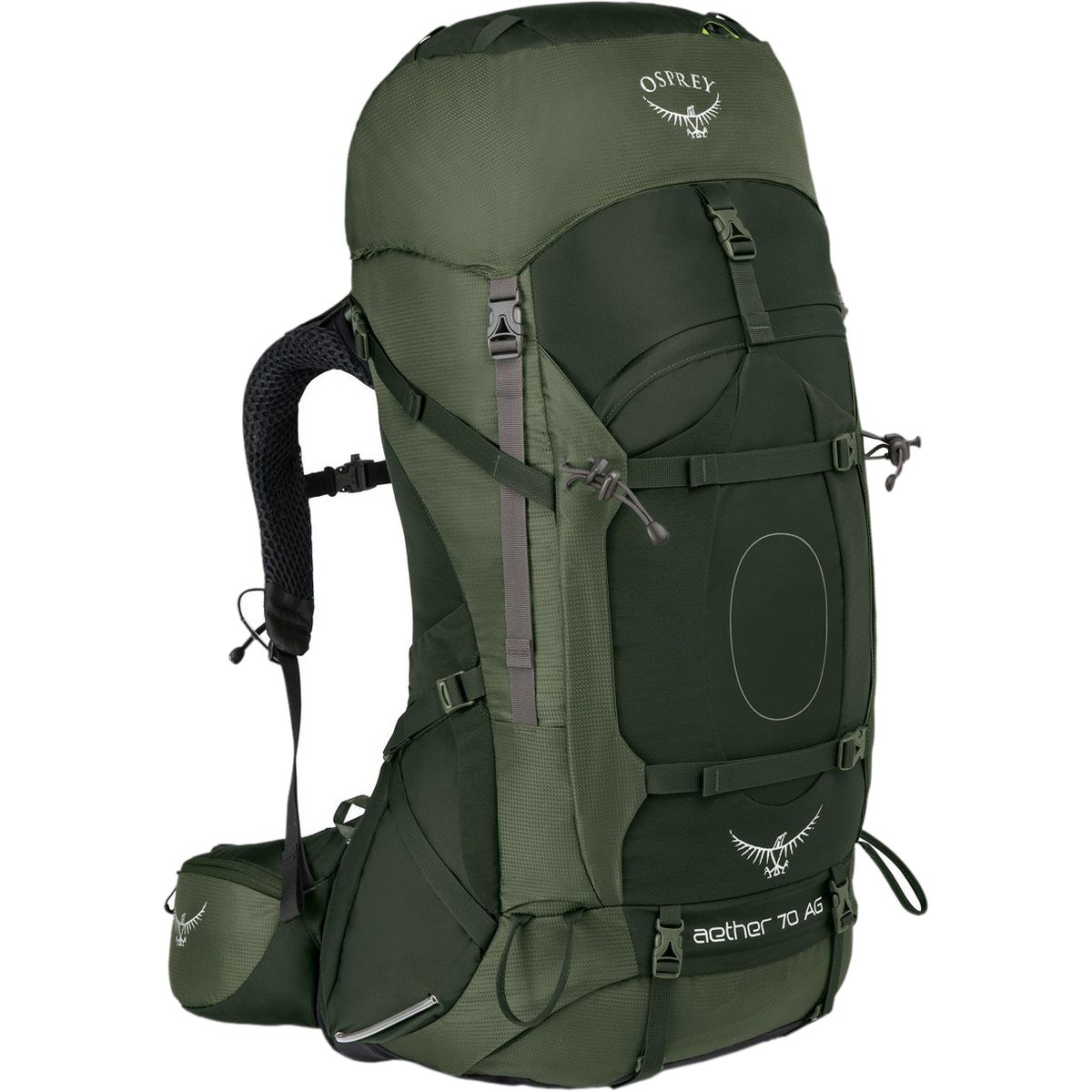
- 70 AG (2,363 g): The Anti-Gravity version carries the earlier suspension: a curved outer metal frame and center stay with a tensioned mesh panel that holds the pack a couple of inches off the back. Mesh runs continuously through the back panel, shoulder straps and hipbelt, which gives a wraparound feel and much better ventilation than the foam AirScape panel. Wilderness Magazine’s testers found it spread a 20 kg load evenly with no pressure points, and owners on rough ground report it stays settled through boulder hopping. It adds a side entrance to the main compartment and a detachable daypack lid. The cost is roughly 130–170 g over the standard 55, 65 and 70, a lighter-denier body fabric (about 200–210D with a 500D base, against the 420HD of the standard builds), and mesh pockets and attachment points that can be vulnerable in abrasive conditions. For hot climates and hikers who run warm, it’s the one to pick.
- 85 L Men’s (2,435 g): The expedition-size option and the heaviest of the five, about 5 lb 6 oz empty. Reviewers peg this size at 5- to 10-day trips and loads of 60 lbs or more. Gear Institute’s testers found it performed best when heavily loaded, praised its compression and storage, and docked it for weight. Owners of the 85 L point to sturdy construction and a top lid that detaches as a small summit pack. The size is justified for winter trips, group gear, or long stretches between resupplies. It’s overkill for a typical three-season trip.
Pros & Cons
Pros
- Stable, comfortable carry from 30 to 60 lbs
- Torso, shoulder straps and hipbelt adjust on the fly
- U-zip front access plus top and bottom entry
- Thick 420HD nylon on the standard builds should last
- Large, deep hipbelt pockets
- Rain cover included
- bluesign®-approved fabrics with PFC-free DWR
- Five versions from 55 to 85 L, with the 70 AG adding real ventilation
Cons
- About 4 lb 13 oz to 5 lb 6 oz empty
- Rain cover has no anchor and can blow off in wind
- Rigid back panel feels stiff with lighter loads
- Hipbelt zipper pulls snag
- No Stow-on-the-Go pole attachment on the standard builds
- Standard back panel ventilates less than the earlier Anti-Gravity design
- 70 AG uses lighter body fabric than the standard builds
Who Should Buy This
The Aether fits backpackers with a heavier kit: car campers moving into overnight trips with traditional gear, national-park weekenders who put comfort before grams, and anyone hauling extra food or shared gear for a group. The adjustability suits shared or family packs that get passed between torsos. Hikers who sweat heavily under load should look at the 70 AG. Expedition and winter hikers with truly bulky gear belong in the 85 L. Hikers with a base weight under about 12 lbs, thru-hikers chasing efficiency, and anyone planning technical scrambling should look at a lighter, more flexible frame pack.
Verdict
The Aether is one of the most accomplished load haulers in its class. The adjustability, organization and fabric durability back up the Gold Award, and any capacity gives heavy-load hikers a comfortable carry. The near-5-lb empty weight and the wind-prone rain cover keep it from a higher score, and it’s a poor fit for anyone counting grams.