High Sierra Pathway 2.0 Backpack Review
A budget-friendly, big-box hiking pack that trades ultralight weight for a low price and solid organization — here's how it holds up.
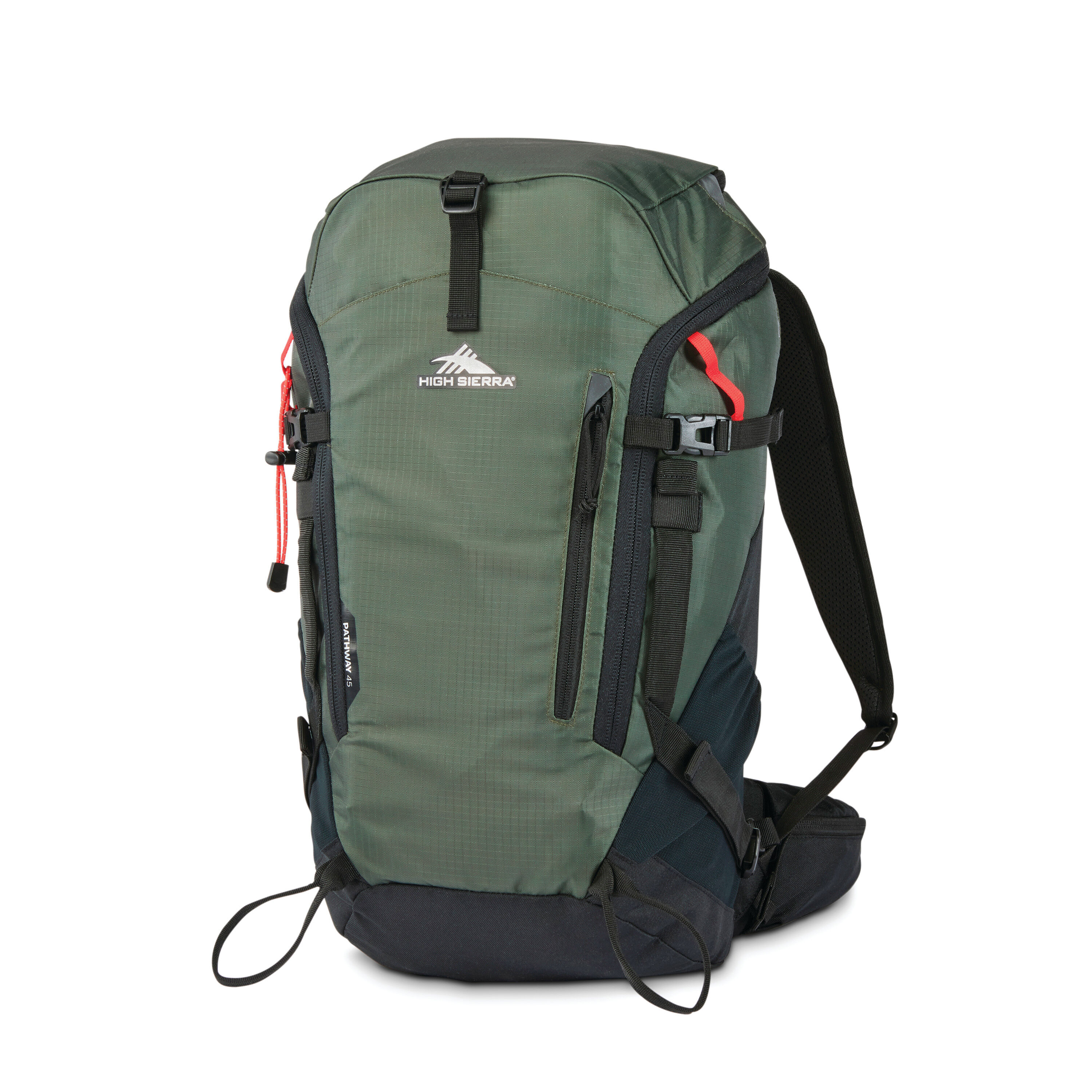
Overview
The High Sierra Pathway 2.0 is a budget hiking and travel pack line sold in four sizes — 30L, 45L, 60L, and 75L — through big-box retailers like Best Buy, Bass Pro Shops, and Scheels rather than specialty outdoor shops. It’s aimed at casual hikers, day-trippers, and weekend campers who want a functional, well-organized pack without spending ultralight-cottage-industry money, not at thru-hikers chasing base weight.
Key Specs
| Spec | Detail |
|---|---|
| Available sizes | 30L, 45L, 60L, 75L |
| Weight (45L) | 2.76 lbs / ~1252 g |
| Weight (60L) | 4.0 lbs |
| Weight (75L) | 4.6 lbs |
| Back panel | EVA molded + Airmesh |
| Hydration compatible | Yes (internal sleeve, hose pass-thru port) |
| Reflectivity | 360° |
| Trekking pole storage | Yes |
| Exterior | Water-repellent coating |
| Access | Wrap-around zip main compartment (lay-flat opening) |
| Price (MSRP) | ~$70 (30L) to ~$120 (75L) |
Would the Pathway 2.0 Backpack earn its spot in your pack?
1252 g · 44.2 ozAdd the High Sierra Pathway 2.0 Backpack to your gear closet and see exactly what it does to your base weight — then build your next packing list around it. Free, in about two minutes.
Free · No credit card · iOS & Android · Trusted by 3,000+ backpackers
Performance
Let’s be upfront about category: this isn’t a pack that’s going to show up on an r/Ultralight base-weight spreadsheet, and I couldn’t find much discussion of it there — the Pathway 2.0 lives mostly in the world of Best Buy and Bass Pro customer reviews rather than gear-forum deep dives. That’s telling in itself: it’s a mainstream, mass-market pack, not a niche backpacking-specific design, and most of the available user feedback comes from retailer review programs where reviewers received promo considerations for writing them. I’m factoring that bias in below.
On capacity and organization, the design checks the boxes you’d expect from a general-purpose hiking pack. A wrap-around zipper allows for lay-flat packing and effortless access to the main compartment, plus a front stuff pocket, a top zip pocket with a key leash, and two additional zippered exterior pockets. The side pockets are stretch mesh and sized to fit bottles up to 32 oz, with a dedicated internal hydration sleeve and hose pass-thru port. For a weekend pack, that’s a reasonable amount of quick-access storage without needing to dig into the main compartment every time you want a snack or a map.
Comfort is where the EVA-molded, Airmesh-backed panel is doing its job. One Best Buy reviewer of the 60L specifically called out padded shoulder straps and an adjustable sternum strap that make a noticeable difference during long hikes, distributing weight well across the back and reducing strain. That lines up with what you’d expect from the spec sheet — it’s a comfort-first back panel, not a load-transfer suspension system built around an internal frame stay, so don’t expect it to carry a fully loaded 60L or 75L the way a dedicated backpacking pack with a real frame would.
Weather resistance seems adequate for casual use rather than sustained downpours. The same 60L reviewer noted the pack held up across sunny days to unexpected drizzle, keeping gear dry — encouraging, but that’s a light-rain data point, not a multi-hour-storm one, and the spec sheet only claims a water-repellent coating rather than a fully seam-taped waterproof build. I’d pack a liner or rain cover for the 60L/75L if you’re using it for actual overnight backpacking rather than day hikes or travel.
The most consistent complaint, even from otherwise positive reviews, is weight once loaded up. The same reviewer who liked the 60L’s comfort also flagged that it can feel on the heavier side when fully packed, which matters if you prioritize ultralight gear — and that’s really the core tension with this whole line. A 4.6 lb empty pack for the 75L is roughly double what a comparable-capacity ultralight pack (Zpacks Arc Blast, Gossamer Gear Mariposa, etc.) would weigh, before you’ve put anything in it. That’s the trade-off you’re making for the $70–120 price point and big-box availability versus a $200+ frameless or single-wall pack.
Anecdotally, the 45L has held up to some real trail use — one Scheels reviewer mentioned it survived a demanding one-day push without issue, and a Best Buy reviewer took the 45L up a moderate New England summit with no complaints. That’s thin data, but it’s at least consistent: nobody’s reporting broken zippers, blown seams, or strap failures in the reviews I found.
Pros & Cons
Pros
- Genuinely well-organized: front stuff pocket, top zip pocket, dual exterior zip pockets, and mesh side pockets cover most quick-access needs
- Comfortable, breathable EVA/Airmesh back panel that multiple users praised for long-hike comfort
- Hydration-ready out of the box with a proper hose pass-thru
- Wrap-around zip main compartment makes packing/repacking far easier than a top-loader
- Widely available at big-box retailers, easy returns, low price point across all four sizes
Cons
- Heavy for its capacity compared to purpose-built backpacking packs — 2.76 to 4.6 lbs empty depending on size
- No internal frame or load-lifter system described in the specs, so heavier loads on the 60L/75L likely ride less securely than a framed pack
- Water-repellent coating only — not a rain-ready design for multi-day exposure
- Very little independent, unbiased long-term testing available; most existing reviews come from retailer promo programs
- Not really built or marketed for serious thru-hiking use, despite the capacity range suggesting otherwise
Who Should Buy This
This is a sensible pick for casual day hikers, car campers, and travelers who want one pack that can flex between a daypack (30L) and a weekend bag (45–60L) without spending real money on a specialty pack. It’s also a reasonable low-risk option for someone testing whether they even enjoy backpacking before investing in lighter, pricier gear. If you’re planning multi-day trips where every ounce and every mile in the rain matters, the weight and lack of a proper frame will start working against you — that’s where the ultralight pack market exists for a reason.
Verdict
The Pathway 2.0 does what a budget hiking pack should: it organizes gear well, carries comfortably on shorter trips, and won’t break the bank. It’s not, and doesn’t pretend to be, a lightweight backpacking pack, so weigh that trade-off honestly against your trip length and load. For casual use and occasional overnights, I’d call it a solid 6/10 — for serious thru-hiking ambitions, look elsewhere.